



Victorian Brass Altar Lights
Victorian brass altar lights bring genuine ecclesiastical dignity into domestic spaces through robust metalwork and tall, commanding forms.
Victorian Brass Altar Lights
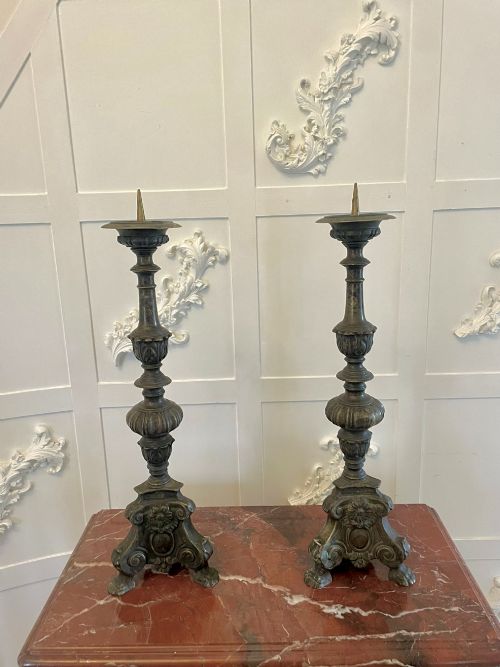
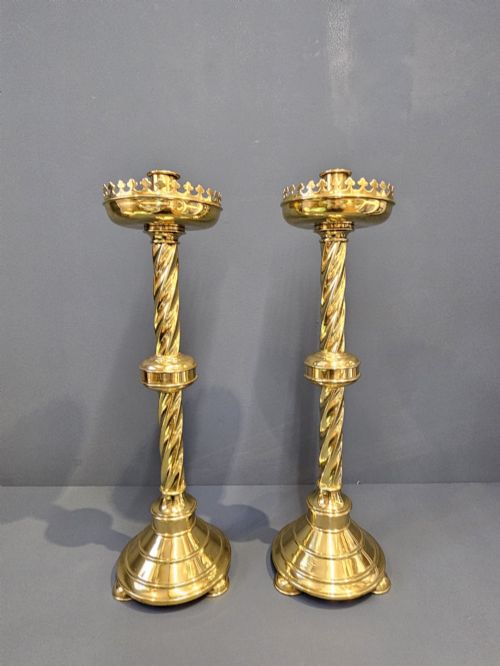
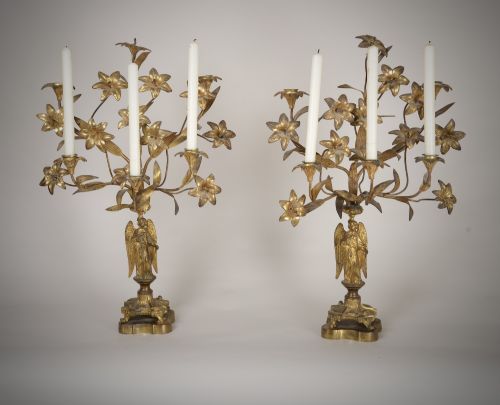
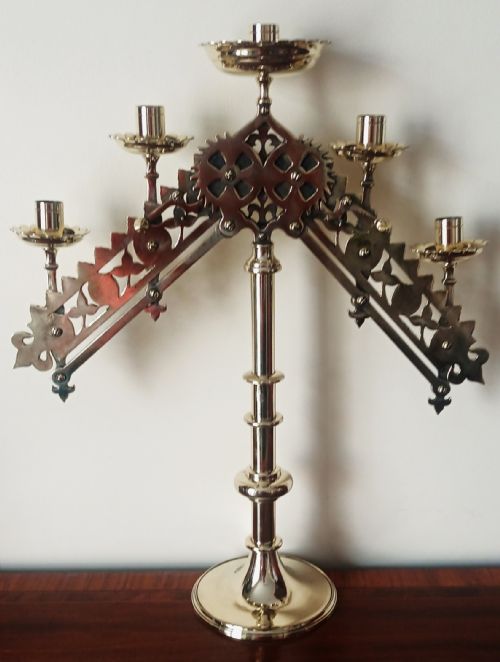
Victorian brass altar lights encompass tall ecclesiastical candlesticks, pricket stands and candelabra originating primarily from the nineteenth century. Buyers searching for victorian brass altar lights will encounter heavy, upright forms designed for church settings, frequently offered as matching pairs or graduated sets.
The dominant aesthetic draws heavily from Gothic Revival design, manifesting in architectural stems, knopped shafts and wide drip pans. While many pieces retain their original function as altar sticks, others appear adapted into table lamps for modern interior use.
The material palette spans standard brass, cast brass, bronze and gilt brass, occasionally displaying painted details or applied ormolu. Dating generally clusters around the middle to late nineteenth century, extending into Edwardian ecclesiastical productions and early twentieth-century interpretations.
Materials and construction
Construction relies heavily on casting and lathe-turning, producing thick-walled brass and bronze components that provide stability for tall shafts. Individual elements such as bases, knops and drip pans are assembled mechanically or joined with threaded rods.
Finishes range from polished surfaces to patinated bronze and gilt applications, sometimes paired with secondary materials like fabric shades or silk fringe on converted examples. Metalwork techniques include chasing, engraving and pierced decoration to accentuate the Gothic motifs.
Listings feature 19th century, Victorian, Edwardian and early 20th century periods alongside materials including brass, bronze, gilt brass and ormolu.
Assessing quality
Quality rests in the crispness of the casting detail and the architectural balance of the overall proportion. Heavier metal gauge and complex multi-tiered bases separate superior ecclesiastical commissions from standard production pieces.
The integrity of original components, such as matching drip pans and undamaged prickets, determines the retention of authentic ecclesiastical character. Superior examples exhibit deliberate chasing and refined surface finishes rather than generic factory stamping.
T Thomason & Co
The Victorian Brass Altar Lights Glossary
- Pricket
- A sharp metal spike on top of a candlestick designed to secure a candle in place. This form is particularly common on ecclesiastical lighting where large wax candles were burned.
- Knop
- A decorative swelling or knob on the stem of a candlestick. It provides both visual interruption and a secure grip for moving the heavy metal object.
- Gothic Revival
- An architectural and decorative style popular during the nineteenth century that revived medieval forms. It heavily influences the pointed arches and tracery seen on church metalwork.
- Ormolu
- Finely ground high-carat gold applied to a bronze base using a mercury amalgamation process. The technique produces a rich golden finish found on select French metalwork.
- Drip pan
- A wide disc positioned beneath the candle socket to catch falling wax. On altar lights, these pans are often substantial in diameter to protect the fittings below.
Victorian Brass Altar Lights: Frequently Asked Questions
What is a pricket candlestick?
A pricket candlestick uses an upward-pointing spike instead of a traditional socket to hold the base of a candle. This design was standard for large church candles.
Such pieces require candles with a pre-drilled base or rely on the weight of the wax itself to stay balanced upon the metal spike.
How were these used originally?
These lights stood upon church altars to provide illumination during ecclesiastical services and ceremonies. Their imposing height ensured visibility across large liturgical spaces.
Many examples bear the marks of heavy ritual use, including deep wax accumulations and purposeful construction designed to withstand daily handling.
Can I convert them to lamps?
Many ecclesiastical candlesticks are adapted into table lamps by routing a cord through the centre or mounting electrical fittings above the original stem. This allows the tall, architectural brass forms to function safely in modern domestic lighting schemes.
Reversible conversion methods preserve the underlying antique metalwork without permanently altering the primary structure.
How do I date these pieces?
Dating relies on stylistic clues such as the presence of Gothic Revival architectural details, casting methods, and distinct nineteenth-century proportioning. Heavier construction and specific patination patterns typically point towards the Victorian era.
Makers' marks or registration stamps, when present, provide a more precise point of origin within the broader nineteenth-century timeline.