




Victorian Bowfront Cupboard
A victorian bowfront cupboard brings curved timber fronts and compact storage into a room, offering both practical utility and period character.
Victorian Bowfront Cupboard
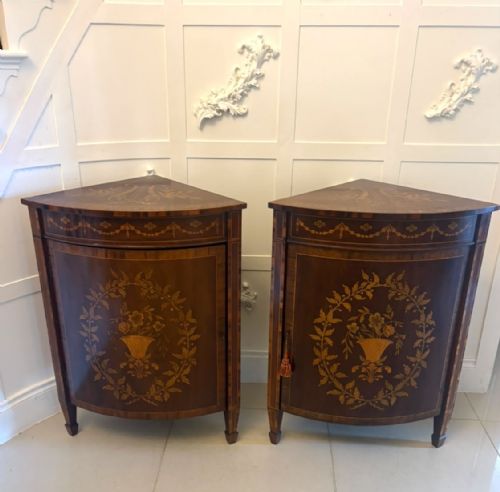
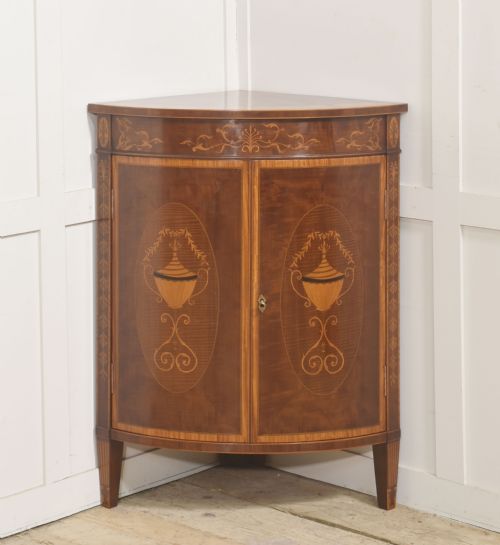
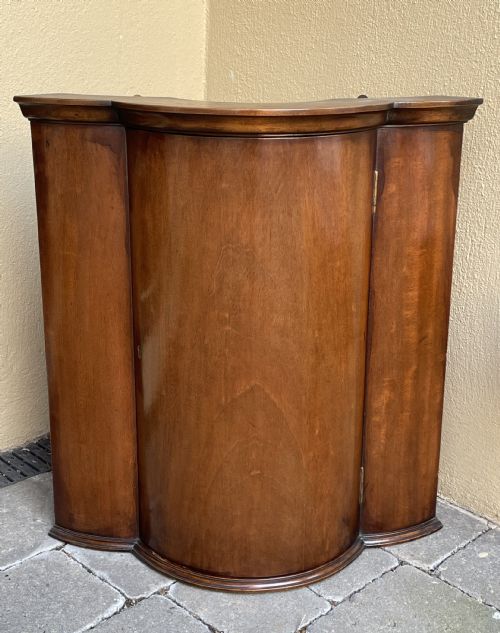
The term victorian bowfront cupboard covers a diverse group of nineteenth-century furniture built with curved front profiles, taking the form of corner cabinets, bedside lockers, and display cases. These pieces range from substantial standing cupboards to smaller hanging designs and bedside units.
The selection here draws heavily on corner cabinets and bedside cabinets from the nineteenth century, alongside satinwood and mahogany display pieces. Many items incorporate revival styles such as Sheraton Revival and Chippendale Revival alongside standard Victorian joinery.
Makers utilised a variety of timbers including mahogany, satinwood, walnut, and burr walnut, sometimes enhanced with marquetry inlay or painted decoration. Smaller apprentice pieces and miniature chests also appear among the bowfront forms.
Assessing quality and craftsmanship
Quality in these curved cupboards rests upon the precision of the joinery where the bowed doors meet the frame and the stability of the timber over time. Superior examples display carefully selected veneer grains and refined marquetry inlay rather than simple painted decoration.
The execution of secondary details, such as the quality of the brass fittings, the clarity of glass in display doors, and the crispness of any carving, separates standard utility items from finer decorative pieces.
The Victorian Bowfront Cupboard Glossary
- Bowfront
- A furniture front that curves outward in a convex shape, softening the corners of the piece and creating a rounded silhouette.
- Marquetry
- The art of applying pieces of veneer to a structure to form decorative patterns, often utilising contrasting timbers like satinwood and mahogany.
- Vitrine
- A glass-fronted display cabinet designed for showing porcelain, books, or curiosities while protecting them from dust.
- Sheraton Revival
- A late nineteenth-century design movement inspired by the neoclassical furniture of George Sheraton, noted for delicate satinwood and painted finishes.
Victorian Bowfront Cupboard: Frequently Asked Questions
Where were these cupboards placed?
These cabinets served multiple functions around the Victorian home, from bedside tables holding lamps to corner units utilising empty room angles. Hanging corner cupboards saved floor space in smaller rooms.
Display cabinets and vitrines stood in reception rooms to showcase valued objects and tableware behind glass doors.
How do I identify a Victorian piece?
Nineteenth-century pieces often display characteristic timber choices like mahogany, walnut, and satinwood, combined with period construction methods. Stylistic clues include Sheraton Revival inlay work or Victorian revival motifs.
Examining the interior timbers and backboards helps confirm the nineteenth-century origins of the construction.
Are bowfront cupboards practical for modern homes?
These cupboards offer compact storage solutions that fit neatly into corners or bedside spaces without dominating a room. Their enclosed shelving keeps contents tidy while displaying wood grains and decorative inlay.
Display versions allow for modern collections to be stored safely behind glass.