
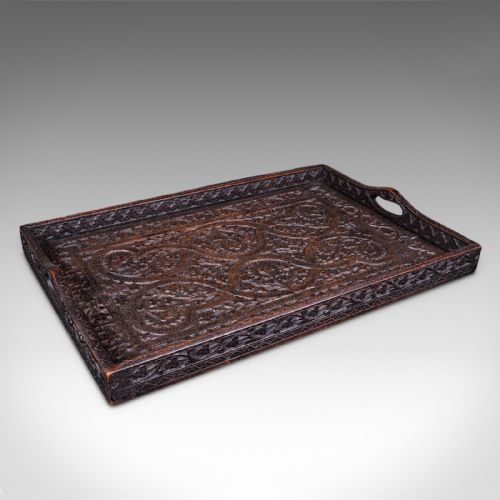


Victorian Anglo Indian Tray
A victorian anglo indian tray brings intricate colonial craftsmanship and rich timber into a room, offering both history and utility.
Victorian Anglo Indian Tray
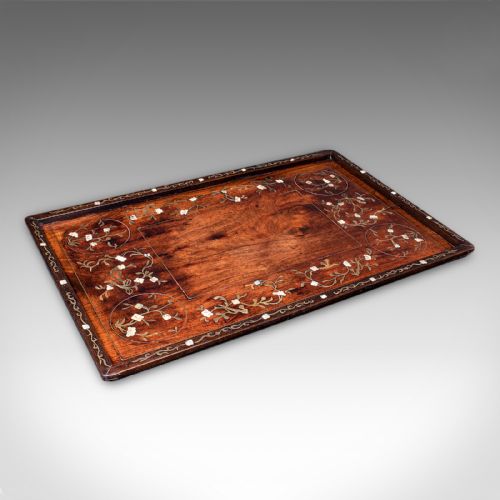
A victorian anglo indian tray encompasses serving platters, decorative chargers, and removable table tops spanning from the nineteenth century into the early twentieth century. Buyers seeking this phrase encounter carved wooden pieces in teak and mahogany alongside heavy metallic examples in brass, copper, and mixed metal.
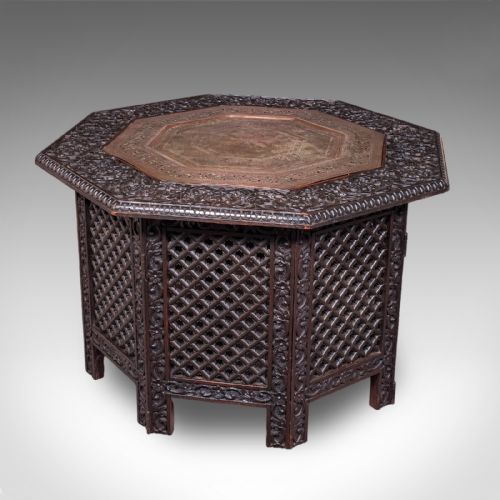
The selection ranges from circular serving trays with carved edges to large wall chargers and occasional tables with inset metal tops. Many pieces reflect the Anglo-Indian and Indo-Persian styles popular during the Victorian period and the subsequent Raj era.
Smaller desk accessories and afternoon tea platters appear alongside larger furniture forms that double as trays. The variety spans from deeply carved hardwood to pierced and repoussé worked metal plates.
Materials and construction
Carved hardwoods such as teak and mahogany form the structural foundation of the wooden pieces, often paired with bone or silver plated elements. Artisans utilised hand carving techniques to achieve dense foliate and geometric patterns across the timber surfaces.
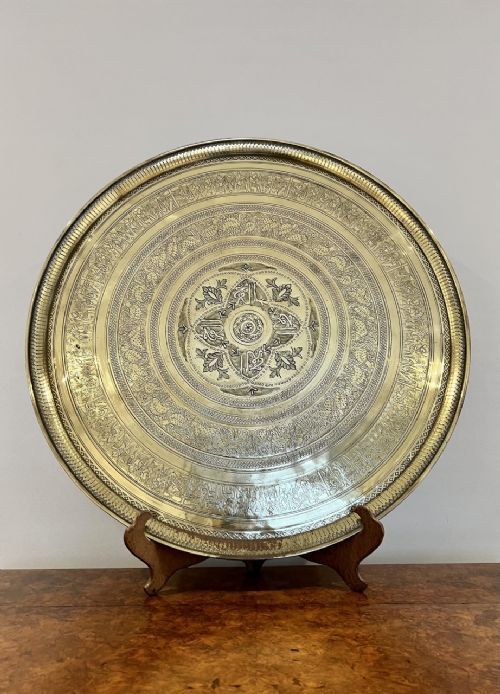
Metal items rely on brass, copper, and mixed metal, shaped through piercing, hand hammering, and repoussé work. Skilled hands decorated these metal surfaces with intricate chased designs and pierced borders.
Papier-mâché also appears among the desk accessories, finished with hand painted details. These diverse materials demonstrate the technical skill of nineteenth century workshops adapting traditional motifs for British homes.
The listings span from the Victorian era into the 1930s, uniting teak, mahogany, brass, copper, and papier-mâché.
Factors of quality
Quality rests in the crispness of the hand carving and the depth of the repoussé work on the metal surfaces. Finer examples show sharp, deliberate incisions and well-defined motifs rather than soft or shallow tool marks.
The selection of materials dictates the standing of a piece, from heavy gauge copper and dense teak to simpler constructions. Superior items maintain structural integrity in their joints and retain their original surface patination without excessive modern intervention.
The Victorian Anglo Indian Tray Glossary
- Repoussé
- A metalworking technique where the metal is hammered from the reverse side to form a raised design on the front. This method creates tactile, dimensional patterns across copper and brass chargers.
- Anglo-Indian
- A descriptive term for decorative arts produced during the British period in India, blending British furniture forms with traditional Indian craftsmanship. It defines the distinct cultural crossover seen in these items.
- Pierced
- A method of cutting through the metal or wood to create openwork patterns and lace-like borders. This technique lightens the visual weight of heavy brass and copper trays.
- Teak
- A dense, durable tropical hardwood prized by makers for its resistance and stability. It provides a dark, rich ground for intricate surface carving.
Victorian Anglo Indian Tray: Frequently Asked Questions
What were these trays used for?
These pieces served practical roles in colonial households for afternoon tea service, holding correspondence, or displaying decorative objects in reception rooms.
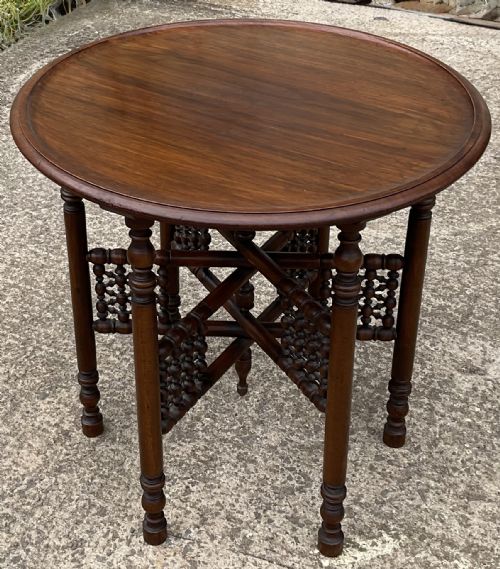
Larger versions often functioned as removable table tops on folding wooden stands, allowing furniture to be easily packed and stored.
How do I care for a wooden tray?
Keep wooden surfaces away from direct heat sources and extreme humidity changes to prevent the timber from splitting or warping.
Apply a minimal amount of neutral wax occasionally to nourish the hardwood without building up a heavy residue.
How do I clean metal trays?
Dust metal surfaces gently with a soft, dry cloth to remove everyday particles without disturbing the aged surface finish.
Avoid harsh chemical dips or abrasive metal polishes that strip away the dark patination accumulated over the decades.
How do I date these pieces?
Dating relies on examining the construction methods, tool marks, and material choices recorded across the nineteenth and early twentieth centuries.
Stylistic shifts from Victorian Gothic and classical revivals toward later Raj period aesthetics help narrow down the period of manufacture.