
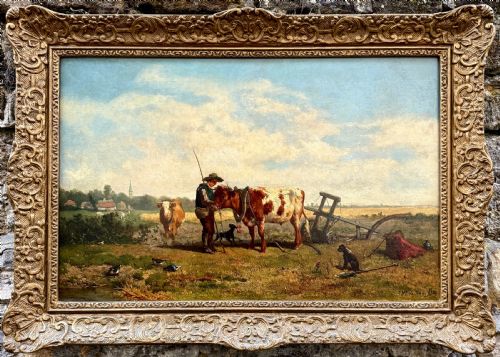


Victorian Agricultural Art
Victorian agricultural art captures rural life, livestock, and farm labour through paintings, watercolours, and models that celebrate the countryside.
Victorian Agricultural Art
Victorian agricultural art encompasses oil paintings, watercolours, etchings, and scale models depicting rural scenes, farmyard animals, and field labour. These works document the agricultural landscape through the nineteenth and early twentieth centuries, reflecting pastoral life and rural industry.
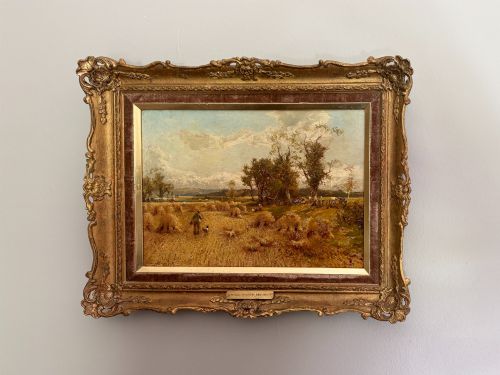
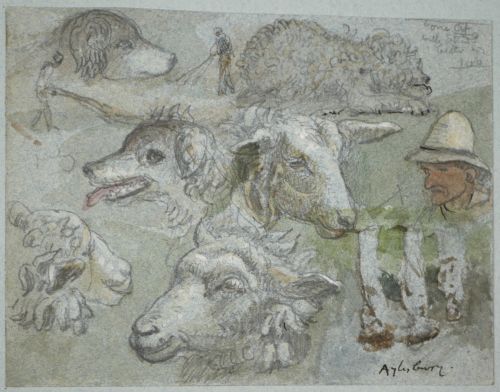
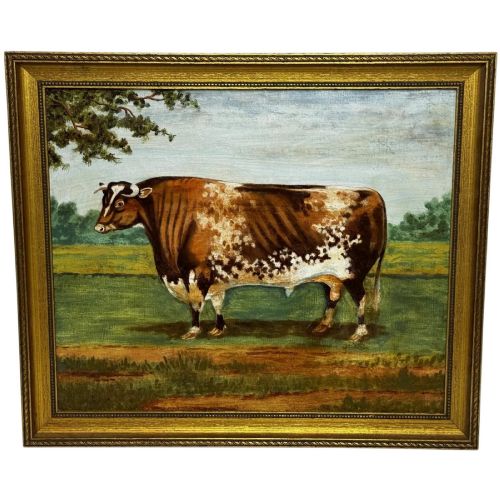
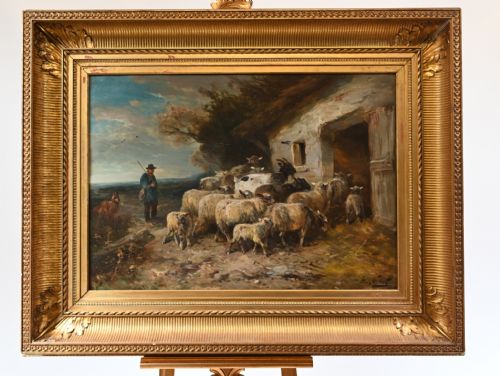
Buyers frequently encounter oil on canvas paintings and watercolours portraying prize livestock, shire horses, and farmworkers harvesting crops. The selection includes detailed portrayals of shorthorn bulls, sheep flocks, and pastoral landscapes by British and European artists.
Materials and Techniques
Painters utilised oil paint on canvas or paper, applying pigment with varying brushwork to render the textures of animal coats, feathers, and harvested wheat. Watercolours on paper capture lighter, transparent atmospheric effects in landscape settings.
Draftsmen and printmakers employed etching techniques to produce detailed linear works on paper, while wood was shaped and joined to construct utilitarian objects and scale models of farm equipment like ploughs.
A beech dairy maid's shoulder yoke sits alongside grand oil paintings of prize shorthorn bulls.
Assessing Quality
Quality rests upon the artist's ability to render anatomical precision in animals and the natural interaction between figures and their rural environment. Works by accomplished painters display careful observation of light, atmosphere, and animal form.
The depth of composition and the handling of the medium separate standard decorative pieces from works with greater artistic execution. Superior examples command attention through balanced proportions and confident brushwork or draughtsmanship.
Henry Schouten·Herbert Dicksee·James William Booth·William Huggins·George Cole
The Victorian Agricultural Art Glossary
- Oil on Canvas
- A painting medium where pigments suspended in drying oil are applied to stretched woven fabric. This combination allows for rich colour blending and textured brushwork.
- Watercolour
- A painting method where water-soluble pigments are applied to paper. It yields translucent washes of colour suited to capturing light and sky.
- Etching
- A printmaking process where lines are incised into a metal plate with acid before ink is applied and transferred to paper. This technique produces fine, crisp lines.
- Genre Painting
- Art depicting scenes from everyday life, typically involving ordinary people engaged in common activities. In this context, it often shows farmworkers and labourers.
- Pastoral
- Art relating to the countryside, rural life, and domestic animals. It evokes a simple and idealized view of farm existence.
Victorian Agricultural Art: Frequently Asked Questions
What subjects appear most often?
Prizewinning cattle, sheep flocks, shire horses, and farmworkers engaged in harvesting or ploughing dominate the available subjects.
Artists also recorded specific landscapes, farmyards, and rural buildings populated by livestock and domestic fowl.
How do I display oil paintings safely?
Keep paintings away from direct sunlight and areas subject to sudden humidity changes to protect the canvas and paint layer.
Ensure wall fixings securely support the weight of framed oils and heavy wooden items.
Are scale models common?
Scale models of agricultural equipment, such as ploughs, appear alongside traditional flat art and utilitarian wooden items.
These three-dimensional objects provide insight into nineteenth-century farming mechanics.
What defines pastoral art?
Pastoral art focuses on the idealized depiction of rural landscapes, shepherds, farmers, and domestic animals.
These works celebrate the rhythm of agricultural seasons and country life.