


Venice Grand Canal Oil
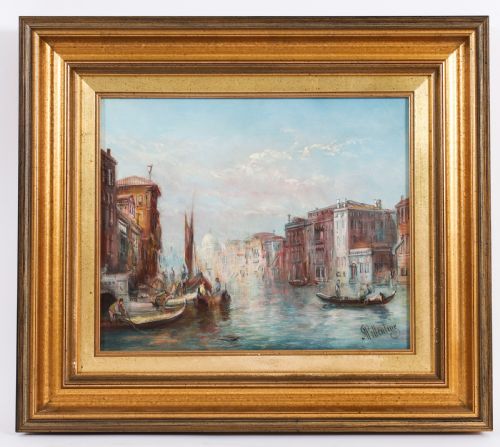
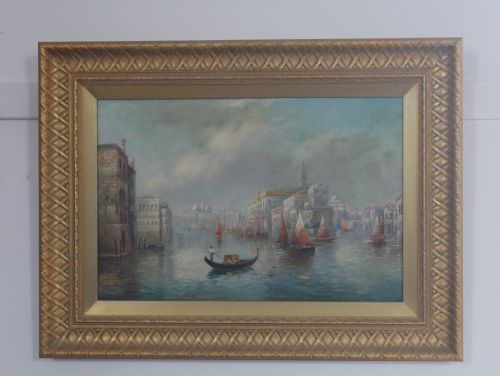
A venice grand canal oil captures the iconic waterways, palazzos and light of the lagoon through historic painted canvas.
Venice Grand Canal Oil
A venice grand canal oil brings nineteenth-century Italian scenes into the room, depicting famous landmarks such as the Doge's Palace, the Dogana and the Santa Maria della Salute.
Most examples found here date from the nineteenth century, executed in oil on canvas and often housed in giltwood or gesso frames.
The selection ranges from detailed architectural townscapes to broader romantic and impressionist interpretations of the Venetian waterways.
Materials and Technique
Artists painted primarily with oil on canvas, utilising traditional pigment mixtures that allowed for subtle blending of light on water and stone.
Frames are constructed from wood with decorative gesso and gilded surfaces, often matching the Victorian period of the paintings themselves.
Listings feature oil on canvas works framed in giltwood, gesso and wood across Victorian, Impressionist and traditional Italian styles.
Quality and Execution
The strength of a composition rests in the handling of light on the water and the accuracy of architectural perspective in the palazzos.
Finer works display confident brushwork in the rendering of gondolas, figures and sky, distinguishing master hands from standard studio output.
Alfred Pollentine·Antoine Bouvard Senior·William Raymond Dommersen·Jane Vivian·Alexander Edward Waite
The Venice Grand Canal Oil Glossary
- Veduta
- A highly detailed, painted topographical view of a city, particularly popular in eighteenth and nineteenth-century Italy. These works focus on accurate architectural representation combined with atmospheric light.
- Giltwood
- Wood carved and coated with gold leaf or a metallic substitute. It forms the decorative border of traditional frames surrounding nineteenth-century canvases.
- Gesso
- A plaster-like mixture applied to wood frames to create a smooth surface for gilding. It allows for intricate moulded ornamentation.
- Impressionist
- A style involving relatively small, thin yet visible brush strokes and open composition. It emphasises accurate depiction of light and its changing qualities.
Venice Grand Canal Oil: Frequently Asked Questions
What periods do these paintings come from?
The available works span the nineteenth and twentieth centuries, with a heavy concentration of nineteenth-century pieces recorded in the listings.
Artists from the Victorian era onward captured the Venetian lagoon using traditional oil on canvas methods.
How should I frame these canvases?
Many works come in their original giltwood or gesso frames, which match the period of the painting.
Retaining these frames maintains the historical context of the artwork on the wall.
What subjects appear most often?
Common subjects include the Grand Canal, the Bridge of Sighs, the Doge's Palace and Santa Maria della Salute.
Gondolieri and sailboats frequently populate the foreground of these architectural townscapes.
Are these works signed by artists?
Several pieces bear signatures or attributions to known nineteenth-century painters such as Alfred Pollentine and Antoine Bouvard Senior.
Unsigned works also appear, attributed through stylistic analysis and period characteristics.