

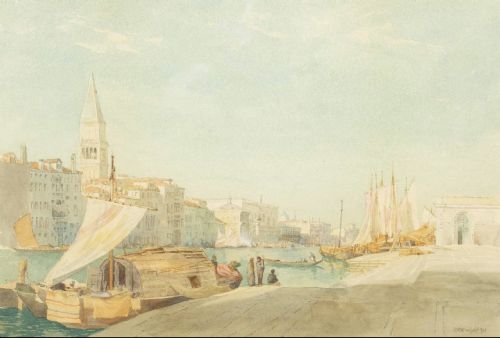


Venetian Architectural Artwork
Venetian architectural artwork brings the canals, bridges and palazzos of the lagoon directly onto the wall.
Venetian Architectural Artwork
Venetian architectural artwork comprises paintings and works on paper capturing the distinctive buildings, waterways and cityscape of Venice. The selection on this page spans the Victorian and Edwardian eras through to the mid-twentieth century.
Buyers encounter a variety of forms including oil paintings, watercolours, gouache and mixed media pieces. Subjects frequently focus on recognisable landmarks such as the Grand Canal, the Bridge of Sighs and Santa Maria della Salute.
The materials reflect traditional fine art practices across different decades. Works range from detailed nineteenth-century watercolours to mid-century expressionist oils on canvas.
How they were made
Artists utilise oil paint on canvas or wood panels to build rich textures and deep colour fields for larger architectural views. Watercolours and gouache on paper allow for swift, atmospheric captures of light reflecting off the lagoon.
Ink and pastel are frequently combined with watercolour or gouache to define the intricate gothic and renaissance details of Venetian facades. Canvas, paper and board serve as the primary supports across the periods represented.
Represented styles range from Victorian fine art and impressionism to mid-century expressionism and traditional Italian work.
What varies in quality
The handling of light and perspective distinguishes works of higher artistic ambition from standard topographical records. Mastery over the hazy atmospheric conditions unique to the Venetian lagoon elevates a composition.
The strength of draughtsmanship in rendering complex architectural elements like bridges, domes and palazzos determines the visual impact of the piece. Brushwork economy and colour harmony further separate competent paintings from exceptional ones.
Thomas Ellison·Richard Henry Wright·Vittore Zanetti Zilla·Hercules Brabazon Brabazon·David Law·Emanuele Cappello·Wilfred Knox·Alfred Pollentine·John D Walker·Helen Donald Smith
The Venetian Architectural Artwork Glossary
- Gouache
- An opaque water-based paint that dries to a matte finish, often used alongside watercolour to add highlights to architectural elements.
- Impressionism
- A nineteenth-century painting style characterised by relatively small, thin yet visible brush strokes and an emphasis on accurate depiction of light.
- Mixed media
- An artwork in which more than one medium or material has been employed, such as pastel combined with ink and gouache.
Venetian Architectural Artwork: Frequently Asked Questions
What periods do these artworks cover?
The pieces span from the nineteenth century through the Edwardian period and into the mid-twentieth century, including works from the 1910s, 1920s, 1930s and 1940s.
This broad timeline shows how different artistic movements interpreted the unchanging architecture of the lagoon over time.
What mediums are commonly used?
Artists used oil paint on canvas and wood, alongside works on paper created in watercolour, gouache, ink and pastel.
Some compositions combine multiple mediums on paper to capture both fine architectural details and atmospheric water effects.
How do I choose between oil and watercolour?
Oil paintings on canvas offer heavier texture and deeper colour saturation, making them suited for large wall displays. Watercolours and gouache provide a lighter, more translucent quality that reflects traditional sketching traditions.
Both mediums successfully capture the distinct light and watery reflections characteristic of Venetian cityscapes.
How do I date an artwork?
Dating relies on recorded artist active periods, stylistic traits associated with movements like impressionism or mid-century expressionism, and framing or paper evidence.
Victorian and Edwardian pieces often carry specific nineteenth or early twentieth-century signatures and exhibition histories.