





Upholstered Swivel Stool
An upholstered swivel stool brings mechanical ingenuity and period charm to a room, offering adjustable seating shaped by nineteenth-century craftsmanship.

Upholstered Swivel Stool
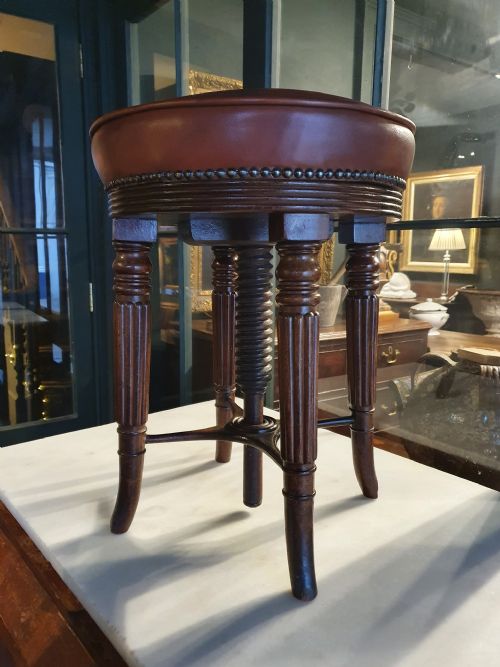
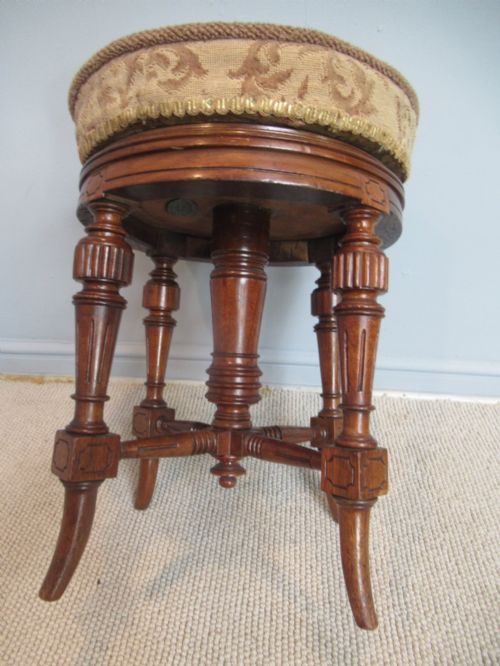
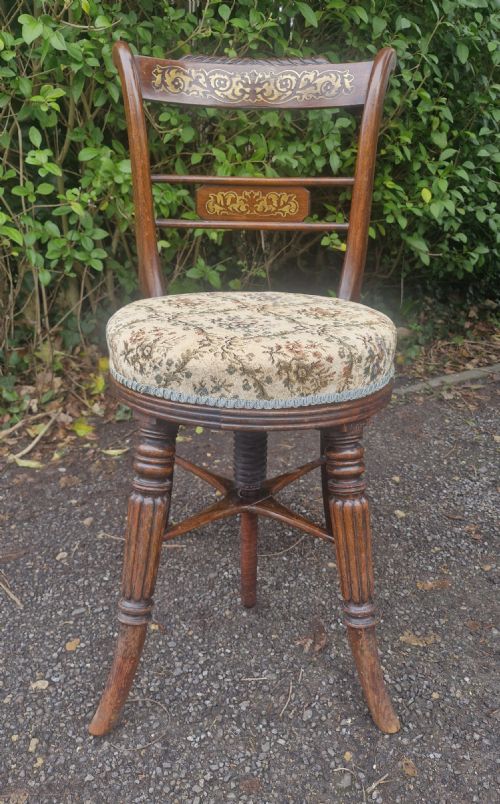
The upholstered swivel stool category encompasses adjustable music stools, piano stools, revolving chairs, and bar stools spanning the nineteenth century through the twentieth. These pieces trace their origins to Georgian, Regency, William IV, and Victorian periods, often taking the form of rise and fall piano seats or dressing table stools.
Most examples met on this page date from the Victorian era alongside earlier Regency and William IV iterations. They appear in mahogany, walnut, and rosewood, frequently fitted with revolving mechanisms or screw-top height adjustments designed for musicians and pianists.
Materials and construction
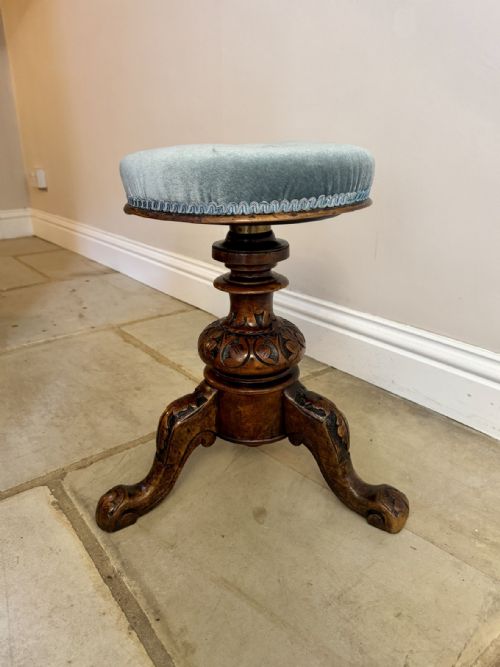
Cabinetmakers built these revolving stools using dense timbers including mahogany, walnut, and rosewood, occasionally incorporating satinwood, brass inlays, and gilt paint. Carved details and turned columns provide structural support beneath the rotating seats.
Upholstery materials range from traditional leather and velvet to contemporary fabric coverings. The mechanical action relies on central wooden or metal screw threads that allow the seat to rise and fall when turned.
Periods represented stretch from Georgian and Regency eras through William IV, Victorian Arts and Crafts, and Edwardian times.
Distinctions in craftsmanship
Quality reveals itself in the smoothness of the revolving mechanism and the stability of the central screw adjustment. Superior pieces retain tight joints in the turned or carved wooden frames without wobble in the rotating top.
Refinement of timber selection and the execution of carved walnut, rosewood, or mahogany details separate standard production from exceptional cabinet work. Maker attributions and intact original leather or velvet upholstery further distinguish the upper tier of pieces.
James Shoolbred·H Brooks and Co
The Upholstered Swivel Stool Glossary
- Revolving
- Turning around an axis or centre point. This action allows the seated person to rotate freely without moving the base.
- Rise and fall
- An adjustable height mechanism operated by a screw thread. Turning the seat lifts or lowers it to the desired position.
- Music stool
- A seat designed specifically for keyboard players and musicians. These often feature swivel tops or height adjustment for playing comfort.
- Patent
- A government licence protecting a mechanical invention. Patent music chairs incorporate specific registered mechanisms developed by nineteenth-century makers.
Upholstered Swivel Stool: Frequently Asked Questions
What is an upholstered swivel stool used for?
These pieces served primarily as piano and music stools where players needed to adjust their height and turn easily towards sheet music or instruments. They also functioned as dressing table seats in period bedrooms.
Today they suit various interior uses, functioning as piano seats, vanity stools, or occasional seating around living spaces and home bars.
How do I adjust the height on these stools?
Height adjustment relies on a central screw mechanism hidden beneath the upholstered top. Rotating the seat clockwise or anti-clockwise raises or lowers the platform along a threaded wooden or metal shaft.
Some nineteenth-century examples feature rise and fall lever actions or simple revolving screws that lock into place with secondary thumb screws or brackets.
How can I tell a Victorian swivel stool from a Regency one?
Regency pieces often display classical influences with brass inlays, simulated rosewood finishes, and sabre legs reflecting early nineteenth-century design. Walnut and rosewood woods dominate the later Regency and William IV periods.
Victorian examples frequently feature heavier carved walnut frames, elaborate turned pedestals, and Arts and Crafts or late-century aesthetic details dating from the 1850s to the 1900s.
Are these stools suitable for daily seating?
The sturdy mahogany and walnut frames constructed by nineteenth-century cabinetmakers provide robust support for regular use. The swivel and screw mechanisms handle daily rotation when operated with care.
Updating the internal padding or leather and velvet upholstery allows these antique seats to handle modern daily demands while preserving their period mechanical character.