


Dark Wood Music Chair
These dark wood music chair examples span Victorian, Georgian and Edwardian periods, offering functional seating designed for musicians and pianists.

Dark Wood Music Chair
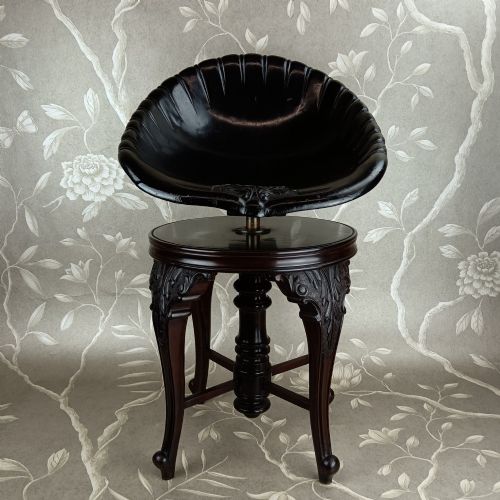
A dark wood music chair serves players at the piano, harp or cello, providing specialised seating for performance. You will find swivel tops, revolving mechanisms, and height-adjustable functions across these Victorian, Georgian and 19th century forms.
The selection ranges from revolving piano stools and rise and fall mechanisms to elbow chairs and side chairs. Mahogany and rosewood predominate, frequently paired with upholstery or velvet seats.
Makers such as Jennens & Bettridge, Gillows and James Shoolbred appear in the listings alongside Swiss marquetry and Anglo-Burmese colonial pieces. Each dark wood music chair reflects the specific domestic musical culture of its era.
What varies in quality
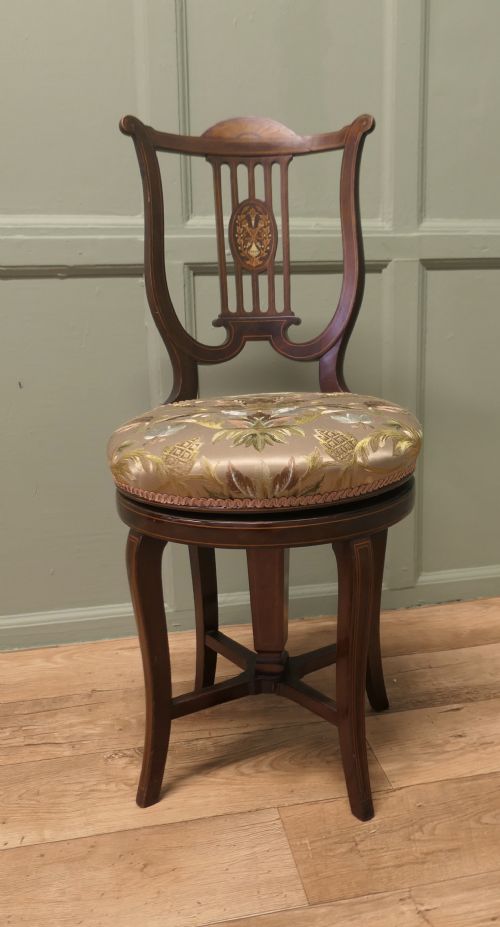
The sophistication of the mechanical adjustment mechanism dictates much of the value, with smooth revolving actions and precise height regulation separating standard items from superior workshop output. Carved detailing on the timber, such as lyre backs or marquetry inlay, indicates greater labour investment.
Attribution to documented makers like Gillows or James Shoolbred elevates a piece beyond anonymous production. The choice of figured rosewood or dense mahogany over simpler woods also marks the upper tier.
Listings feature mahogany, rosewood and walnut as the primary timbers, complemented by brass mechanisms and velvet upholstery.
Jennens & Bettridge·Gillows·James Shoolbred
The Dark Wood Music Chair Glossary
- Revolving
- A seat mechanism allowing full rotation on a central axis. This allows musicians to turn easily toward instruments or sheet music stands.
- Rise and fall
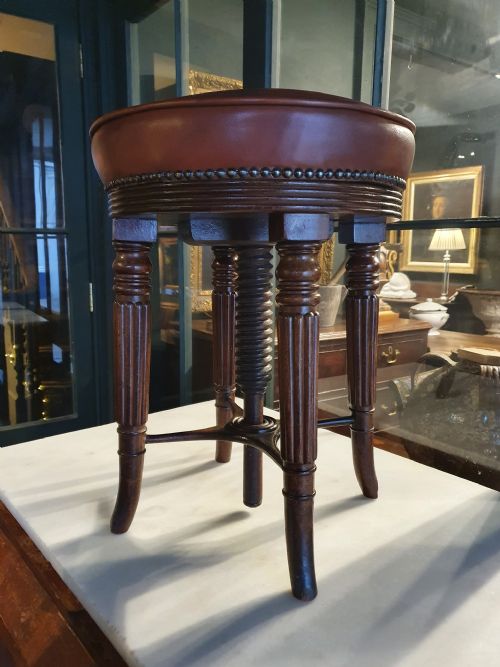
- An adjustable height system operated by a threaded screw or rack mechanism. Players operate this to find the correct seating posture.
- Marquetry
- Decorative veneer patterns inlaid into the wooden surface. Artisans use contrasting woods to create pictorial or geometric designs.
- Lyre back
- A chair back shaped in the form of a classical stringed musical instrument. This motif directly signals the intended musical use of the seating.
- Papier-mâché
- A composite material formed from paper pulp mixed with glue and resin, pressed and lacquered. Jennens and Bettridge utilised this technique for decorative Victorian surfaces.
Dark Wood Music Chair: Frequently Asked Questions
How do I adjust the height?
Many examples feature a revolving screw mechanism beneath the seat pad. Turning the top clockwise or anti-clockwise raises or lowers the sitting surface.
Other designs use a rise and fall lever or ratchet system to lock the seat at the desired level.
Were these made only for pianos?
While piano stools form the majority of these listings, specialised variants exist for other instruments. Harpist and cello chairs feature open or low-slung backs to accommodate the musician's arms and instrument.
General music chairs and elbow chairs served vocalists and instrumentalists alike in the Victorian and Georgian parlor.
Can I use these at a modern desk?
Revolving music chairs with adjustable height mechanisms function well in contemporary spaces. The compact footprint and swivel action suit modern working environments.
Upholstered velvet and mahogany frames also integrate easily into traditional studies.