

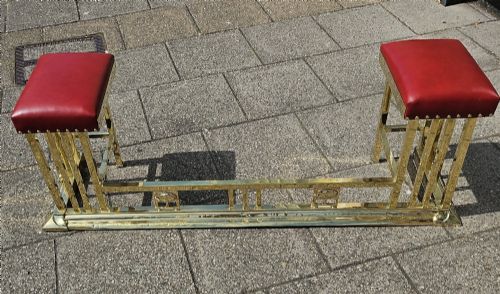


Upholstered Fireplace Seat
These upholstered fireplace seat options range from sturdy brass club fenders to mahogany footstools designed to sit near a hearth.

Upholstered Fireplace Seat
An upholstered fireplace seat brings practical comfort directly to the hearth through low-slung club fenders and padded stools. These pieces combine metal frames with cushioned tops designed for sitting close to a fire.
Buyers will encounter forms ranging from heavy iron and tan leather club fenders to William IV kilim-covered footstools. Each object serves the dual purpose of hearth accessory and occasional seating.
Materials and construction methods
Metal fabrication forms the backbone of these pieces, utilising brass, cast steel, and heavy iron for structural durability near heat. Woodwork relies on hardwoods such as mahogany, rosewood, walnut, and oak.
Upholstery techniques incorporate leather, velvet, linen, and kilim fabric secured to padded seats. Metal components often feature polished brass finishes or silvered treatments alongside riveted leather details.
Upholstered Fireplace Seat Retail Price Guide 2026
Typical asking prices for upholstered fireplace seat among the pieces listed under this phrase on Sellingantiques today, from the lower quarter to the upper quarter. They describe what is for sale here now, not the wider market.
Materials documented across the inventory include brass, leather, mahogany, fabric, wood, velvet, linen, and iron.
Assessing quality and craftsmanship
Subtleties in metalwork and timber selection separate standard utilitarian builds from finer decorative examples. Heavier gauge steel, substantial brass tubing, and dense hardwoods indicate superior structural integrity.
The finish of the upholstery and the precision of the joinery dictate the overall refinement of the piece. Hand-carved wooden details and high-grade leather seating distinguish the more ambitious workshop productions.
William Birch
The Upholstered Fireplace Seat Glossary
- Club fender
- A low metal frame surrounding a hearth, featuring upholstered top rails designed for sitting. These fixtures originated in gentlemen's clubs and Victorian drawing rooms.
- Kilim
- A flatwoven textile used historically for hard-wearing upholstery on stools and benches. Collectors value these wool fabrics for their distinctive geometric patterns.
- Sheraton Revival
- A late 19th-century design movement inspired by 18th-century neoclassical furniture forms. Pieces in this style emphasise classical restraint and fine mahogany construction.
- Cast steel
- An alloy melted in crucibles to achieve greater uniformity than traditional iron. This material provided the strength required for heavy 19th-century hearth accessories.
Upholstered Fireplace Seat: Frequently Asked Questions
What is a club fender?
A club fender is a metal structure built to surround an open fireplace, incorporating cushioned seats along the top rails. This design allows people to sit close to the fire while protecting the room from sparks.
Most examples use brass or steel frames paired with leather or fabric upholstery. They appeared frequently in 19th-century and Edwardian interiors.
How do I date an upholstered fireplace seat?
Dating relies on identifying the underlying materials, structural styling, and upholstery types. Victorian and Edwardian pieces often exhibit distinct brass tubing, heavy cast iron, or specific revival woodwork.
Examining the fixings, metal patination, and secondary woods helps narrow the decade of manufacture. Stylistic cues like Sheraton Revival or Art Deco details further pinpoint the period.
Were these seats used for actual sitting?
Yes, club fenders and hearth stools were specifically built to provide seating directly by the fire. The upholstered rails offer a comfortable perch in cooler months.
Their low profile kept sitters beneath the level of rising smoke while maximising warmth from the hearth. Many surviving pieces retain heavy leather upholstery chosen for durability.
What maintenance do leather upholstered seats need?
Leather surfaces benefit from periodic conditioning to keep the hide supple and prevent cracking near heat sources. Gentle cleaning with appropriate leather balms preserves the original finish.
Metal frames such as brass or steel require occasional dusting and non-abrasive polishing to maintain their surface character without stripping the patination.