

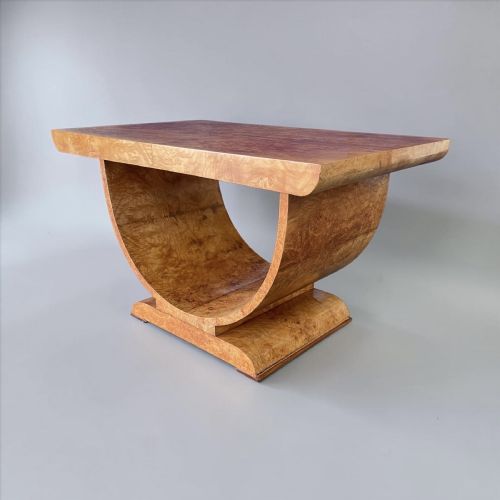

U Shaped Coffee Table
These u shaped coffee table designs bring together varied period forms and rich timbers, offering practical surface space with distinct character.
U Shaped Coffee Table
When you search for a u shaped coffee table, you are looking at low tables designed with curved or serpentine contours, often adapted from Victorian, Edwardian, and Art Deco periods. These pieces appear in forms such as coffee tables, occasional tables, centre tables, and nests of tables.
You are most likely to meet burr walnut and mahogany versions on this page, alongside occasional pieces in rosewood and satinwood. Many examples utilise shaped, kidney, or oval tops derived from nineteenth and early twentieth-century designs.
How they were made
Cabinet makers constructed these pieces using solid timbers like mahogany and walnut, frequently applying burr walnut veneer to create patterned surfaces on the top. Marquetry inlay, boxwood stringing, and brass details often accent the borders and legs.
Construction techniques combine traditional joinery with curved sawing to achieve the distinct serpentine and kidney outlines. Polish finishes are applied to highlight the natural grain and colour of the wood.
Periods represented span from the nineteenth century through Edwardian times to Art Deco 1930s designs.
What varies in quality
The standard of a piece rests on the choice of timber and the precision of the cabinet work. Richly figured burr walnut veneers and finely executed marquetry inlay distinguish finer examples from plain constructions.
Proportion and the handling of curved edges determine visual balance. Tables with well-integrated shaped tops and clean structural lines command greater appreciation than simpler iterations.
The U Shaped Coffee Table Glossary
- Burr walnut
- A wood harvested from the wart-like growths on walnut trees, yielding complex swirling grain patterns. It is frequently sliced into veneer for decorative table tops.
- Marquetry
- The art of applying pieces of veneer to a structure to form decorative patterns and pictures. It often incorporates varied timbers like boxwood and satinwood.
- Kidney-shaped
- A curved table top configuration resembling the organ, popular in Victorian and Edwardian occasional furniture. This outline softens the footprint of the piece in a room.
- Serpentine
- A line that curves outward then inward, creating a wavy edge. This profile appears frequently on the rims of period coffee and centre tables.
- Satinwood
- A durable timber with a golden sheen used for stringing and inlay work. It contrasts sharply against darker woods like mahogany.
U Shaped Coffee Table: Frequently Asked Questions
How do I style a u shaped coffee table?
Place the table centrally before seating to allow the curved edges to soften room geometry. Keep decorative objects minimal to let the wood grain and inlaid details remain visible.
Pair the piece with complementary period seating or contrasting modern upholstery to balance the interior arrangement.
What periods do these coffee tables come from?
The listings include pieces spanning from the nineteenth century through the Edwardian era and into the Art Deco period of the 1930s. Revival styles referencing Queen Anne and French designs also appear.
Each period brings distinct timber choices, from heavy rosewood to figured burr walnut and light satinwood.
How do I clean an antique wood table?
Dust the surface regularly with a soft, dry cloth to prevent particulate accumulation. Avoid silicone polishes that can damage historic finishes over time.
Apply quality beeswax sparingly when the wood appears dry, buffing gently to maintain the natural sheen.