
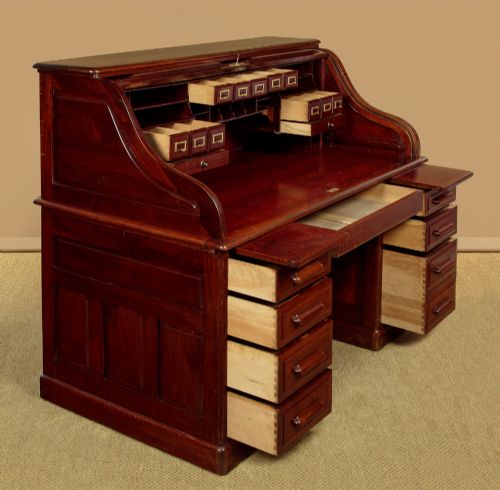


Twin Pedestal Roll Top
These twin pedestal roll top desks combine deep pedestals of drawers with a slatted tambour closure, offering a practical workspace that locks securely.
Twin Pedestal Roll Top
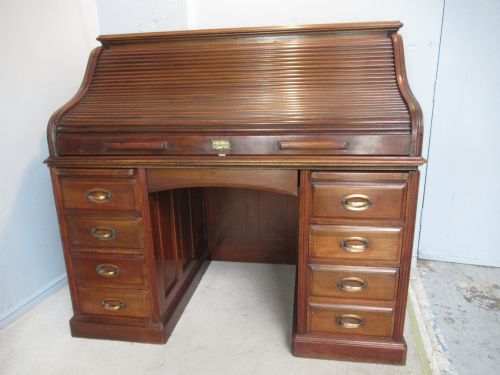
A twin pedestal roll top desk organises paperwork behind a flexible timber shutter while housing banks of drawers on either side of the sitting space. These large pieces serve as substantial workstations for studies and libraries.
Most examples found here date from the Victorian, Edwardian, and interwar periods, built predominantly in oak and mahogany with occasional walnut surfaces. The form evolved to handle business administration and correspondence with dedicated internal pigeonholes.
Desks vary from robust solid oak pieces to finely figured mahogany and walnut constructions, reflecting the changing tastes of offices and domestic studies from the nineteenth century onward.
Construction and Materials
Cabinet makers built these desks using solid and veneered timbers including oak, mahogany, walnut, maple, and satinwood, often paired with brass hardware and leather writing inserts. The structural carcass relies on heavy pedestals designed to support the weight of the upper writing surface and tambour mechanism.
The defining tambour shutter consists of narrow wooden slats glued to a fabric or canvas backing, allowing the flexible curtain to slide smoothly in curved side grooves. This intricate assembly required precise joinery to ensure the roll top operates without binding.
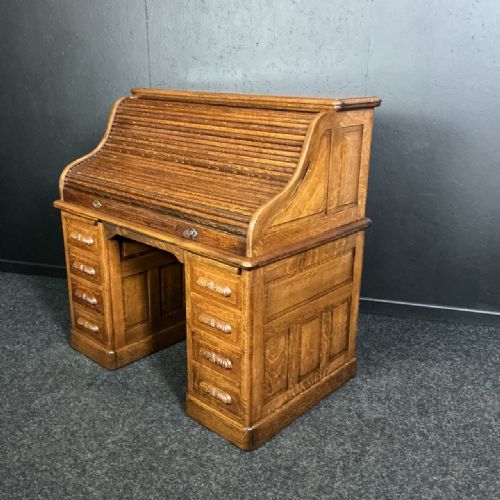
Several heavy oak desks carry an 'S' shaped profile, giving a distinctively sweeping curve to the working front.
Judging Quality
Quality rests on the selection of timber figures, the smoothness of the tambour track, and the structural integrity of the pedestal drawers. Superior pieces utilise dense solid oak or carefully matched mahogany veneers with well-fitted internal compartments.
Finer desks display crisper mouldings, original brass fittings, and intact locking mechanisms with working keys. The weight of the timber and the complexity of the internal pigeonhole arrangement separate standard utilitarian models from finer showroom examples.
The Twin Pedestal Roll Top Glossary
- Tambour
- A flexible shutter made of narrow wooden slats fixed to canvas, allowing the desk top to curve open and closed. This mechanism conceals the desk interior when locked.
- Twin pedestal
- A desk design featuring two separate stacks of drawers that support the writing surface on either side of the user. This arrangement creates a central kneehole.
- Cylinder top
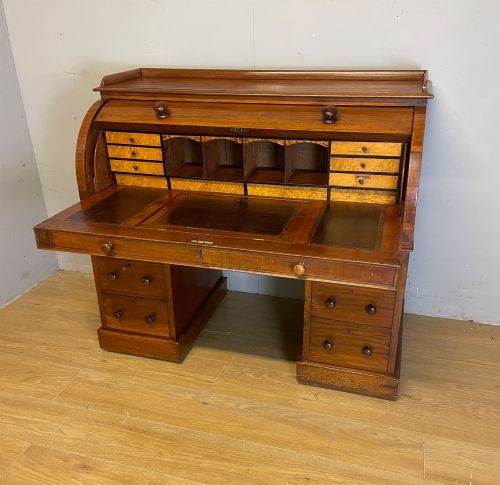
- A solid curved wooden lid that slides in a circular track rather than flexible slats, seen on certain nineteenth-century variants. It provides a smoother exterior profile than a slatted tambour.
- Pigeonhole
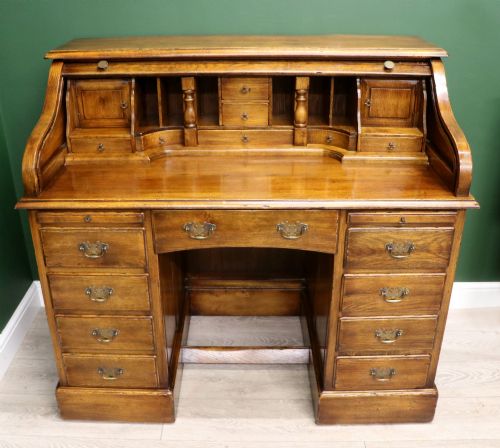
- A small compartment within the desk interior used for sorting letters and documents. These tiers sit above the main writing surface behind the roll top.
- S-curve
- A descriptor for desks where the front profile sweeps outward in a distinctive contour. This ergonomic shape characterises larger commercial models from the Edwardian era.
Twin Pedestal Roll Top: Frequently Asked Questions
How do I maintain the roll top mechanism?
Keep the wooden tracks clean from dust and debris so the tambour slats slide freely without catching. Apply a suitable wax to the runners if movement becomes stiff.
Avoid placing heavy objects on top of the desk that might warp the housing channels over time.
What is the difference between a cylinder top and a roll top?
A cylinder top uses a single solid curved piece of wood that slides on a curved track, whereas a roll top uses many small slats attached to canvas. Both serve to conceal the writing surface when pulled down.
Cylinder desks generally appear on earlier nineteenth-century pieces, while slatted versions become common in the Edwardian period.
How do I identify an Edwardian desk?
Edwardian desks often feature lighter oak or mahogany construction with simpler linear details compared to heavily carved Victorian furniture. Many incorporate large panelled backs that allow the desk to sit free in the middle of a room.
Internal fittings in these pieces usually reflect early twentieth-century stationery formats and business needs.