
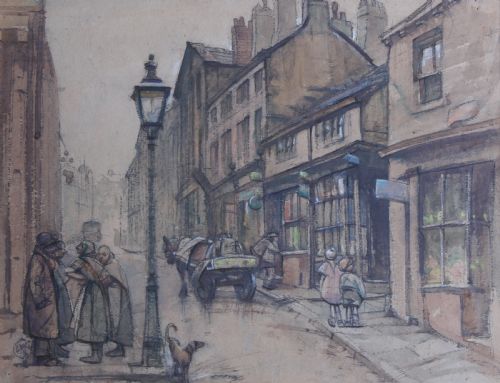


Twentieth Century Watercolour Landscape
A twentieth century watercolour landscape captures British and European scenery through fluid pigment on paper, prized for its immediacy and atmospheric depth.
Twentieth Century Watercolour Landscape
A twentieth century watercolour landscape presents views of rural fields, coastal harbours, and town markets executed on paper. Buyers encounter works ranging from Edwardian garden scenes to mid-century marine watercolours of Yorkshire and Devon.
The selection includes framed original paintings and drawings spanning from the Edwardian era through the nineteen-sixties. Traditional British landscapes and British Impressionism dominate the visual styles recorded across these watercolours.
Works originate from various British schools and individual painters working across England, Scotland, and overseas locations like Venice and Brittany. The subjects often feature recognizable regional topography, such as Wensleydale, St. Ives, and London parks.
How They Were Made
Artists executed these works using watercolour pigment and ink applied to paper supports. Some compositions incorporate pencil underdrawing beneath the washes of colour.
Finished watercolours were housed behind glass within timber frames, frequently utilising burr wood mouldings or gilt finishes to complement the artwork.
Cattle occasionally wander into the composition, immortalised by an artist who paused to sketch them on a quiet morning.
What Varies in Quality
Quality rests on the confidence of the brushwork and the artist's ability to capture atmospheric light and movement. Top tier examples demonstrate assured handling of washes and precise command over perspective, whereas lesser works appear flat and tentative.
The preservation of the pigment against fading and the condition of the paper surface significantly influence the visual impact. Original frames featuring period gilt wood or burr veneers also elevate the overall integrity of the piece.
Thomas Ellison·Fred Lawson·Robert Leslie Howey·Stanley Orchart·Ernest F. Hill·John Hobson Nicholson·Frank Wood·Owen Bowen·Fred Mayor·George Hamilton Constantine·Walter Henry Sweet·Rowland Henry Hill·Cuthbert Crossley·Edmund Gouldsmith·Yves Brayer·Hirst Walker·Beatrice Parsons·Fred Stead·Charles Eyres Simmons·R. J. S. Bertram·Charles Ashmore·Wycliffe Egginton·George Jackson
The Twentieth Century Watercolour Landscape Glossary
- Watercolour
- A paint consisting of a pigment suspended in a water-soluble vehicle. It is applied in translucent washes to create luminous effects on paper.
- British Impressionism
- A painting style focused on light and everyday subjects. Practitioners adopted loose brushwork influenced by continental movements.
- Gilt Wood
- Timber carved or moulded and coated with gold leaf or metallic gilt paint. It is commonly found on traditional picture frames.
- Burr Wood
- Wood harvested from tree growths that produce swirling, highly figured grain patterns. It is typically polished to form decorative picture frames.
Twentieth Century Watercolour Landscape: Frequently Asked Questions
How do I hang a watercolour?
Watercolours require protection from direct sunlight to prevent the pigments from fading over time. Position them away from strong light sources and damp environments.
Ensure the frame is securely hung using appropriate wall fixings suited to the weight of the glass and timber moulding.
What is British Impressionism?
British Impressionism emerged in the late nineteenth and early twentieth centuries as artists adopted lighter palettes and broken brushstrokes. Painters moved outdoors to capture natural light and transient atmospheric effects.
This approach contrasted with rigid academic traditions, focusing instead on everyday rural, marine, and urban scenes.
How do I identify the date?
Dating relies on artist signatures, exhibition labels, and stylistic markers characteristic of specific decades such as the nineteen-twenties or nineteen-thirties. Framing materials and paper types also offer clues to the period of creation.
Inscribed titles and dates on the reverse of the paper or mount often confirm when the landscape was painted.
Were these painted outdoors?
Many landscape watercolours began as quick plein-air sketches captured directly in front of the scenery. Artists utilised portable materials to record weather, light, and topography on location.
Studio finishing sometimes followed, though the primary observation of subjects like marine views or garden flowers relied on direct outdoor study.