
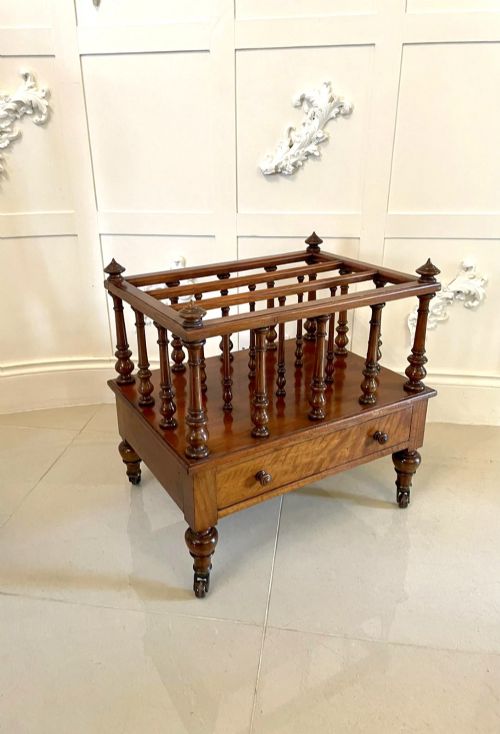
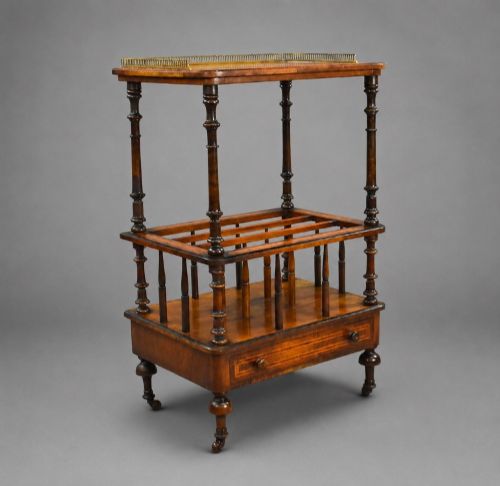


Turned Walnut Magazine Stand
These turned walnut magazine stand pieces are nineteenth-century reading holders designed to keep periodicals tidy in domestic rooms.
Turned Walnut Magazine Stand
The dominant forms seen here are canterburys and combined magazine and music racks originating from the mid-nineteenth century. Most examples date from the 1850s, 1860s, and 1870s, reflecting the Victorian appetite for specialised domestic furniture. Pieces range from simple freestanding magazine stands to elaborate whatsits fitted with shelves and partitions.
Makers such as Edwards and Roberts and Shoolbred produced notable versions during this period, often combining turned supports with compartmented tops. The typical piece relies on walnut, burr walnut, or black walnut, sometimes incorporating brass, ceramic, or iron fittings. This combination of turned woodwork and compartmentalised storage defines the category.
How they were made
Construction relies heavily on walnut, burr walnut, and figured walnut timbers selected for their grain and rich tone. Cabinet makers utilised these woods to build sturdy frames with partitioned sections for papers and books.
Turned wooden uprights and legs form the structural support, often paired with brass, ceramic, or iron elements. Inlaid decoration and figured veneers appear on finer examples from the Victorian workshops.
Joinery techniques of the nineteenth century ensure stability across freestanding canterburys and music racks. The combination of turned elements and compartment dividers required precise carpentry to withstand daily domestic use.
Listings feature nineteenth-century pieces spanning the Victorian period from 1850 to 1870, constructed primarily in walnut, burr walnut, and black walnut.
What varies in quality
The choice of timber creates a distinct separation in quality across these pieces. Standard walnut provides a sober surface, whereas burr walnut and figured walnut display striking grain patterns that elevate the visual presence of the furniture.
Maker attribution alters the standing of a piece within the period. Work originating from known London firms like Edwards and Roberts or Shoolbred demonstrates superior cabinet work compared to anonymous workshop output.
The complexity of the form dictates the standard of manufacture. Simple magazine stands sit at the functional end, while multi-tiered canterburys featuring turned columns, inlays, and integrated castors represent the higher tier of nineteenth-century production.
Edwards and Roberts·Shoolbred
The Turned Walnut Magazine Stand Glossary
- Canterbury
- A low, freestanding stand with vertical partitions, originally designed to hold sheet music and later used for newspapers and magazines. This form became a staple of nineteenth-century sitting rooms.
- Burr walnut
- A veneer sliced from the grotesque growths on a walnut tree, prized for its swirling, highly figured grain patterns. Cabinet makers utilised it on principal surfaces to create decorative impact.
- Whatnot
- An open set of freestanding shelves used for displaying ornaments or holding books and papers. Victorian examples often incorporated turned supports and lower storage compartments.
- Figured walnut
- Timber exhibiting distinctive grain formations resulting from growth irregularities or branching. It offers a decorative alternative to plain walnut boards.
- Turned woodwork
- Components shaped on a lathe to produce cylindrical, baluster, or spindle profiles. This technique provided the structural legs and uprights for nineteenth-century stands.
Turned Walnut Magazine Stand: Frequently Asked Questions
What is a nineteenth-century canterbury?
A nineteenth-century canterbury is a low, compartmentalised stand built to hold sheet music, books, and periodicals within easy reach of a chair. These pieces typically feature vertical wooden partitions and turned legs.
Cabinet makers of the Victorian era produced them in various woods, predominantly walnut, to suit the formal living spaces of the period.
How do I date a walnut magazine stand?
Dating relies on examining the timber, construction methods, and stylistic cues present in the piece. Mid-nineteenth-century examples often display turned walnut supports, brass castors, and figured veneers.
Makers' stamps or labels, when present, provide a direct link to specific workshops operating during the Victorian decades.
Where should I place a walnut rack at home?
These stands fit naturally beside a sofa, armchair, or desk where reading materials accumulate. Their compact footprint allows them to occupy small spaces while keeping periodicals organised.
Keeping them away from direct heat sources protects the walnut timber and any applied veneer from drying out.
What is the difference between a music rack and a magazine stand?
Music racks were originally constructed with specific internal dimensions to accommodate bound scores and sheet music. Magazine stands often feature broader partitions suited to periodicals and newspapers.
Many nineteenth-century examples served both functions interchangeably as domestic habits evolved over time.