

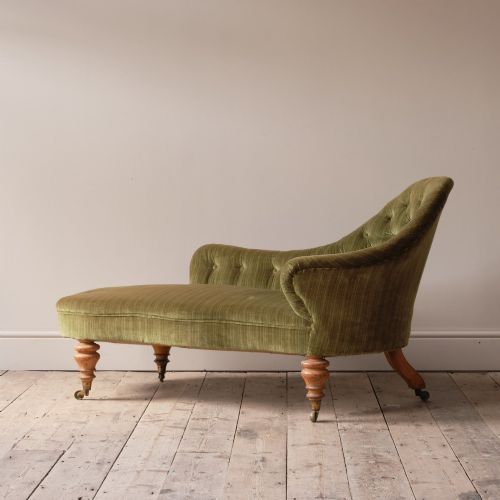
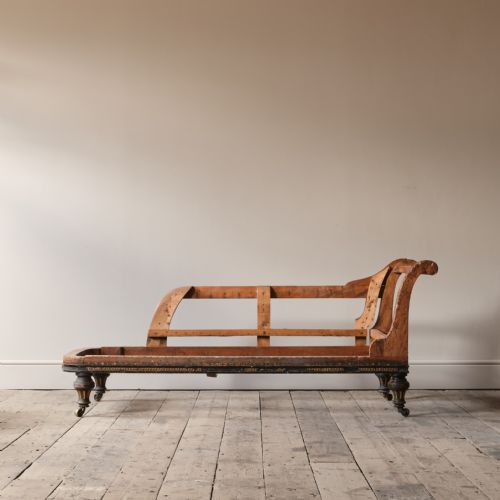
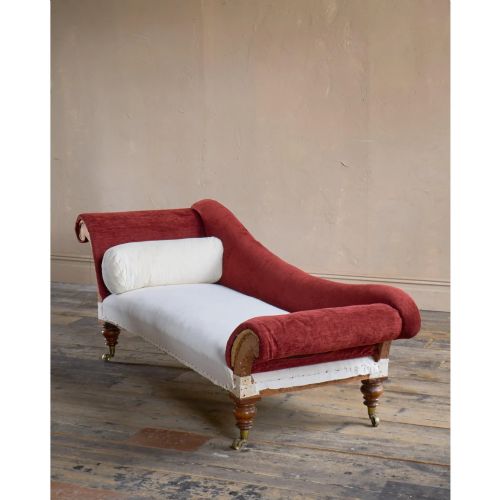
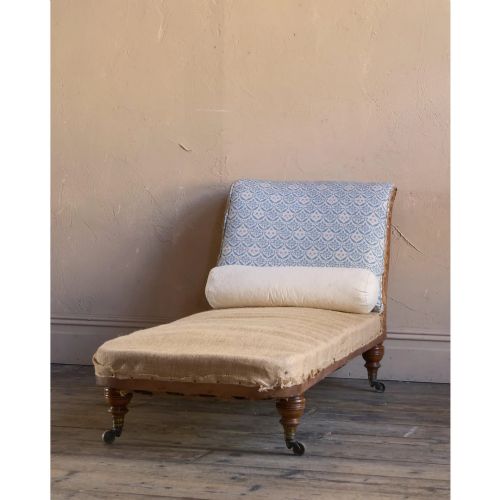
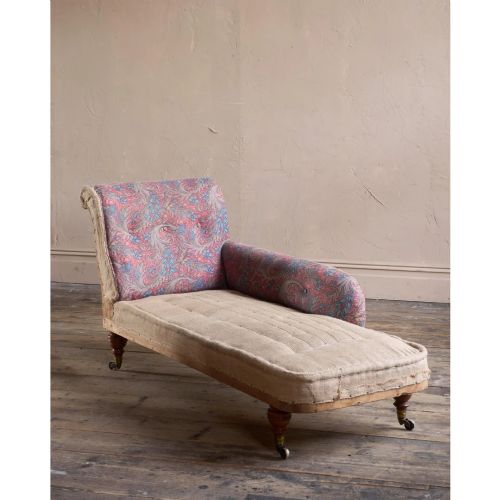

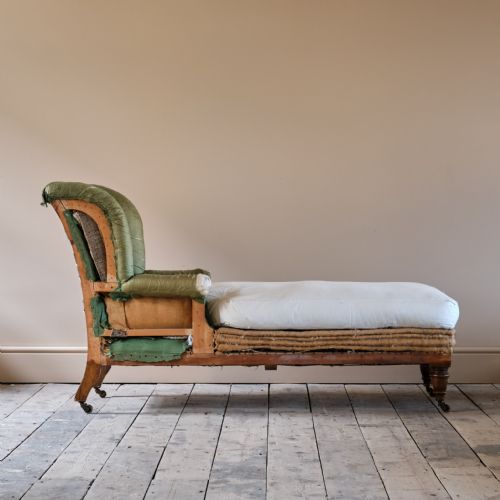


Turned Leg Fainting Couch
A turned leg fainting couch brings nineteenth century reclining comfort to a room, offering an extended seat designed for resting without full sleep.
Turned Leg Fainting Couch
When searching for a turned leg fainting couch, you are looking at nineteenth century daybeds and chaise longues built for reclining in the parlour or drawing room. These pieces bridge the gap between a sofa and a bed, featuring a raised headrest and a long upholstered seat supported by turned timber legs.
The versions you are most likely to meet on this page hail from the Regency, Victorian, and Napoleon III periods, spanning the early to late nineteenth century. They appear in forms ranging from grand mahogany frames to fully upholstered day beds resting on original castors.
Makers such as Holland & Sons, Howard and Sons, and Miles & Edwards produced notable examples, alongside pieces in the manner of Gillows. The object types vary in name between chaise longues, daybeds, and reclining day beds, yet all serve the same purpose of semi-recumbent repose.
How they were made
Makers constructed the structural frames of these pieces using solid hardwoods such as mahogany. Turned legs were carved and fitted to support the substantial weight of the timber framework and upholstery.
Upholstery methods involved traditional stuffing materials covered in fabrics including velvet, calico, hessian, and leather, often finished with buttoning. Brass castors were frequently attached beneath the turned legs to allow smooth movement across the floor.
Turned Leg Fainting Couch Retail Price Guide 2026
Typical asking prices for turned leg fainting couch among the pieces listed under this phrase on Sellingantiques today, from the lower quarter to the upper quarter. They describe what is for sale here now, not the wider market.
Listings span the nineteenth century, including Regency and Victorian periods, constructed from mahogany, hardwood, velvet, leather, and brass.
What varies in quality
The distinction between standard production and the work of premier nineteenth century cabinet makers lies in the crispness of the timber turning and the integrity of the frame construction. Pieces associated with prominent workshops display superior joinery and more refined proportions in the scrolled headrest.
Quality also rests in the execution of the upholstery and the retention of original components like brass castors. Whether finished in buttoned velvet or supple leather, superior examples maintain a harmonious balance between the wooden undercarriage and the upholstered upper body.
Holland and Sons·Howard and Sons·Miles and Edwards
The Turned Leg Fainting Couch Glossary
- Chaise Longue
- A long upholstered chair for reclining, literally translating from French as long chair. These pieces typically feature a single raised end for supporting the head.
- Day Bed
- An elongated seat used for resting or lounging during the day without retiring to a proper bed. It shares close similarities with the chaise longue and fainting couch.
- Castor
- A small wheel mounted on a swivel assembly attached to the bottom of a furniture leg. They allowed heavy nineteenth century daybeds to be repositioned easily across carpets.
- Buttoning
- An upholstery technique where twine is pulled through the padding and secured with buttons to create a diamond pattern. This method kept internal fillings evenly distributed.
- Regency
- An English design period spanning the early nineteenth century defined by classical influences and rich mahogany timbers. Pieces from this era often exhibit clean architectural lines.
Turned Leg Fainting Couch: Frequently Asked Questions
How do I date a fainting couch?
Dating relies on stylistic clues, frame materials, and cabinet-making characteristics associated with periods like the Regency and Victorian eras.
Earlier pieces often use solid mahogany with classical influences, while later Victorian examples introduce varied upholstery styles and turned leg profiles.
Where should I place a daybed?
A daybed works well positioned against a long wall in a living room, study, or master bedroom to create a dedicated reading corner.
Because many feature finished backs and sides, certain models can also float within a larger room layout.
What materials are used in these pieces?
Frames are built from hardwoods like mahogany, while lower supports incorporate brass castors on turned wooden legs.
The upholstery utilises fabrics such as velvet, calico, hessian, and leather, frequently accented with deep buttoning.