
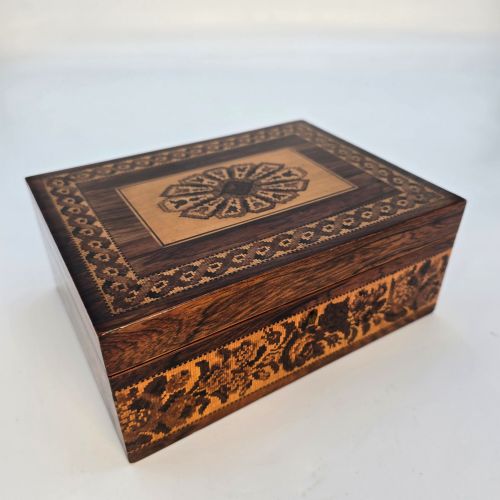


Tunbridge Ware Mosaic Box
These tunbridge ware mosaic box examples offer intricate micro-mosaic woodwork from the nineteenth century, prized for detailed pictorial lids and geometric borders.
Tunbridge Ware Mosaic Box
A tunbridge ware mosaic box represents a specialised form of nineteenth-century English decorative woodwork originating from Kent. When searching for a tunbridge ware mosaic box, buyers encounter various container forms designed for domestic storage.
The selection on this page centres on Victorian pieces alongside Regency examples. Common forms include tea caddies, jewellery boxes, sewing boxes, stationery boxes, and small trinket boxes made for personal use.
Most items utilise dark timbers such as rosewood or walnut as a carcase, framing complex inlaid geometric patterns or pictorial scenes on the lid. These functional objects served polite society for holding tea, correspondence, or needlework.
How They Were Made
Craftsmen constructed these pieces using hundreds of tiny blocks of naturally coloured and dyed woods assembled into bundles. Woods like boxwood, holly, sycamore, and walnut provided a wide palette for the mosaic designs.
The assembled bundles were sliced crosswise to produce numerous identical picture or pattern tiles. These minute mosaic tiles were then applied as veneer to solid timber carcases of rosewood, walnut, or mahogany, often complemented by brass fittings and silk linings.
Listings feature Victorian and Regency periods with core materials including rosewood, walnut, boxwood, holly, and sycamore.
What Varies in Quality
Quality in a tunbridge ware mosaic box depends on the scale of the mosaic work and the complexity of the imagery. Smaller mosaic tesserae and pictorial panels depicting specific locations demonstrate superior craftsmanship compared to repetitive geometric banding alone.
The choice of carcase timber and internal fittings further distinguishes the grade of the piece. Lined boxes with fitted compartments in retained original condition command higher regard than plain interiors or heavily altered examples.
Edmund Nye·Henry Hollamby
The Tunbridge Ware Mosaic Box Glossary
- Micro-mosaic
- A decorative technique utilising thousands of microscopic wooden tiles glued together to form a picture or pattern. This method defines the primary visual appeal of the craft.
- Tesserae
- The individual small blocks or squares of coloured wood cut from multi-wood rods. These tiny pieces form the building blocks of the mosaic design.
- Tea Caddy
- A lidded container historically used for storing loose tea leaves. Many surviving examples feature fitted interior compartments and lockable lids.
- Marquetry
- The art of applying pieces of veneer to a structure to form decorative patterns or pictures. It differs from mosaic by using flat veneer sheets rather than assembled block ends.
- Carcase
- The underlying structural body of a box upon which the decorative veneers are applied. Rosewood and walnut commonly form this foundational frame.
Tunbridge Ware Mosaic Box: Frequently Asked Questions
What is a tunbridge ware mosaic box?
A tunbridge ware mosaic box is a nineteenth-century wooden container decorated with tiny mosaic tiles assembled from different coloured woods. These boxes often feature geometric patterns or pictorial views on their lids.
Originating in Kent, England, they served various domestic purposes including tea storage, sewing, and correspondence. Their production required immense skill in miniature woodworking.
How do I date a tunbridge ware box?
Dating relies on stylistic clues, wood types, and construction methods characteristic of the Regency and Victorian eras. Most surviving pieces date from the mid to late nineteenth century.
Makers such as Edmund Nye and Henry Hollamby operated during the peak of production around eighteen-fifty to eighteen-eighty. Labelled pieces or known provenance help narrow down the period further.
What were these boxes used for originally?
These containers served practical functions in nineteenth-century households for organising valuables and dry goods. Common types include tea caddies, stationery boxes, jewellery boxes, and sewing compendiums.
Many contained fitted compartments, mirrors, or velvet and silk linings suited to their specific domestic purpose. They sat upon tables in parlours and bedrooms as both utility items and decorative displays.
How should I clean my box?
Maintenance requires gentle dusting with a soft, dry cloth to protect the delicate wooden mosaic tiles. Moisture and direct sunlight can damage the fragile veneer and historical glue.
Applying specialised furniture wax should be done sparingly, as modern polishes can seep between the tiny wooden tesserae. Professional conservation is recommended for any loose or missing mosaic elements.