
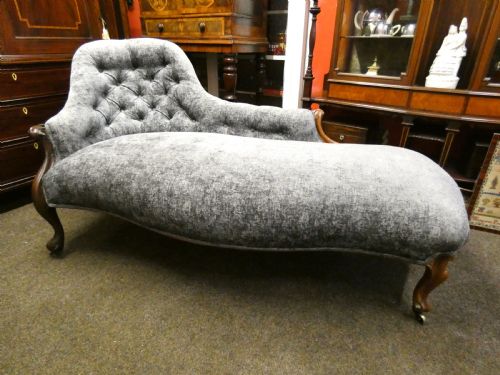
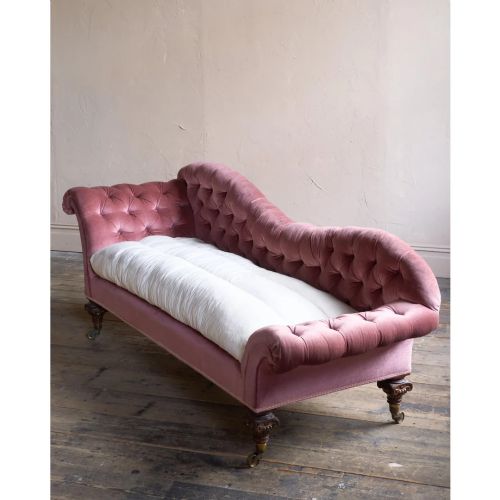
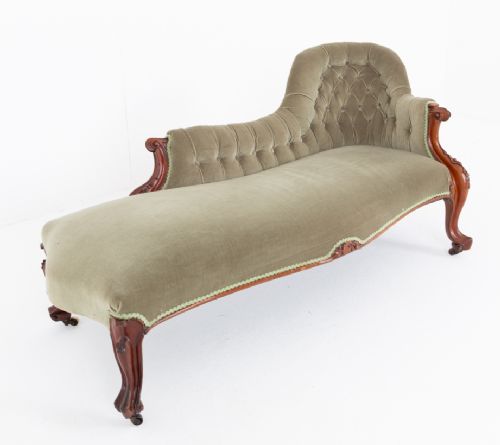


Tufted Upholstered Chaise
Tufted upholstered chaise pieces offer reclining comfort in rosewood, mahogany and walnut frames.
Tufted Upholstered Chaise
A tufted upholstered chaise combines the long seat of a daybed with the backed design of a sofa, built for reclining in the nineteenth century. These seating pieces appear frequently in Victorian, Regency and Louis XVI Revival styles, often featuring buttoned upholstery and carved wooden frames.
The versions met most often on this page date from the Victorian era and the broader nineteenth century, constructed in mahogany, rosewood or walnut. Many examples incorporate specific regional maker attributions or distinct design details such as ionic column legs, double spoon backs and barley twist supports.
Materials and construction
Makers built the structural frames of these pieces using dense hardwoods including mahogany, rosewood and walnut, frequently shaping the wood with carved details or turned supports. The upholstery framework relied on supportive fabric webbing and horsehair stuffing, held in place by deep button tufting.
Surface finishes involved polishing the natural wood grain to a rich sheen, while the seating areas utilised textiles such as velvet, damask and various upholstery fabrics. Skilled joinery anchored the scrolled ends and single-ended backrests securely to the main wooden bases.
Victorian conversation seats let two people sit face-to-face in a charming S-shape without ever bumping knees.
What separates the best examples
Quality in a tufted upholstered chaise rests upon the crispness of the timber carving and the architectural ambition of the frame. Pieces featuring documented maker stamps or workshop attributions show superior cabinetmaking in the joinery of the scroll end and the integration of turned legs.
The precision of the button tufting and the selection of the primary show wood dictate the visual authority of the piece. Dense rosewood or finely figured mahogany frames paired with hand-finished upholstery distinguish the finest workshops from standard production.
Howard & Sons·H. Goodall & Sons·Holland & Sons·Jas Shoolbred·Miles & Edwards
The Tufted Upholstered Chaise Glossary
- Chaise Longue
- A long reclining chair or daybed designed for one person to stretch out. The form combines a seated sofa end with an extended bench section.
- Buttoned
- An upholstery technique where buttons are pulled deep into the padding at regular intervals. This creates distinct tufted diamond patterns across the fabric.
- Rosewood
- A dense, dark timber featuring pronounced grain patterns favoured by nineteenth-century cabinetmakers. It provides exceptional weight and strength for carved frames.
- Double Spoonback
- A chair or settee backrest shaped like two parallel spoons. The curved wooden rims frame the upholstered padding.
- Barley Twist
- A carved wooden support shaped like a spiral or twisted rope. This decorative turning appears frequently on nineteenth-century legs and stretchers.
Tufted Upholstered Chaise: Frequently Asked Questions
How do I style a tufted chaise?
Place the piece against a long wall in a drawing room or bedroom where its single-ended backrest remains visible. Allow sufficient surrounding floor space so the scrolled wooden frame can be appreciated from multiple angles.
Pair the furniture with neutral wall colours to let the velvet or damask upholstery stand out. Keep surrounding seating low to maintain balanced sightlines across the room.
What is a daybed?
A daybed serves as a dual-purpose piece for daytime lounging and resting. Nineteenth-century examples often blur the boundary between a chaise longue and a couch.
These pieces feature extended upholstery for stretching out fully. Many incorporate decorative wooden frames in mahogany or walnut.
How do I date a Victorian chaise?
Examine the timber used in the frame, noting the shift from early nineteenth-century mahogany to mid-Victorian rosewood and walnut. Heavy carving and rosewood construction typically point towards the 1850 and 1860 decades.
Check for maker stamps on the wooden rails or webbing. Documented workshops provide precise chronological markers within the broader Victorian period.