




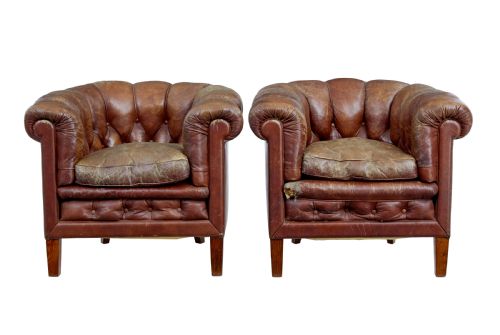


Tufted Leather Lounge
These tufted leather lounge pieces offer deep buttoning and rich hides, bringing historic comfort and gravitas to any room.
Tufted Leather Lounge
When you search for tufted leather lounge, you encounter an array of seating ranging from compact armchairs to grand multi-piece suites. The selection spans distinct eras, with nineteenth-century examples and Victorian Chesterfields dominating the offerings alongside Swedish club chairs and twentieth-century designs.
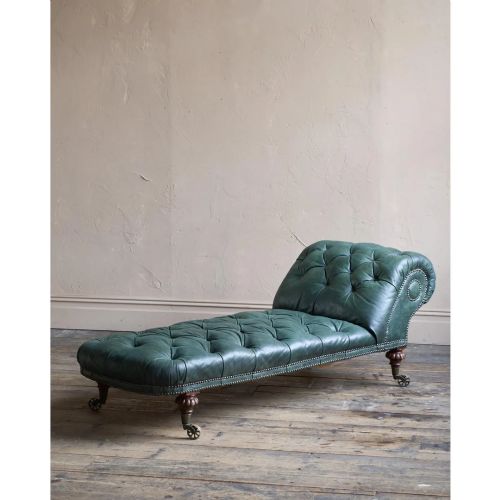
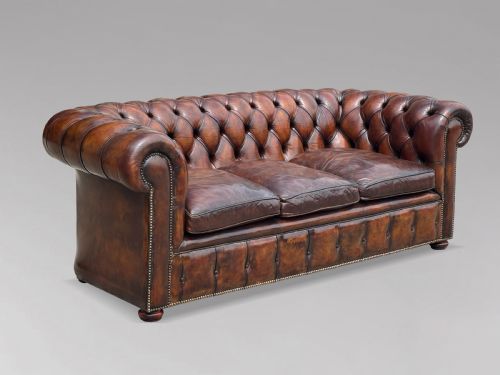
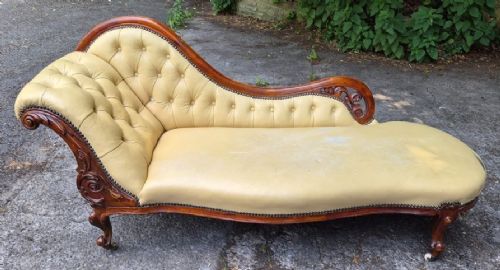
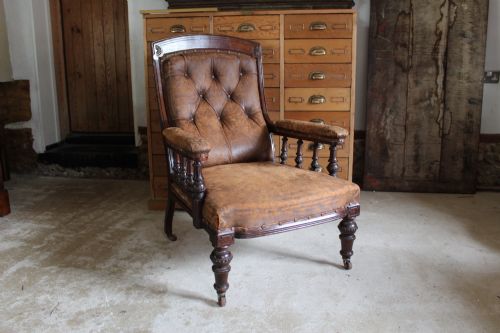
Forms include deep-seated library chairs, scroll-ended chaise longues, and spacious three-seater sofas featuring characteristic buttoning. Buyers meet everything from George III wingbacks to robust campaign chairs and substantial lion-carved armchairs.
Origins stretch across British and continental workshops, encompassing traditional styles like Regency and George III alongside early twentieth-century interpretations. The pieces serve as both functional seating and substantial decorative anchors within a room.
Materials and construction
Construction relies heavily on sturdy hardwood frames of mahogany, walnut, rosewood, and birch, providing the structural integrity required for heavy seating. These wooden frameworks often feature detailed hand-carved elements, cabriole legs, or exposed mahogany frames.
Upholstery employs durable leather secured with traditional tufting techniques, frequently complemented by brass nailhead detailing along the borders. Interior padding and framing methods support the deep buttoning characteristic of Chesterfield sofas and library chairs.
The inventory spans the eighteenth, nineteenth, and early twentieth centuries, including Swedish club chairs and Victorian campaign furniture.
Markers of quality
Quality reveals itself in the depth and precision of the button tufting, the richness and patina of the leather hide, and the crispness of any carved woodwork. Superior examples exhibit tightly secured upholstery and substantial timber frames that remain stable over generations.
The sophistication of the frame carving, such as detailed lion motifs or shaped cabriole legs, separates standard production from exceptional craftsmanship. Preservation of original brass hardware and the integrity of the underlying support structure further distinguish the finest specimens.
The Tufted Leather Lounge Glossary
- Chesterfield
- A form of upholstered sofa or armchair characterised by deep button tufting and rolled arms of equal height. This classic seating style remains a cornerstone of traditional British furniture.
- Chaise Longue
- An upholstered sofa in the shape of a chair that is long enough to support the user's legs. These reclining seats often feature a single raised end and date frequently to the nineteenth century.
- Cabriole leg
- A furniture leg that bends out in a curve and tapers inward to a small foot. This design element appears on various Victorian library chairs and seating pieces.
- Wingback
- An armchair with side panels or wings attached to the back of the arms designed to shelter the user from drafts. Early examples date back to the eighteenth century.
- Campaign chair
- A portable chair designed to be easily folded or disassembled for military travel. Mid-nineteenth-century iterations often incorporate adjustable reclining mechanisms and leather upholstery.
Tufted Leather Lounge: Frequently Asked Questions
What is a Chesterfield?
A Chesterfield is a traditional upholstered seating form defined by deep button tufting and low, rolled arms. These pieces are typically finished in dark or whisky brown leather.
Originating in Britain, they function as both sofas and armchairs, offering deep proportions designed for relaxed lounging in studies and libraries.
How do I date a leather lounge chair?
Dating relies on examining the woodwork, framing style, and upholstery methods. Characteristics such as George III wings or Victorian carved mahogany frames provide clear chronological markers.
Hardware like brass nailheads and the specific cut of the hardwood also help determine whether a piece belongs to the eighteenth, nineteenth, or early twentieth century.
Where were these pieces used?
These lounge pieces traditionally furnished formal libraries, gentleman's studies, and drawing rooms of grand houses. They were built to provide durable, comfortable seating for reading and conversation.
Over time, their robust construction allowed them to transition into eclectic modern living spaces and commercial reception rooms.
How do I care for antique leather?
Maintaining antique leather requires keeping the hide nourished with appropriate balms to prevent drying and cracking. Avoid placing the seating in direct sunlight or near heat sources.
Gentle dusting and occasional conditioning preserve the natural patina and suppleness developed over decades of use.