


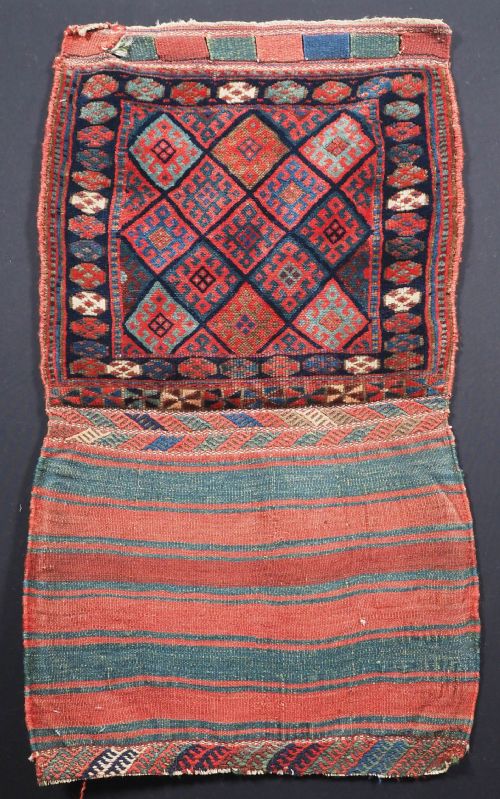


Tribal Saddle Bag Face
A tribal saddle bag face brings the kinetic geometric artistry of nomadic weavers straight onto a wall or floor.
Tribal Saddle Bag Face
A tribal saddle bag face represents the front panel of a larger utility bag once carried across animal flanks by nomadic groups in Persia and the Caucasus. These textile fragments survive from the nineteenth century, ranging from complete khorjin faces to single halves and chuval panels.
Makers include regional nomadic confederations such as the Shahsavan, Qashqa'i, Khamseh, Luri, Afshar, Baluch, and Tekke Turkmen. Buyers encounter specific motifs like large boteh, tile patterns, and repeating güls woven into these portable formats.
The objects function today as compact decorative rugs or wall hangings. Most pieces on this page stem from the second half of the nineteenth century up to nineteen hundred.
Materials and construction
Weavers constructed these textiles using hand-spun wool and natural dyes, often incorporating cotton for structural support in specific regional formats. The resulting pile and flatweave surfaces display the rich, luminous quality of traditional dyeing methods.
Techniques alternate between standard pile knotting and the complex soumak technique seen in Shahsavan khorjin pieces. Plain weave backs appear on certain examples alongside the decorated faces.
Tribal Saddle Bag Face Retail Price Guide 2026
Typical asking prices for tribal saddle bag face among the pieces listed under this phrase on Sellingantiques today, from the lower quarter to the upper quarter. They describe what is for sale here now, not the wider market.
Nomads packed these bags with everything from salt to bedding, meaning the surviving faces spent decades rubbing against the sides of camels and donkeys.
Factors determining quality
Quality rests in the handling of natural dyes and the crispness of the tribal design, whether a repeating tile pattern or a central boteh. Lustrous, luminous wool elevates an individual piece above standard utility weaving.
Structural integrity of the weave and the precision of regional patterns distinguish finer nomadic examples. The density of the hand-spun wool directly influences how well the geometric forms maintain their visual impact.
The Tribal Saddle Bag Face Glossary
- Khorjin
- The Persian term for a double saddlebag used by nomadic tribes for transport. These items were designed to carry possessions across the backs of animals.
- Soumak
- A flatweave technique involving coloured threads wrapped around warp threads in a herringbone or braided pattern. This method creates a sturdy textile without a raised pile.
- Chuval
- A large storage bag face produced by Turkmen tribes. These panels often feature repeating gül designs.
- Boteh
- A stylised almond or paisley motif with a curved upper tip. This ancient symbol appears frequently in Afshar and other Persian tribal weavings.
- Gul
- A primary octagonal medallion or repeated floral motif used extensively by Turkmen and other Central Asian weavers. Each tribal group utilised distinct variations of this emblem.
Tribal Saddle Bag Face: Frequently Asked Questions
How do I hang a bag face?
Mounting a textile requires distributing the weight evenly across the upper edge rather than piercing the fabric with nails or hooks. Many collectors use custom cotton sleeves hand-stitched to the reverse.
This method allows the piece to hang flat against a wall without placing undue stress on the hand-spun wool or cotton foundations.
Who made these tribal textiles?
Nomadic confederations and village groups living across Persia and the Caucasus produced these works during the nineteenth century. Specific tribes include the Qashqa'i, Shahsavan, Afshar, and Luri peoples.
Each group utilised distinct colour palettes, wool qualities, and geometric symbol systems passed down through generations.
How do I identify different tribes?
Tribal attribution relies on structural traits, colour choices, and characteristic motifs unique to specific geographic regions. For instance, Shahsavan pieces often showcase soumak technique, while Afshar items frequently display boteh designs.
Examining the handling of hand-spun wool and natural dyes provides further clues to the origin of an individual weaving.