

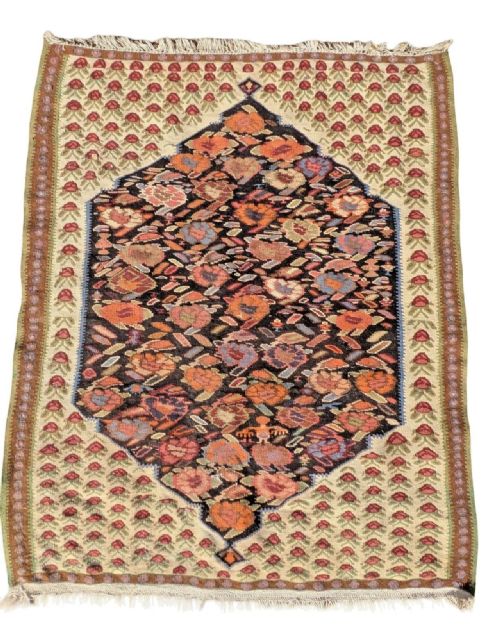


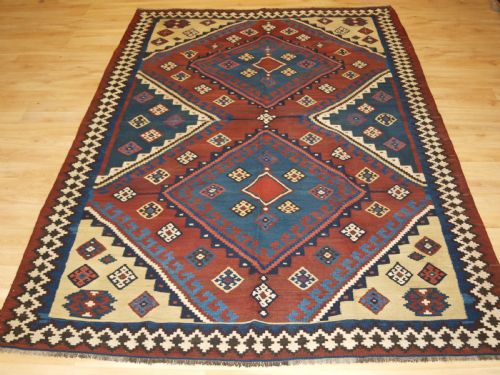


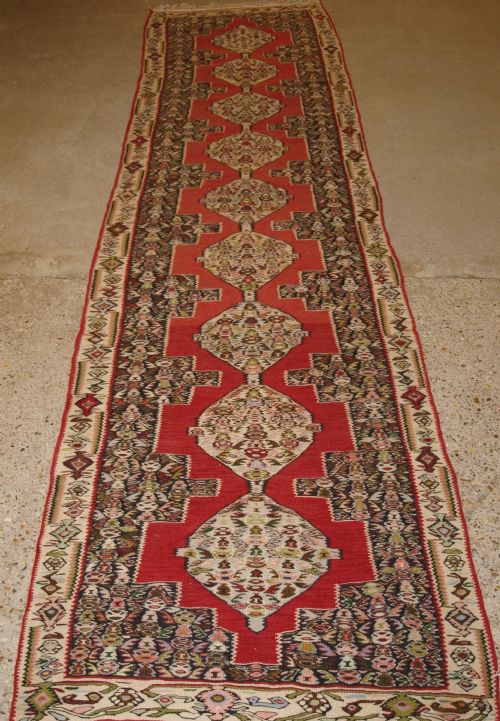


Tribal Medallion Kilim
These tribal medallion kilim flatweaves bring geometric pattern and rich dyed wools straight to the floor.
Tribal Medallion Kilim
A tribal medallion kilim is a flatwoven textile featuring central geometric motifs created by weaving the warp and weft threads together. These pieces originate from various regions including Persia, Anatolia, Central Asia, the Caucasus, and the Balkans.
The inventory on this page ranges across the early twentieth century, spanning decades from 1900 to 1930. Buyers encounter formats such as room-sized carpets, large area rugs, and runner rugs.
Designs feature distinct repeat medallions, diamond motifs, and bold central elements tied to traditions such as Bidjar, Ushak, Uzbek, Karabagh, Pirot, Kurdish, Qashqai, and Malatya.
What varies in quality
Quality rests in the precision of the geometric repeat and the sharpness of the central medallion design. Tighter weaving and finer wool preparation distinguish the more accomplished regional pieces.
The depth and preservation of the dyed wools dictate the visual impact of each flatweave, with certain pieces displaying particularly harmonious pastel or bold colour schemes.
Tribal Medallion Kilim Retail Price Guide 2026
Typical asking prices for tribal medallion kilim among the pieces listed under this phrase on Sellingantiques today, from the lower quarter to the upper quarter. They describe what is for sale here now, not the wider market.
The Tribal Medallion Kilim Glossary
- Kilim
- A flatwoven textile produced without a pile by tightly interweaving warp and weft strands. This construction results in a lightweight, reversible rug.
- Medallion
- A central decorative motif placed in the field of the textile. These designs range from single large focal points to repeated geometric shapes.
- Warp
- The stationary vertical threads stretched across the loom before weaving begins. The weft threads are passed over and under these foundational strands.
- Weft
- The horizontal threads passed through the warp to build the pattern and colour blocks. In kilims, these threads are tightly beaten down to conceal the warp.
Tribal Medallion Kilim: Frequently Asked Questions
How do I care for a flatweave rug?
Protect the flatweave by placing a suitable underlay beneath it to prevent slipping and reduce friction on hard floors. Regular gentle vacuuming without a rotating brush roll keeps dust from settling between the tight weft threads.
Professionally clean the textile when necessary, avoiding immersion washing unless handled by a specialist familiar with antique dyed wools.
Where should I place a runner rug?
Runner formats suit narrow spaces such as hallways, corridors, and bedside areas where low-profile floor coverings are practical. Their flat structure allows doors to swing freely overhead without catching.
Ensure the dimensions match the walkway so the border patterns remain visible and unobstructed by furniture.
Can I use these textiles on walls?
Many collectors hang flatweaves as wall art to showcase the geometric medallion designs away from foot traffic. Use a professional sleeve mounting method that distributes the weight evenly along the top edge.
Avoid hanging textiles in direct sunlight to protect the natural and early dyed wools from fading over time.
What defines a flatweave structure?
Flatweaves lack the knotted pile found in traditional carpets, relying instead on interlocking weft threads to form the surface pattern. This construction creates a thin, durable textile that lies flat on the floor.
The absence of pile means the design appears equally clear on both sides of the fabric.