
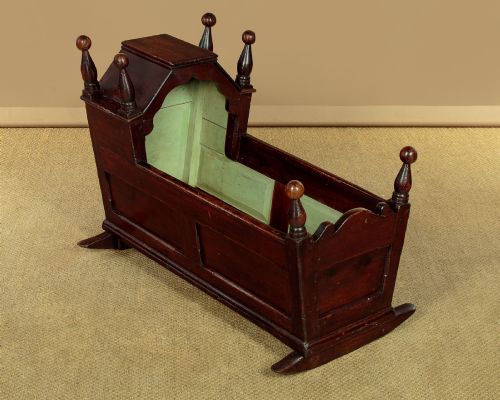


Traditional Wooden Rocking Crib
These traditional wooden rocking crib pieces offer centuries of domestic history in solid oak, pine, and mahogany.
Traditional Wooden Rocking Crib
When you search for a traditional wooden rocking crib, you are looking at domestic infant beds mounted on curved rockers or rocking mechanisms. These pieces span from the seventeenth century through the Victorian period, reflecting centuries of family life.
The versions you are most likely to meet on this page are oak panelled examples, often dating from the nineteenth century in a seventeenth century style, alongside nineteenth century painted pine cradles from Swedish or Welsh origins.
Makers utilised local timbers available to them, resulting in sturdy structures designed to soothe infants. The forms vary from hooded and panelled boxes to open rocking frames with upholstered interiors.
How they were made
Cabinet makers and vernacular joiners constructed these cradles predominantly from solid oak, pine, and mahogany, frequently employing traditional panelled construction methods. Field panels, pegged joints, and carved details give these wooden frames their structural integrity.
Surfaces exhibit either the natural grain of polished oak and mahogany or layers of original paintwork, particularly seen in Welsh and Swedish pine examples. Metal fixtures, iron elements, and occasionally glass components appear in the construction and hardware.
Canopy tops and hoods required specialised joinery to attach securely to the main body of the crib, while the curved rocking feet underneath were shaped to ensure a smooth motion.
Some nineteenth century cradles retain their original blue paint, adding a splash of historic colour to the nursery.
What varies in quality
The distinction between ordinary vernacular items and finer pieces lies in the precision of the panel work and the choice of primary timber. Oak panelled examples with crisp mouldings contrast with simpler, utility pine versions.
Original painted surfaces and early hardware elevate a piece significantly compared to later alterations or stripped timber. The presence of carved details or specific regional styles, such as William and Mary influences, indicates a higher tier of workmanship.
The Traditional Wooden Rocking Crib Glossary
- Field panel
- A raised wooden panel with bevelled edges set within a grooved frame, commonly seen on seventeenth century and revival oak cribs.
- Rockers
- The curved wooden feet attached to the base of a cradle that allow it to sway back and forth.
- Hood
- A fitted canopy or covered head portion attached to a crib to shield the infant from draughts.
- Pine
- A softwood utilised extensively for vernacular painted cradles in Welsh and Scandinavian regions.
- William and Mary
- A late seventeenth century style characterised by baroque turning and robust panel construction, often referenced in later revival pieces.
Traditional Wooden Rocking Crib: Frequently Asked Questions
What is a traditional wooden rocking crib used for?
These pieces served historically as infant beds designed to soothe babies to sleep through a gentle rocking motion.
Today, collectors appreciate them as historical wooden artefacts and decorative items for the home.
How do I date a wooden rocking crib?
Dating relies upon examining the timber species, construction methods, and surface finishes like early paint or polish.
Stylistic clues such as panel design and revival elements provide further context for the period of manufacture.
Are these cribs safe for modern use?
These historical items are generally acquired for decorative display rather than modern nursery compliance.
Their antique construction methods do not meet contemporary safety standards for infant sleeping environments.
What woods were used in these cribs?
Joiners utilised native hardwoods like oak and mahogany alongside softwoods such as pine.
Selection depended on regional availability and whether the piece was intended to show polished grain or a painted finish.