
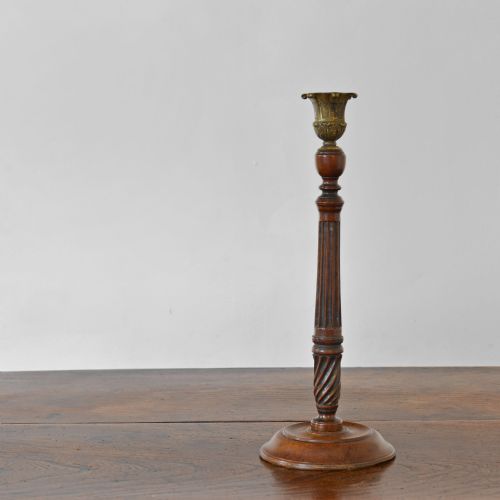


Traditional Wooden Candleholders
Traditional wooden candleholders bring warmth and hand-turned character to a room, offering a tactile connection to centuries of domestic illumination.
Traditional Wooden Candleholders
Traditional wooden candleholders encompass candlesticks, wall sconces, and candle holders shaped from timber for domestic lighting. When searching for traditional wooden candleholders, a buyer encounters forms ranging from simple turned posts to carved figures and mirrored sconces.
The selection on this page spans periods from the eighteenth century through the nineteenth century and into the nineteen-twenties. Common vernacular and revival styles include Georgian, Jacobean revival, and folk art representations.
Most examples rely on dense hardwoods like mahogany and oak, frequently paired with brass sconces or glass elements. Buyers are most likely to meet matched pairs of turned candlesticks dating from the nineteen-twenties alongside earlier Georgian or Anglo-Indian pieces.
How they were made
Craftsmen shaped these pieces using woodworking techniques such as lathe-turning to produce open barley twist or smooth columnar shafts. Other examples demonstrate hand-carving, visible in folk art figures and decorative wall sconces.
Makers integrated materials like brass for drip pans and sconce tops to protect the wooden base from melting wax. Glass and mirrored plates appear on specific wall-hanging pieces to reflect and amplify the candlelight.
Turned wooden components were joined using traditional timber construction methods suited to each period style, from eighteenth-century vernacular builds to nineteen-twenties production.
One exceptional nineteenth-century folk art pair depicts poachers carrying game right on the candle sticks.
What varies in quality
Quality in these pieces rests upon the crispness of the turning and the depth of the hand-carving. Smoother proportions and well-executed joinery distinguish finer examples from standard production.
The choice of material also dictates quality, with dense hardwoods like mahogany and figured oak holding sharper architectural details than softer timbers. Integrated brass fittings that fit snugly into the turned wooden sockets indicate careful assembly.
The Traditional Wooden Candleholders Glossary
- Candlestick
- A portable device designed to hold a single candle upright, typically featuring a base, a vertical shaft, and a nozzle or sconce.
- Barley twist
- A spiral carving resembling a twisted rope, executed on the wooden shafts of candlesticks and furniture.
- Sconce
- A candle holder designed to be mounted directly onto a wall, sometimes backed by a mirror or reflective plate.
- Vernacular
- Everyday objects made by regional craftsmen for local use, following traditional patterns rather than high-style academic designs.
- Folk art
- Utilitarian or decorative objects created by self-trained makers, often featuring expressive hand-carved human or animal forms.
Traditional Wooden Candleholders: Frequently Asked Questions
How do I date an old wooden candlestick?
Dating relies on observing the turning patterns, tool marks, timber species, and overall stylistic markers associated with specific periods like the eighteenth century or nineteen-twenties.
Secondary materials such as brass sconces and the style of construction further help narrow down the decade of manufacture.
Were wooden candleholders safe to use?
Makers incorporated metal brass sconces and drip pans at the top of the wooden shaft to prevent hot wax and flames from contacting the timber directly.
This barrier allowed wooden candlesticks to function safely during periods when open flame was the primary indoor lighting source.
How should I clean polished wood candlesticks?
Maintenance involves dusting with a soft, dry cloth and occasionally applying a mild beeswax to nourish the hardwood surface without building up residue.
Moisture and harsh chemical cleaners should be avoided to protect the historic polish and the integrity of the timber.
What is an Anglo-Indian sconce?
Anglo-Indian pieces combine British colonial forms with traditional craftsmanship and materials originating from the Indian subcontinent, such as mirrored glass panels.
These wall sconces were produced for export or for colonial households during the nineteenth century.