


Traditional Welsh Landscape Art
Traditional welsh landscape art captures mountain ranges, river valleys and coastal views through nineteenth and early twentieth century brushwork.
Traditional Welsh Landscape Art
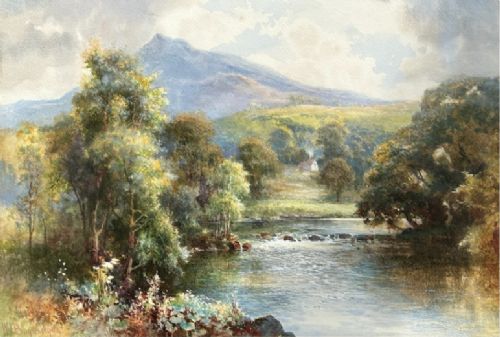
Traditional welsh landscape art brings the topography of Snowdonia, North Wales and rural valleys into framed compositions. These works record river passes, mountain peaks such as Moel Siabod, and coastal stretches like Cardigan Bay.
The selections encountered here span the nineteenth century into the twentieth century, capturing pastoral scenes and mountainous terrain through distinct regional documentation. Painters travelled through Conwy, Beddgelert and Capel Curig to record local topography.
Oil paintings on canvas and wood panel sit alongside delicate watercolour paintings on paper. These diverse mediums preserve the changing light over Welsh rivers and valleys across Victorian and Edwardian periods.
Materials and Technique
Artists built traditional welsh landscape art using oil on canvas, oil on wood panel, and watercolour on paper. Canvas supports allowed for layered brushwork in large mountainous scenes, while paper suited detailed watercolour studies.
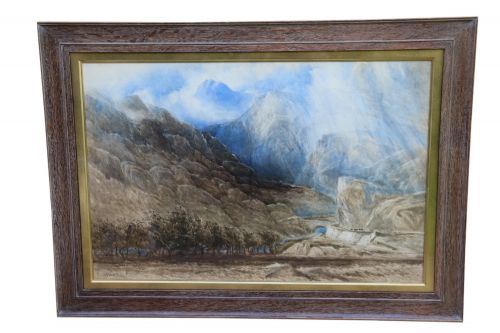
Original frames often consist of carved wood, gesso and giltwood or gilt wood mouldings that complement the palette of the paintings. These period frames secure and frame the paper and canvas supports.
The listings span the eighteenth, nineteenth and twentieth centuries, featuring oil and watercolour mediums framed in giltwood and gesso.
Factors of Quality
Quality rests in the handling of light, atmosphere and topographical accuracy across the mountain and river compositions. Superior works capture weather effects, such as passing showers over mountain ranges, with confident brushstrokes.
The prestige of the artist and the documentary value of the specific Welsh location shape the standing of each piece. Well-documented views of recognisable landmarks by established painters command greater attention.
William Joseph Boyes·Henry Martin Pope·Hubert Wellington·Sidney Richard Percy·Thomas Spinks·Charles Leslie·William Mellor·Walter J Watson·J Barclay·William Langley·Julius Caesar Ibbetson·John Cuthbert Salmon·Samuel Sidley·Henry Brittan Willis·Cornelius Pearson·Samuel Towers·Benjamin Williams Leader·Clarence Woodburn·David Bates·Thomas Swift Hutton·Charles France·Carleton Grant·John J Hamer·James Poole·William Mander
The Traditional Welsh Landscape Art Glossary
- Oil on Canvas
- A painting medium where pigments suspended in oil are applied to stretched fabric. This technique allows for rich colour blending and textured application.
- Watercolour
- A painting method using water-soluble pigments on paper supports. It produces translucent washes ideal for capturing atmospheric sky and water effects.
- Giltwood
- Wood carved and coated with a thin layer of gold leaf or metallic powder. It provides ornate framing for nineteenth century paintings.
- Gesso
- A plaster mix applied to wood frames to create a smooth surface before gilding. This mixture provides the base for decorative moulding details.
Traditional Welsh Landscape Art: Frequently Asked Questions
What subjects appear in traditional welsh landscape art?
These works focus on mountain ranges, river valleys, castles and coastal views across Wales. Artists painted specific locations including Snowdon, the Conwy river and Cardigan Bay.
Scenes frequently incorporate local figures, cattle or farm workers to give a sense of scale to the vast terrain.
Which periods do these paintings represent?
The available works date principally from the nineteenth century through to the mid-twentieth century. Victorian and Edwardian periods are strongly represented by regional artists.
Pieces range from late eighteenth century studies up to works created during the nineteen forties.
How do oil and watercolour works differ?
Oil paintings utilise heavy pigments on canvas or wood panels, allowing for textured brushwork and deep colour saturation. They offer robust durability and dramatic lighting effects.
Watercolours employ delicate washes on paper to capture atmospheric transparency, requiring protective glass framing to preserve the surface.
How should I display framed landscape paintings?
Hang these works away from direct sunlight to protect delicate watercolours and oil pigments from fading over time. Stable room temperatures prevent warping in nineteenth century wood panels and giltwood frames.
Pairing pieces with traditional room aesthetics highlights the period character of the gesso and gilt mouldings.