


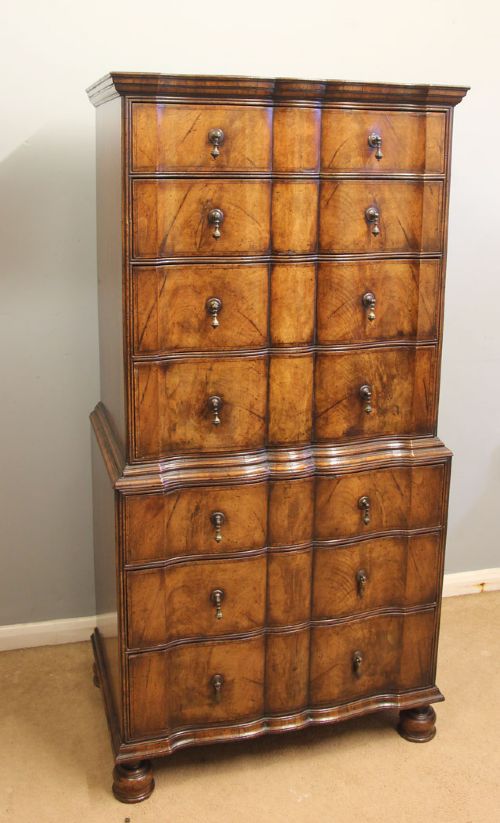


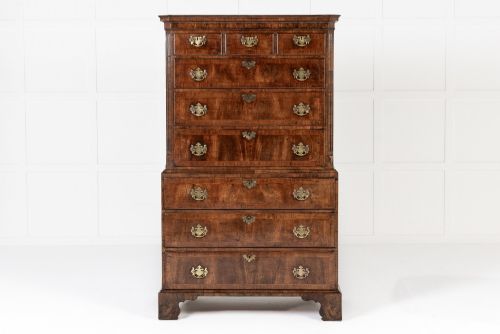


Traditional Walnut Highboy
A traditional walnut highboy brings vertical storage and rich timber grain to a room, offering practical elegance for the collector of period furniture.
Traditional Walnut Highboy
When you search for a traditional walnut highboy, you are looking at tall case furniture designed to hold garments while occupying a modest floor footprint. These pieces typically take the form of a chest on stand or a taller chest on chest, combining upper and lower sections for substantial capacity.
You are most likely to meet examples spanning the seventeenth, eighteenth, and nineteenth centuries, along with later revivals from the early twentieth century. These variations encompass styles from William and Mary through Queen Anne, George II, and George III, reflecting shifts in leg shapes, cornices, and drawer arrangements over generations.
Materials and Construction
Cabinetmakers built these tall pieces primarily using solid walnut, oak as a secondary structural timber, and occasionally fruitwood. Selected sections frequently featured burr walnut or figured walnut veneers to create striking patterned surfaces across the drawer fronts and primary panels.
Construction methods relied on stable carcase framing and dovetailed drawer boxes designed to withstand the weight of multiple stacked compartments. Brass drop handles and escutcheons were fitted to secure the drawers, with stands often supported on cabriole legs or barley twist turnings.
Traditional Walnut Highboy Retail Price Guide 2026
Typical asking prices for traditional walnut highboy among the pieces listed under this phrase on Sellingantiques today, from the lower quarter to the upper quarter. They describe what is for sale here now, not the wider market.
Listings for this phrase include examples incorporating walnut, burr walnut veneer, oak, fruitwood, and brass hardware across multiple centuries.
Assessing Quality and Character
The division between standard examples and the finest pieces rests upon the choice of timber veneer and the crispness of the cabinetwork. Grain matching across drawer fronts and the depth of colour in the walnut surface indicate the maker's original ambition.
Proportion and the retention of original brass hardware or structural stands dictate the enduring integrity of the piece. Subtle details in the moulding and the preservation of the underlying oak carcase separate honest period examples from later interpretations.
The Traditional Walnut Highboy Glossary
- Chest on stand
- A form comprising a lower support frame with legs carrying a smaller upper drawer section. This design lifts the storage off the floor and creates a lighter profile than a standard chest.
- Burr walnut
- A specialised timber cut from the abnormal growth knots of the walnut tree. It yields highly figured, swirling patterns prized for decorative veneer work.
- Tallboy
- A tall chest of drawers made in two stacked sections, often combining a lower chest with a slightly narrower upper chest. The configuration maximises vertical capacity.
- Marquetry
- The art of forming decorative patterns using fitted pieces of wood veneer. Artisans applied contrasting timbers to create floral or geometric designs across the surface.
Traditional Walnut Highboy: Frequently Asked Questions
Where should I place a traditional walnut highboy?
These tall pieces suit bedrooms, hallways, or living spaces where vertical storage is required without sacrificing floor area. Their substantial height makes them a focal point against a plain wall.
Ensure the room has stable humidity levels to protect the timber and veneer surfaces from extreme temperature shifts over time.
How do I clean a walnut surface safely?
Dust the timber regularly with a soft, dry cloth to prevent particulate buildup on the polished grain. Avoid chemical sprays or silicone polishes that can degrade the traditional finish.
Apply a microcrystalline wax sparingly once or twice a year if the surface appears dry, buffing gently to maintain the natural lustre.
Can I store heavy items inside?
The upper and lower drawers handle everyday garments, linens, and accessories comfortably within their original structural limits. Distribute weight evenly across the base of each drawer to protect the internal runners.
Avoid overloading deep compartments, particularly in older or revival pieces where the drawer bottoms rely on traditional thin timber panels.