




Traditional Solitaire Ring
A traditional solitaire ring carries a single prominent stone that draws the eye directly to the craftsmanship of its setting.
Traditional Solitaire Ring
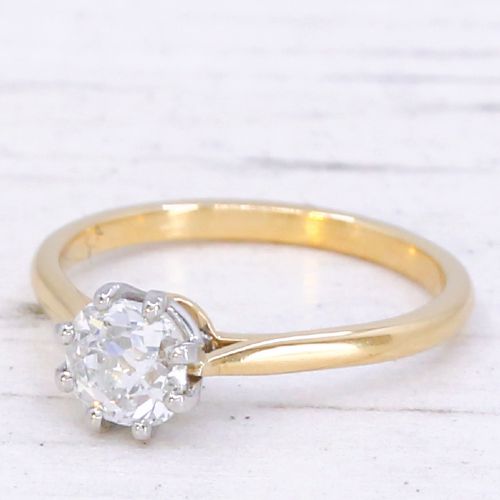
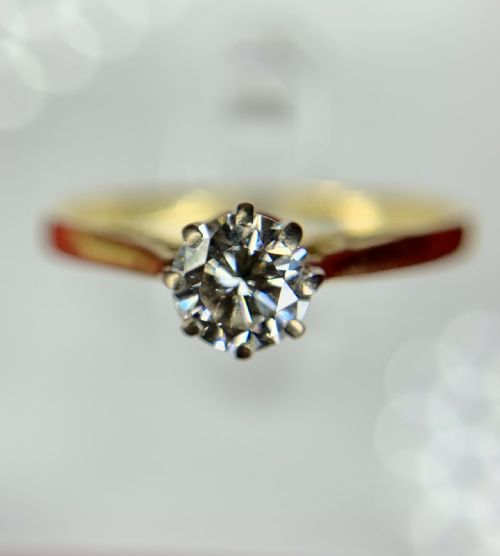
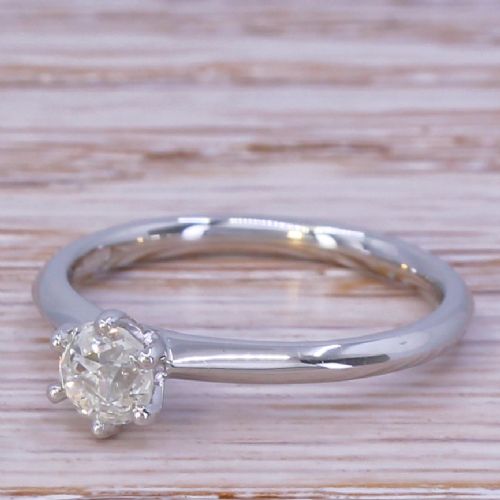
A traditional solitaire ring focuses attention entirely upon one central gemstone mounted on a precious metal band. These pieces encompass engagement rings spanning the Victorian, Edwardian, Art Deco, Mid-Century, and vintage eras.
The selections encountered here range from early Victorian claw-set opals and mine-cut diamonds to mid-century platinum and yellow gold mountings. Each piece demonstrates the enduring appeal of single-stone design across successive decades of jewellery manufacturing.
How they were made
Metals such as platinum, 9ct, 18ct, and 22ct gold form the foundations of these rings, often combining white and yellow gold or platinum mountings to enhance the appearance of the central gem. Stones are secured using traditional claw settings or illusion settings that visually expand the focal point.
Cut styles reflect the technological methods of their respective periods, moving from hand-cut old mine and old cushion cuts in Victorian and 1920s examples to cleaner faceted diamonds in later mid-century items.
The listings span periods from Victorian and 1900 through to the 1960s, utilising platinum and gold alongside diamonds and opals.
What varies in quality
Quality differences emerge in the weight, cut precision, and clarity of the central diamond, opal, or ruby, alongside the structural integrity of the metal band and prongs. Certified stones provide documented assessments of colour and clarity grades.
The finesse of the metalwork, from delicate Edwardian gallery wirework to robust Victorian claw settings, dictates the overall refinement and durability of the mounting.
The Traditional Solitaire Ring Glossary
- Old cut
- A diamond facet style popular in antique pieces, featuring a smaller table and larger culet that produce a distinctive candlelit sparkle.
- Claw set
- A mounting technique where metal prongs hold the gemstone securely while allowing maximum light to enter from the sides.
- Illusion set
- A mounting style where the metal surrounding a smaller diamond is faceted or polished to trick the eye into perceiving a larger stone.
- Mine cut
- An early diamond cutting style characterised by a cushion shape, high crown, and deep pavilion, typically found in pieces predating the twentieth century.
Traditional Solitaire Ring: Frequently Asked Questions
How do I date a traditional solitaire ring?
Dating relies upon examining the cut of the central gemstone, the alloy marks, and the structural style of the setting. Victorian pieces often display hand-cut stones in heavy gold claws, while Art Deco examples favour geometric platinum mountings.
Maker marks, hallmarking conventions, and gemological reports further narrow the period of manufacture, distinguishing nineteenth-century examples from mid-century productions.
Are these rings suitable for daily wear?
Most traditional solitaire rings are robust enough for everyday use, provided the metal band and stone settings remain sturdy. Platinum and higher-carat golds offer strong foundations, though antique claw settings benefit from periodic professional inspection.
Opal rings require greater care than diamond examples due to the softer nature of the gemstone, necessitating removal during rigorous physical tasks.
What is an old cut diamond?
An old cut diamond refers to stones shaped by hand before modern automated laser cutting was established. These diamonds possess a smaller table and a deep pavilion designed to catch ambient light effectively.
Such stones exhibit a warm, charming luminescence rather than the intense geometric brilliance associated with modern brilliant cut diamonds.