



Traditional Mahogany Vanity Table
A traditional mahogany vanity table brings rich timber grain and period craftsmanship into a bedroom, offering a surface for morning routines.
Traditional Mahogany Vanity Table
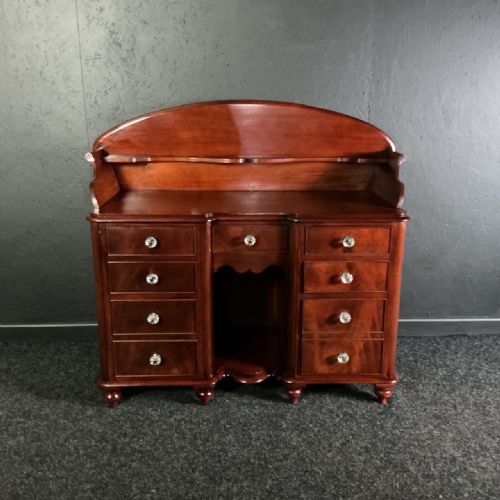
When you search for a traditional mahogany vanity table, you encounter dressing tables, kneehole desks, washstands and companion stools spanning the eighteenth to the early twentieth century. Pieces range from grand Georgian serpentine designs to compact Edwardian washstands and Victorian pedestal dressing tables.
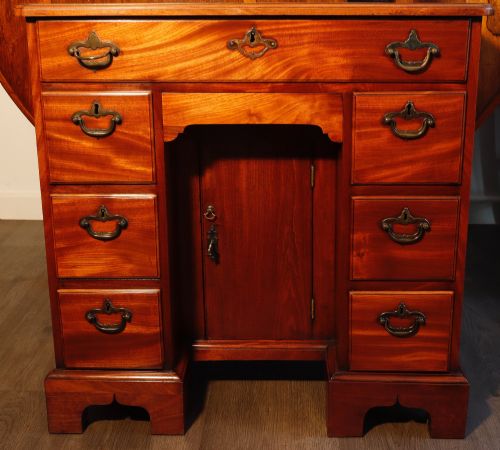
The selection on this page demonstrates various regional and period interpretations, including Chippendale style carved stools and George II style kneehole desks. These items serve multiple domestic functions, operating variously as writing surfaces, wash stations and mirrors.
Most examples rely on mahogany timber, frequently enhanced with flame mahogany veneer, wood inlay and brass fittings. Buyers will find that dressing mirrors and matching stools complete the broader category of bedroom furniture.
Materials and construction methods
Cabinet makers utilised solid mahogany and flame mahogany veneer over secondary timbers, applying wood inlay to define panels and drawer fronts. Structural stability often depended on precise joinery, while brass handles and hinges provided durable hardware.
Surfaces were frequently polished to highlight the grain patterns of the wood, and seating components incorporated upholstery materials such as wool and fabric. Washstands occasionally integrated marble tops to resist water during daily use.
Early cabinet makers occasionally hid secret compartments inside kneehole desks to guard morning letters from prying eyes.
Distinguishing quality across examples
Quality separates pieces through the depth of the mahogany grain and the precision of the wood inlay or carving. Finer examples display symmetrical flame mahogany veneers and intricate hand-carved details, particularly on Chippendale style elements.
The integration of original brass hardware and the crispness of structural mouldings indicate superior workshop production. Tables and desks that retain their matching dressing mirrors or period stools demonstrate higher integrity within the category.
The Traditional Mahogany Vanity Table Glossary
- Flame mahogany veneer
- A thinly sliced section of timber exhibiting a distinctive flickering flame-like grain pattern. Cabinet makers applied this to prominent surfaces like drawer fronts for visual impact.
- Kneehole desk
- A compact desk or dressing table featuring a central recess for the knees, flanked by pedestals of drawers. Georgian and later makers produced these with detailed brass hardware.
- Washstand
- A utilitarian piece of furniture designed to hold a basin and jug for personal washing. Many examples from the period incorporate marble tops to protect the wooden structure.
- Serpentine
- A furniture outline characterised by a wavy line with a convex centre flanked by concave curves. This contour appears frequently on eighteenth-century dressing table mirrors and desks.
Traditional Mahogany Vanity Table: Frequently Asked Questions
What is a traditional mahogany vanity table?
A traditional mahogany vanity table encompasses period dressing tables, kneehole desks and associated mirrors used for grooming and writing. These items date from the eighteenth to the early twentieth century.
They utilise rich timber and veneer work, often accompanied by matching stools upholstered in fabric or wool.
How do I identify a Georgian piece?
Georgian pieces display characteristic proportions, often utilising solid mahogany with understated wood inlay and serpentine fronts. Brass handles are typically original to the period.
Construction methods reflect eighteenth-century workshop practices, prioritizing structural joinery and symmetrical grain selection.
Where were washstands used?
Washstands served as functional bedroom furniture for personal hygiene before modern plumbing became standard in homes. They held basins, jugs and occasionally incorporated marble tops for water resistance.
Over time, many of these tables transitioned into general display or vanity use within period interiors.
What wood is used on these tables?
Mahogany serves as the primary timber across the category, frequently accented with flame mahogany veneer for enhanced visual depth. Secondary woods provide internal structure for drawers and frames.
Inlays of contrasting wood and brass hardware frequently complement the main timber body.
Are matching stools common?
Matching stools appear alongside dressing tables and desks across several periods, including Victorian and Edwardian examples. They often feature cabriole legs and upholstered seats.
These auxiliary pieces complete the dressing set, utilising the same mahogany framing as the main table.