


Edwardian Mahogany Dressing Chest
When you want an edwardian mahogany dressing chest, you are looking at timber furniture that combines a deep reddish-brown grain with practical bedroom storage and pivoting mirror glass.
Edwardian Mahogany Dressing Chest
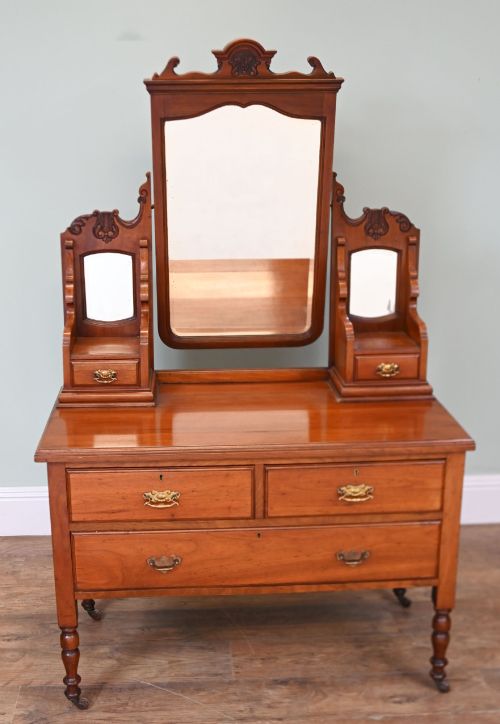
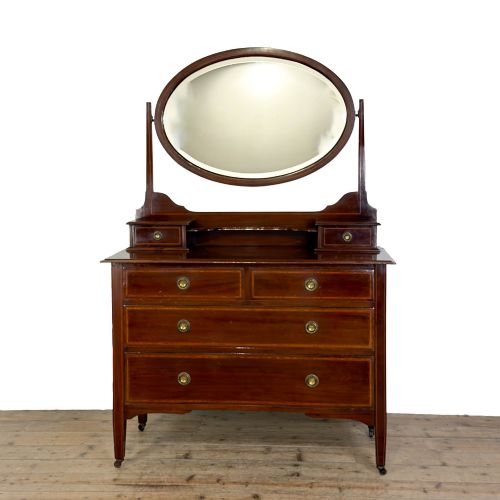
An edwardian mahogany dressing chest is a functional bedroom piece that bridges the gap between a chest of drawers and a dressing table. Most examples encountered here date from the Edwardian period and the early twentieth century, though late Victorian variants also appear regularly in the listings.
The form typically comprises a lower section with multiple graduated drawers topped by a mirror superstructure. While many use the term interchangeably with dressing tables, these chests often retain a sturdier, more upright proportion designed for everyday chamber use.
Materials and Construction
Makers built these pieces primarily from solid mahogany and mahogany veneers, frequently incorporating contrasting lighter timbers for detail. Satinwood inlay and walnut crossbanding appear across the drawer fronts and surfaces to create decorative borders.
Functional elements rely on brass for handles, fittings and casters, while mirror glass provides the reflective surface for the adjustable shields. Velvet occasionally lines smaller compartments, such as jewellery boxes associated with these bedroom suites.
Secondary materials recorded include satinwood inlay, walnut crossbanding, brass hardware, and velvet linings.
Defining Quality
The division between standard and superior pieces rests on the complexity of the timber selection and the precision of the cabinet work. Pieces featuring serpentine fronts, intricate marquetry inlay or matched walnut crossbanding represent a higher tier of workshop production.
Structural harmony also dictates value, particularly in how the mirror superstructure integrates with the base drawers. Finer examples display well-figured mahogany grains and robust secondary woods within the drawer linings rather than relying on heavy surface stain alone.
Edwards & Roberts·Whytock & Reid
The Edwardian Mahogany Dressing Chest Glossary
- Satinwood Inlay
- A decorative technique where small pieces of pale satinwood are inserted into the darker mahogany surface to form contrasting geometric or floral patterns. This ornamentation defines many Edwardian bedroom pieces.
- Shield Mirror
- A dressing glass shaped like an upright heraldic shield, typically mounted on pivoting side arms to allow angle adjustment. These swing mirrors sit atop the main chest body.
- Crossbanding
- A border veneer applied around the edges of a drawer front or tabletop so that the wood grain runs perpendicular to the central panel. It frames the primary timber.
- Serpentine Front
- A furniture facade featuring a gentle concave centre flanked by convex curves. This undulating shape requires advanced woodworking skill.
- Graduated Drawers
- A set of drawers arranged vertically where each tier decreases in depth from bottom to top. This proportion provides stability and visual balance to the chest.
Edwardian Mahogany Dressing Chest: Frequently Asked Questions
What is a dressing chest?
A dressing chest is a hybrid piece of bedroom furniture that combines a chest of drawers with a mounted dressing mirror. It provides both clothes storage and a surface for personal grooming.
Unlike standard dressing tables with open kneeholes, dressing chests usually feature full-width drawers running all the way down to the base.
How do I date an edwardian mahogany dressing chest?
Dating relies on stylistic markers such as satinwood inlay, brass hardware designs, and the presence of bevelled mirror glass supported by upright arms. Most pieces date from around nineteen hundred to nineteen ten.
Earlier transitional pieces often show late Victorian proportions, while later examples from the nineteen twenties lean towards simpler revival styles.
Can I remove the mirror?
Most mirrors detach easily from the main chest by unscrewing the side pivot pins or removing brackets from the backboards. This makes transport significantly easier.
Removing the superstructure temporarily transforms the piece into a standard chest of drawers if room layouts require a lower profile.
How do I care for mahogany furniture?
Maintain mahogany surfaces by dusting regularly with a dry, soft cloth and avoiding silicone-based polishes that build up a hazy film. Keep the wood away from direct heat sources and strong sunlight to prevent the rich red tone from fading.
Occasional application of traditional beeswax helps nourish the grain and protects the antique finish.