
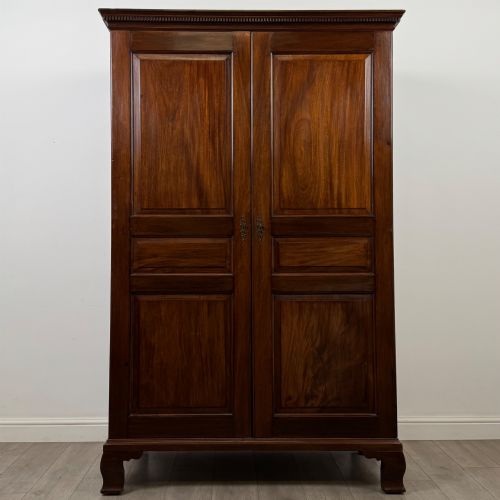
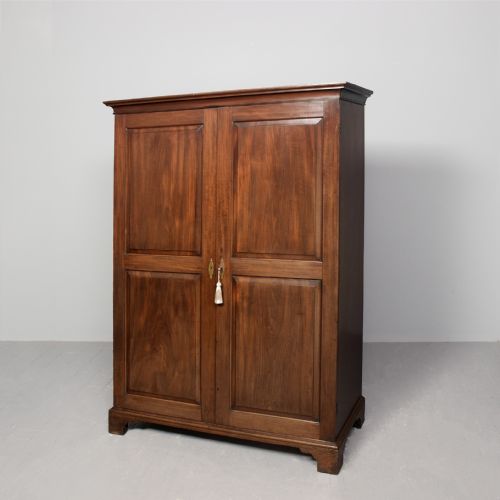
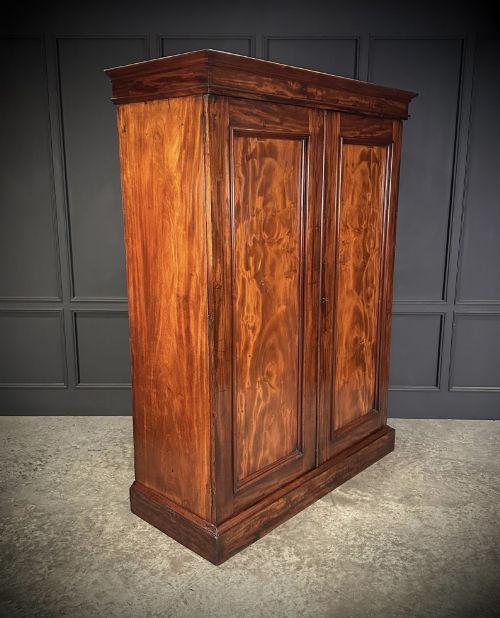
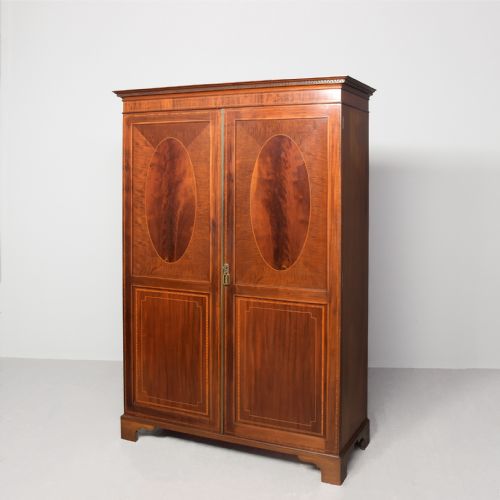
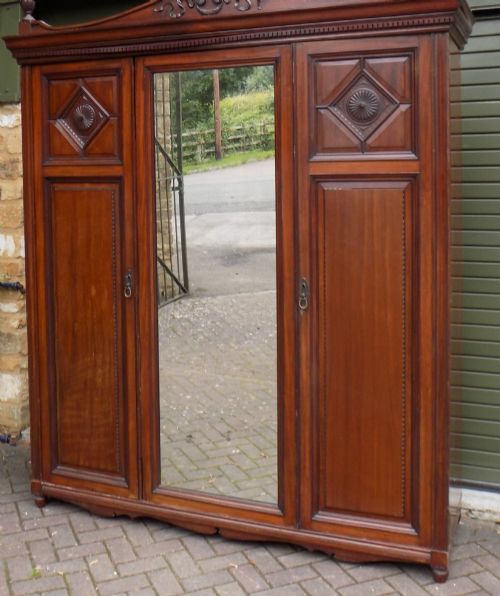
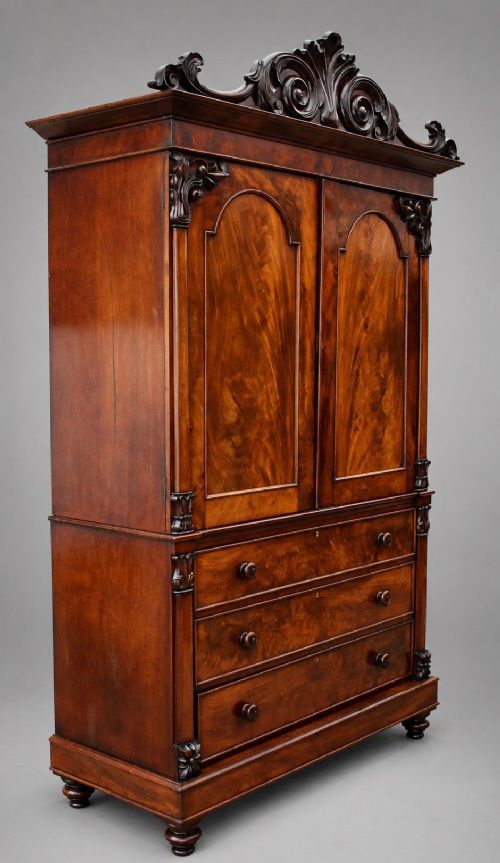


Traditional Mahogany Clothes Armoire
These traditional mahogany clothes armoire pieces offer deep timber tones and stately storage, built to anchor a proper bedroom.
Traditional Mahogany Clothes Armoire
When you search for a traditional mahogany clothes armoire, you encounter grand furniture built to store garments and linen across the eighteenth, nineteenth and early twentieth centuries. The pieces on this page span Georgian, Regency, William IV and Victorian eras, taking the form of large wardrobes, linen presses and compactums.
You are most likely to meet substantial double or triple door wardrobes alongside linen presses featuring sliding trays behind upper doors. These substantial items originate from British and continental workshops, reflecting shifts in domestic storage from stacked linen to hanging garments.
Materials and construction methods
Cabinet makers utilised solid mahogany and rich flame mahogany veneer over secondary timbers such as oak, often selecting Cuban mahogany for its density and deep grain pattern. Boxwood inlay frequently frames panels and doors, adding linear contrast to the dark timber surfaces.
Structural integrity relied on panel and frame construction, dovetail joints within interior drawers and heavy brass hardware securing the large doors. Glass panelling and carved details appear on select examples, supported by substantial plinths and cornice mouldings.
Periods represented span the eighteenth century through the Edwardian era and 1950.
Distinguishing quality across periods
Quality separates pieces through the selection of timber veneers and the crispness of inlaid boxwood lines. Figured flame mahogany requires expert sawing to bookmatch grain patterns symmetrically across wide wardrobe doors, marking out superior cabinet work.
Internal configuration and drawer construction also dictate standard. Pieces featuring well-fitted linen slides, original brass handles and clean secondary oak timbers sit above later or heavily altered examples.
The Traditional Mahogany Clothes Armoire Glossary
- Linen press
- A tall piece of furniture comprising upper doors enclosing sliding trays for folded textiles above a base of deeper drawers. This form evolved to protect household linens from dust before hanging wardrobes became standard.
- Flame mahogany
- A veneer cut from timber where branches met the main trunk, producing a distinctive rippled flame pattern. Cabinet makers used this veneer symmetrically on primary display surfaces.
- Compactum
- A fitted wardrobe designed with internal compartments, hanging space and drawers combined into a single footprint. This form maximised storage efficiency in bedrooms of the late nineteenth and early twentieth centuries.
- Boxwood inlay
- Narrow strips of pale boxwood set flush into dark mahogany surfaces to create geometric borders and lines. This decorative technique highlights panel edges and cornices.
- Breakfront
- A cabinet facade where the central section projects forward from the flanking wings. This architectural arrangement creates depth and shadow on large wardrobes.
Traditional Mahogany Clothes Armoire: Frequently Asked Questions
How do I fit a large wardrobe?
Measure your ceiling height and stair clearance carefully before bringing a large wardrobe into a historic home. Many of these pieces dismantle into sections to ease transport and placement.
Ensure the room has sufficient floor space for the heavy doors to swing fully open without hitting skirting boards or adjacent furniture.
What is a linen press?
A linen press is a traditional storage piece featuring sliding wooden trays behind the upper doors for folded garments and linens. The lower section typically contains two or more drawers for heavier items.
These pieces offer versatile storage options for modern bedrooms where hanging space is less critical than shelf space.
How do I clean mahogany?
Dust timber surfaces regularly with a soft, dry cloth to prevent dirt accumulation in the grain. Avoid silicone sprays and modern polishes that build up a hazy film over the wood.
Apply a traditional beeswax sparingly once or twice a year to nourish the timber and maintain a soft, natural sheen.
How do I date a wardrobe?
Examine the construction methods, timber choice, and hardware style to determine the likely period of manufacture. Georgian pieces often feature simpler bracket feet and hand-cut dovetails, while Victorian examples display heavier mouldings and breakfront facades.
Look at internal secondary woods like oak or deal to confirm the age of drawer linings and back panels.