


Traditional Library Stool
These traditional library stool items are sturdy wooden steps and ladders designed for reaching high shelves in private studies and large rooms.
Traditional Library Stool
When you search for a traditional library stool, you are looking at items designed to help readers reach elevated bookshelves in domestic studies or institutional libraries. The inventory ranges from compact step stools to tall ladders and metamorphic chair combinations.
The pieces appearing on this page span the nineteenth century and the early twentieth century, taking in Victorian, Edwardian, and Regency aesthetic traditions alongside utilitarian and rustic examples. Materials lean heavily towards oak and mahogany, frequently complemented by leather treads.
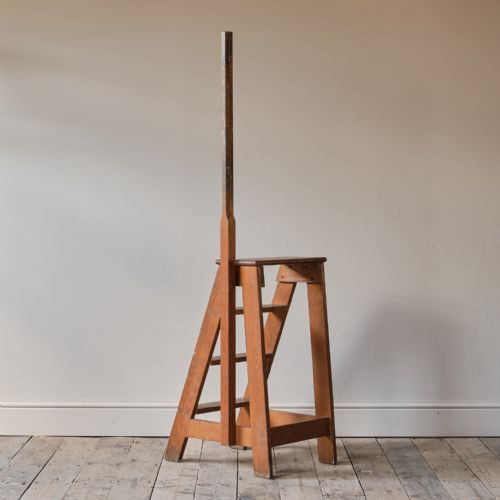
You will encounter straightforward sets of wooden steps alongside more specialised forms like spiral library steps and painted pine ladders. Occasional armchairs and footstools also appear, reflecting the wider seating arrangements found alongside tall bookcases.
How traditional library stool pieces were made
Carpenters and joiners built these items using dense timbers such as oak, mahogany, pine, and mixed hardwoods to ensure stability under weight. Frames often incorporated brass hardware for hinges or folding mechanisms on metamorphic designs.
Treads were frequently inset with leather to provide grip and reduce wear from footwear during daily retrieval of heavy volumes. Finishes range from polished golden oak and dark mahogany to painted surfaces on rustic utility pieces.
Listings span periods from the nineteenth century through the 1930s, featuring oak, mahogany, pine, and leather materials.
What varies in quality
The standard of a piece rests on the selection of timber and the precision of the joinery used in the uprights and treads. Dense golden oak and finely figured mahogany demonstrate a higher grade of manufacture than utilitarian pine or general hardwood.
Detailing such as hand-tooled leather inserts on the steps and the smooth operation of folding or metamorphic actions separate simpler utility ladders from more refined domestic furnishings.
The Traditional Library Stool Glossary
- Metamorphic
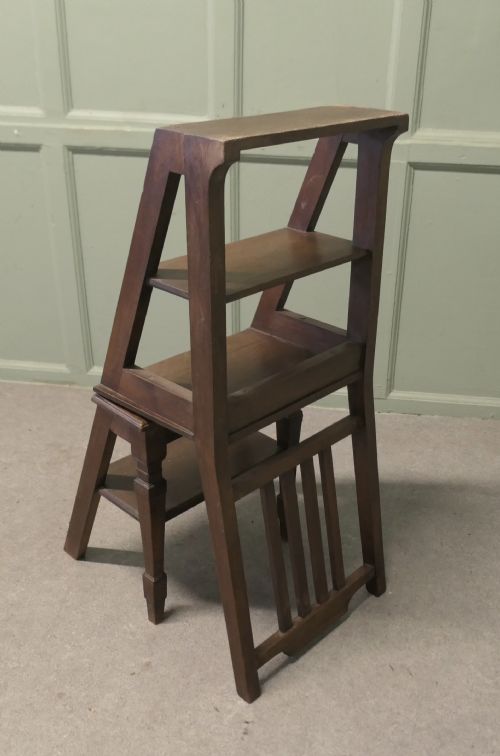
- Furniture designed to transform from one object into another, such as library steps that fold down into a chair.
- Tread
- The horizontal surface of a step upon which a person places their foot when climbing.
- Mahogany
- A durable, reddish-brown tropical hardwood frequently utilised in fine cabinet making during the eighteenth and nineteenth centuries.
- Golden Oak
- A light, warm-toned variety of oak timber popular in furniture production during the late Victorian and Edwardian eras.
- Wingback Armchair
- An upholstered seat featuring protective side panels originally designed to shield the occupant from draughts.
Traditional Library Stool: Frequently Asked Questions
What are library steps used for?
These steps provide safe elevation to reach books shelved near the ceiling in high-ceilinged rooms.
They combine practical utility with sturdy timber construction suited to regular domestic use.
How do I date a set of steps?
Dating relies on identifying the primary wood species, construction methods, and stylistic cues like Victorian or Edwardian turning.
Evidence from the period helps link specific finishes and brass hardware designs to particular decades.
Are these steps safe to climb?
Most examples are built from solid oak or mahogany and remain structurally robust for daily climbing.
Checking the rigidity of the joints and the condition of the treads ensures safe continued use.
What is a metamorphic ladder?
A metamorphic piece cleverly conceals its primary function by shifting shape between a seating option and a set of steps.
These dual-purpose items served space-saving functions in compact studies.