



Traditional Harbour Scene
A traditional harbour scene captures coastal life through maritime paintings spanning the nineteenth and twentieth centuries.
Traditional Harbour Scene
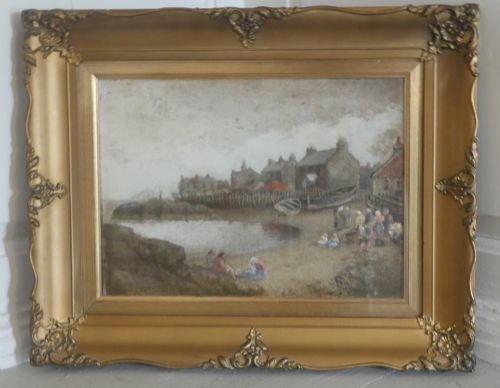
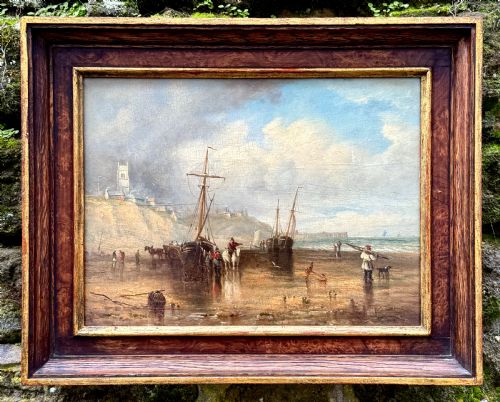
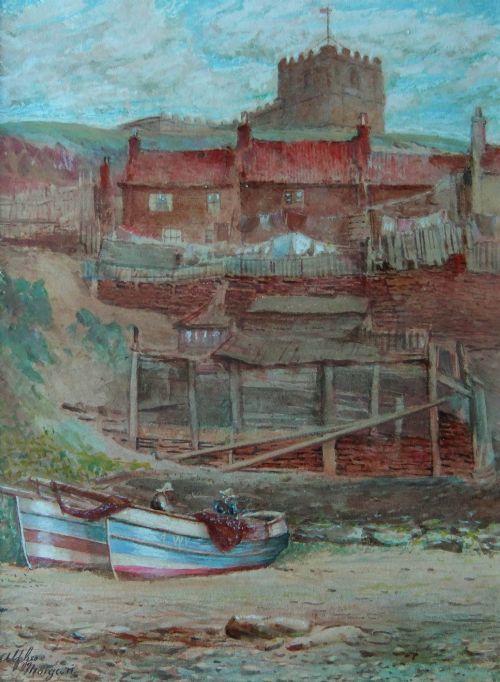
A traditional harbour scene depicts coastal life, fishing boats, and bustling ports executed in oil or watercolour. These works record maritime activity across British and European coastal locations.
Nineteenth century and early twentieth century examples dominate the selection, ranging from detailed Victorian maritime compositions to atmospheric post-impressionist views.
Works appear on canvas, panel, paper, or board, frequently presented in period gilt wood frames that complement the maritime subject matter.
Materials and technique
Artists employed oil paint on canvas or panel to build rich textures and luminous effects, particularly when rendering water and evening light.
Watercolour on paper enabled fluid washes and fine detail, favoured by artists recording specific coastal towns and harbour architecture.
Frames utilise carved and gilded wood, protecting the painted surface while defining the visual boundary of the maritime composition.
Several artists braved stormy northern seas to capture fishing trawlers returning with the catch, proving that great maritime art requires wet boots.
What distinguishes finer examples
Atmospheric depth and mastery of light separate accomplished maritime works from routine topographical views, particularly in the handling of water and changing skies.
The precision of brushwork and confidence in composition determine the strength of a piece, whether capturing choppy seas or calm evening waters.
Original framing and documented provenance enhance an artwork, preserving the integrity of the period piece.
William Banks Fortescue·Thomas Creswick·Alfred G Morgan·William Edward Webb·Arthur Tucker·James Kyd·John Bell·James Webb·John Callow·Ralph Todd·Walter Sweet·Jane Vivian·Hubert Thornley·Charles France·Robert Leslie Howey·Edward Fletcher·William Dommersen
The Traditional Harbour Scene Glossary
- Seascape
- A work of art depicting the sea or marine subjects. These paintings focus on coastal views, shipping, and harbour life.
- Watercolour
- A paint consisting of colour suspended in a water-soluble vehicle. It is typically applied to paper to create translucent washes.
- Oil on Canvas
- Pigment mixed with drying oil applied to a woven fabric support. This technique allows for rich colour blending and textured brushwork.
- Gilt Wood
- Timber decorated with a thin layer of gold leaf. Frames finished this way were standard for nineteenth-century fine art.
- Genre Painting
- Depiction of aspects of everyday life by subjects drawn from ordinary people. In maritime contexts, this includes fishermen and port workers.
Traditional Harbour Scene: Frequently Asked Questions
Where were these harbour scenes painted?
Artists recorded coastal locations across Britain and Europe, including Cornish fishing ports like St Ives and Newlyn, Yorkshire coastal towns, and continental ports such as Rotterdam and Venice.
Specific geographical titles often identify the exact harbour, jetty, or estuary depicted by the artist.
How should I hang an oil painting?
Display paintings away from direct sunlight and fluctuating heat sources to protect both the canvas and the original gilt wood frame.
Ensure the wall fixings match the weight of the framed artwork and support it securely from the picture wire.
What periods do these paintings represent?
The works span from the early nineteenth century through to the mid-twentieth century, capturing shifting artistic styles from Victorian fine art to post-impressionism.
Nineteenth-century pieces often reflect maritime romanticism, while later works adopt looser brushwork and brighter palettes.
Are these watercolours framed under glass?
Watercolour paintings on paper require glass protection to shield the delicate pigments from dust, moisture, and atmospheric pollutants.
Original frames on these watercolours often feature hand-enamelled or gilt detailing appropriate to their period.