
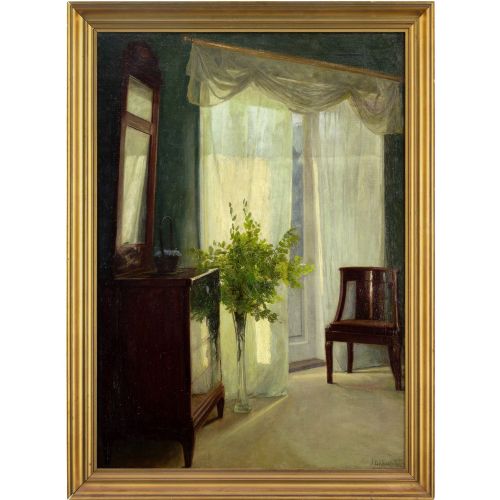


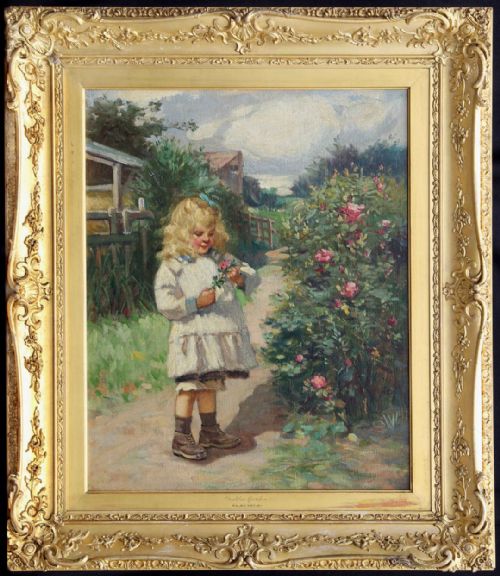


Traditional Garden Oil Painting
These traditional garden oil painting works bring the quiet charm of historical horticultural scenes into your interior spaces.
Traditional Garden Oil Painting
A traditional garden oil painting captures outdoor plantings, country houses, and walled flower spaces using historical fine art mediums. These pieces range from intimate pastoral studies to detailed Victorian genre scenes featuring figures amongst herbaceous borders.
You will encounter works originating across the nineteenth and early twentieth centuries, including British Impressionism and Scandinavian Realism styles. Subjects span from sunlit cottage doors to expansive rural landscapes rendered by named artists and regional schools.
Materials and construction
Painters utilised oil paint applied directly onto stretched canvas surfaces, frequently supported by wooden stretcher frames. Many works retain their period framing executed in giltwood, gilded wood, or moulded plaster.
The application involves layered brushwork characteristic of nineteenth century and early twentieth century artistic practices. Pigments capture natural light and botanical detail across varying scales of canvas.
A persistent terrier dog stands watch in a walled garden, proving that even fine art cannot resist a good canine photobomb.
Assessing quality in historical canvases
Quality rests upon the artist's handling of light, shadow, and botanical perspective within the composition. Masterly brushwork brings depth to foliage and architectural elements, whereas lesser examples remain flat and formulaic.
The integrity of the original canvas surface and the presence of period framing contribute significantly to the standing of the work. Evidence of skilled draughtsmanship in figures and garden structures elevates the piece.
John Lübschitz·John Henry Inskip·Samuel Sidley·Herbert Royle·Ernest Higgins Rigg·John Emms·Edgar Bundy·Ralph Hedley RBA·Fred Merriman·John F Pasmore·Frank Moss Bennett
The Traditional Garden Oil Painting Glossary
- Canvas
- A heavy woven fabric stretched across a wooden frame to serve as a support for oil paint. It provides a durable ground that responds well to traditional layering techniques.
- Giltwood
- Wood carved and coated with a thin layer of gold leaf or metallic gilt. This finish frequently appears on period frames enclosing nineteenth century fine art.
- Genre painting
- Artwork depicting scenes from ordinary life, often including figures engaged in everyday activities. In this context, characters are frequently placed within cultivated garden settings.
- Impressionism
- A nineteenth century painting style characterised by relatively small, thin yet visible brush strokes and an emphasis on accurate depiction of light. British practitioners adapted these principles to domestic landscapes.
Traditional Garden Oil Painting: Frequently Asked Questions
How do I date a garden oil painting?
Dating relies upon stylistic evidence, costume details of any figures depicted, and the construction methods of the canvas and stretcher. Period framing also offers helpful chronological clues.
Signatures, inscriptions, and artist records further narrow the window of creation, aligning the work with nineteenth century or early twentieth century movements.
Where should I hang these paintings?
These works suit traditional reception rooms, studies, and hallways where natural light complements the painted pastoral scenes. Pairing them with period furnishings enhances the historical atmosphere.
Avoid placing canvases in direct sunlight or areas of high humidity to protect the oil paint and canvas support from degradation.
What frames are period correct?
Giltwood and moulded plaster frames from the nineteenth and early twentieth centuries suit these canvases best. Ornate gilded mouldings are typical of Victorian fine art.
Original frames that match the age of the canvas are particularly desirable to collectors and historians alike.