
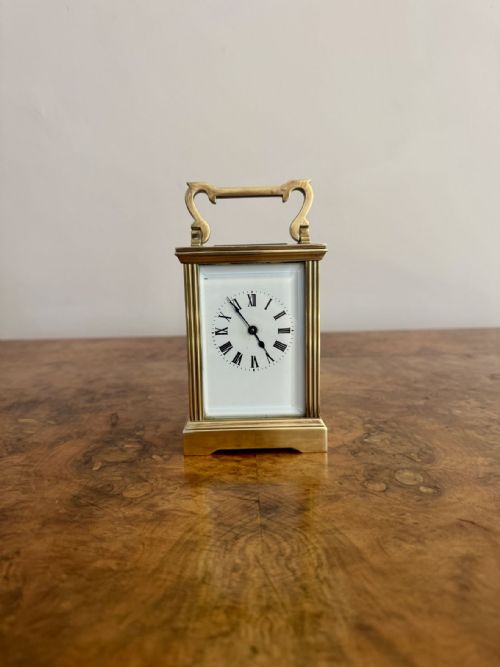


Traditional French Brass Timepiece
A traditional french brass timepiece brings weighty metal, clear glass and steady ticking into a room, offering both practical timekeeping and historic character.
Traditional French Brass Timepiece
When you search for a traditional french brass timepiece, you encounter portable carriage clocks and stationary mantel clocks spanning the nineteenth and twentieth centuries. These objects typically combine a brass case with glass panels, enamel dials and mechanical movements.
The selections available here lean heavily toward carriage clocks housed in brass frames, alongside heavier mantel designs incorporating marble, slate and gilt brass. Pieces originate from periods such as the Victorian era, the Edwardian years and the later decades of the nineteenth century.
Most examples function as desk or table clocks, often featuring eight-day movements or repeating mechanisms. Their forms range from simple oval and gorge cases to architectural four-glass mantel designs.
How they were made
Maker workshops constructed these traditional french brass timepiece objects using heavy brass casings, frequently finished with gilt or polished surfaces to frame the glass windows. Enamel dials provide the face for numerical markers, while internal brass gear trains drive the mechanical movements.
For larger mantel designs, materials such as black slate, marble and ebonised wood form substantial architectural housings that contrast with the bright metalwork. Selected models incorporate specialised housing shapes, including serpentine forms and gorge cases.
Listings feature brass, gilt brass, marble, black slate and glass across nineteenth-century and twentieth-century French and British traditions.
What varies in quality
Quality in a traditional french brass timepiece depends on the crispness of the brass casting, the weight and finish of the case, and the clarity of the enamel dial. Superior examples display refined engraving or shaping on the metal framework and smooth operation of the mechanical movement.
The presence of specialised mechanical complications, such as repeating striking mechanisms, moon phases or date work, separates standard timepieces from more sophisticated workshop productions.
TIFFANY·L Epee·Malecot of Paris·Penlington & Batty
The Traditional French Brass Timepiece Glossary
- Carriage clock
- A small, portable spring-driven timepiece designed for travel during the nineteenth century. These clocks usually feature a brass and glass case with a handle on top.
- Gorge case
- A distinct rectangular brass carriage case style with stepped mouldings on the top and bottom plates. It is a common housing for nineteenth-century French movements.
- Repeater
- A mechanical complication that strikes the hours and quarters on demand when a button or lever is pressed. This function allowed owners to check the time in darkness.
- Four glass mantel clock
- A stationary clock housed within a glass-sided case that reveals the internal movement from all sides. These pieces often sit upon marble or slate bases.
- Eight day movement
- A mechanical clock movement designed to run for eight days on a single winding. This reduced the frequency required for manual winding.
Traditional French Brass Timepiece: Frequently Asked Questions
How do I wind a carriage clock?
Most traditional french brass timepiece examples use a dedicated winding key inserted into the arbour on the backplate. Turn the key gently until resistance indicates the mainspring is fully tensioned.
Avoid overwinding the mechanism, as this places undue strain on the internal springs and gear train.
Why does my clock run fast or slow?
Mechanical clocks require regular regulation through a small adjustment lever located near the balance wheel or pendulum. Changes in temperature and age can alter the expansion of metal components.
A professional horologist can recalibrate the movement if minor adjustments at the regulator lever fail to correct the timekeeping.
How should I clean the brass case?
Dust the exterior regularly with a soft, dry cloth to prevent the accumulation of grime on the metal and glass panels. Avoid abrasive polishes that can wear away gilt finishes or damage delicate engravings.
Preserving the original surface patina maintains the historical integrity of the piece.
What is a repeating carriage clock?
A repeating movement allows the clock to strike the last elapsed hour and quarters upon pressing a plunger on the case. This served a practical purpose before electric lighting.
These mechanisms involve complex internal gearing requiring careful handling.
Where should I place a heavy mantel clock?
Position your clock on a stable, level surface such as a mantelpiece, sideboard or heavy desk. Slate and marble models carry substantial weight and require robust support.
A level surface ensures the mechanical escapement beats evenly and maintains accurate time.