
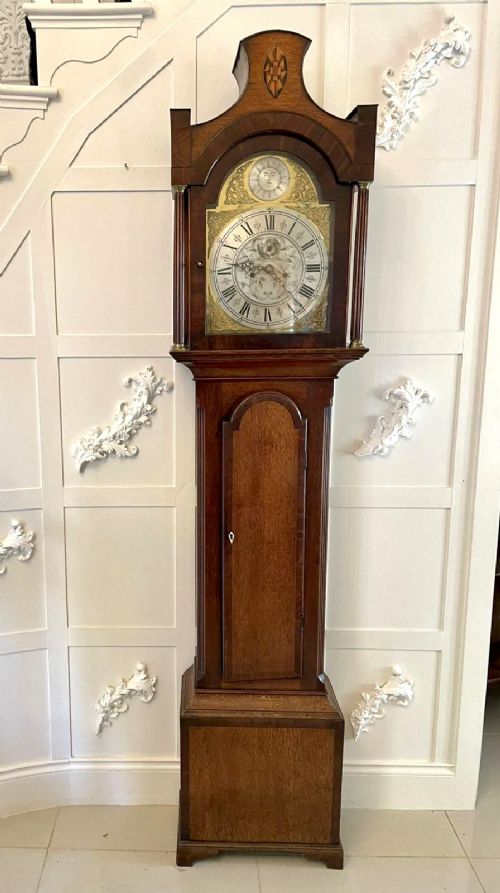
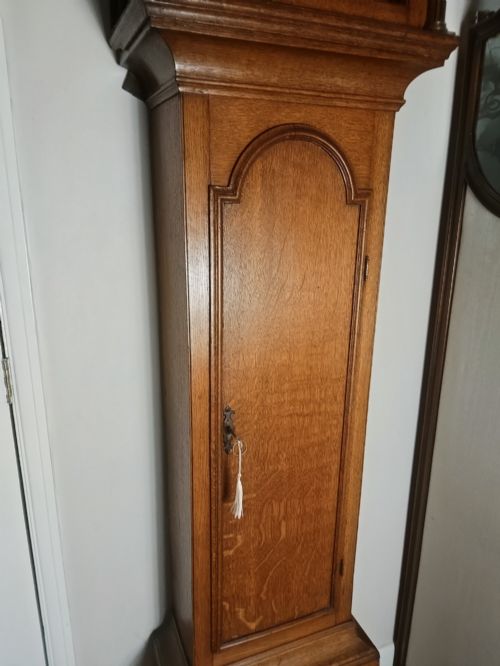
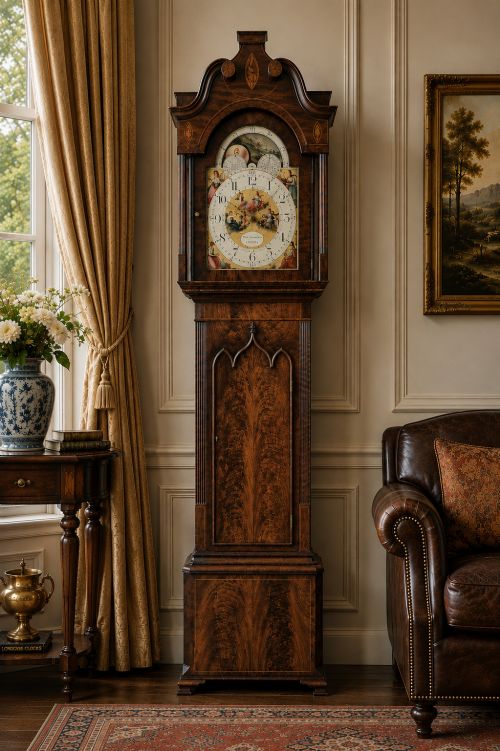
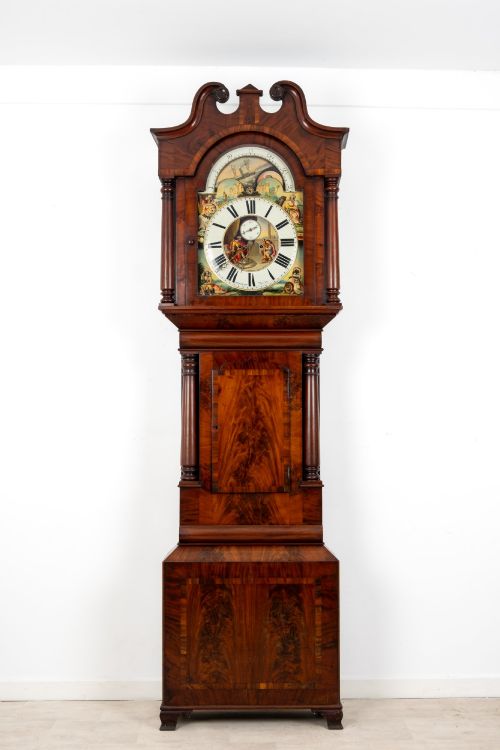
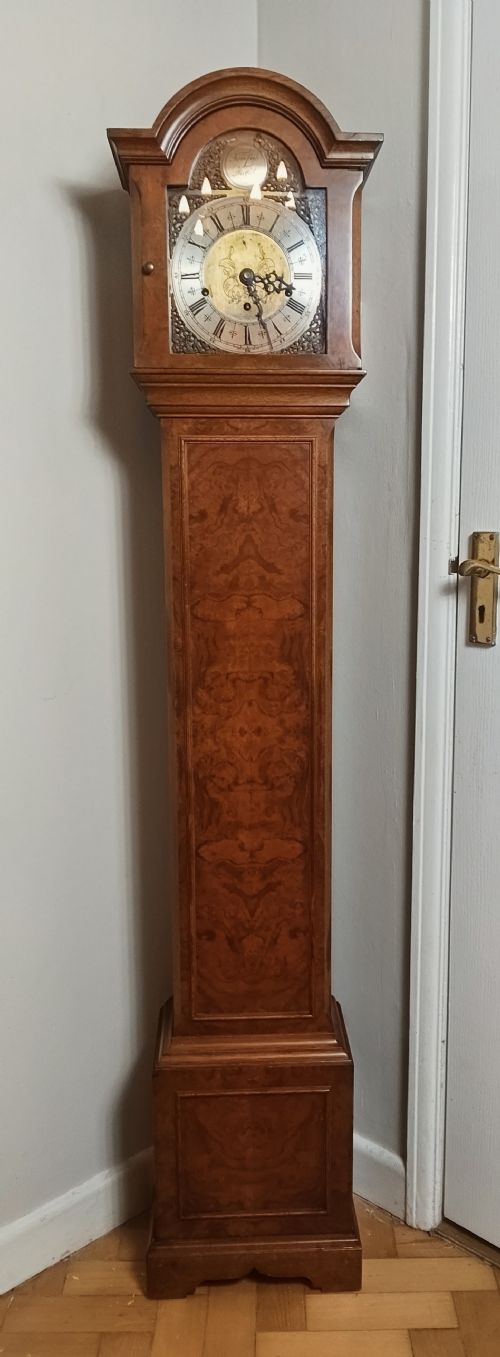
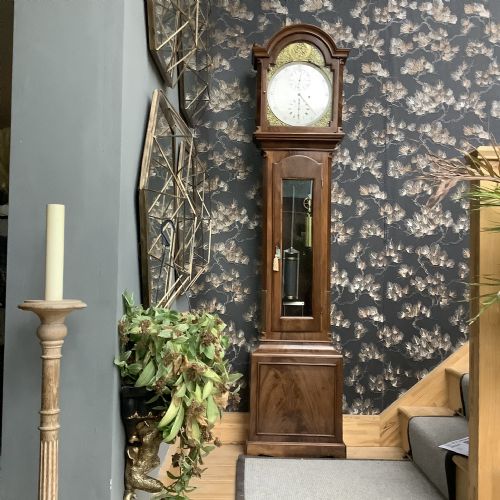


Traditional English Longcase Clock
A traditional english longcase clock marks the hours with steady rhythm, bringing grand proportion and time-honoured craftsmanship to a hallway or landing.
Traditional English Longcase Clock
A traditional english longcase clock stands tall on the floor, housing a weight-driven movement inside a fitted wooden trunk designed to protect the pendulum. These vertical timepieces appear across several periods, most notably through Georgian examples and later Victorian or early twentieth-century interpretations.
The form encompasses both full-sized grandfather clocks and smaller grandmother clocks, constructed in regional workshops as well as by metropolitan clockmakers. Oak and mahogany serve as the primary timbers, frequently accompanied by brass dials and painted iron faces.
Buyers encountering this selection will find robust oak cases from the eighteenth century alongside polished mahogany models featuring moonphase dials. Later twentieth-century chiming variants and occasional lacquered finishes also populate the offerings.
How they were made
Cabinetmakers built the wooden cases using solid timbers like oak, mahogany, and burr walnut, employing precise joinery to house the long pendulum and falling weights safely. Wood surfaces were polished, waxed, or occasionally finished with decorative lacquer schemes.
Horologists constructed the interior movements from brass and steel components, integrating gear trains for timekeeping, striking mechanisms, or musical chimes. Faces combined engraved brass chapter rings, cast spandrels, and hand-painted iron dials displaying phases of the moon.
Some models include a penny moon complication, a charming rustic feature where a simple painted circle tracks the lunar cycle.
What varies in quality
Quality rests in the precision of the movement and the integrity of the cabinetwork, distinguishing standard provincial timepieces from ambitious London commissions. Finer examples display crisp engraving on the brass dial, sophisticated gear trains with musical or moonphase complications, and well-figured timber.
Proportion and execution define the visual appeal, where balanced hood designs and harmonious dial layouts separate standard utility clocks from exceptional collector pieces. Original components and signed movements retain greater character compared to heavily restored assemblies.
Samuel Kellett of Bredbury·Parkinson Bros Batley·Thwaites London·Handley And Moore Of London·John Wylde Nottingham·Richard Alexander Devizes·James Coster Of Henley·Thomas Lees Bury·Furnival Oldham·Packer Of Reading·Richard Northen·William Harley·James Draycot Wells·Edward Glase Of Bridgnorth·Henry Smith
The Traditional English Longcase Clock Glossary
- Moonphase
- A dial mechanism tracking the monthly cycle of the moon. It uses a rotating painted disc visible through an arched opening above the main dial.
- Spandrel
- An ornamental corner piece mounted on the clock face outside the chapter ring. These cast brass motifs evolved from floral designs in early periods to rococo scrolls later on.
- Grandmother clock
- A smaller, more slender version of the traditional longcase clock. These compact timepieces generally date from the twentieth century.
- Chapter ring
- The circular metal ring affixed to the dial bearing the hour numerals. It is traditionally engraved and filled with dark wax for clarity.
- Strike-silent
- A mechanism allowing the clock's striking train to be disengaged at night. This function prevents the hour bell from ringing during sleeping hours.
Traditional English Longcase Clock: Frequently Asked Questions
How do I wind a longcase clock?
Winding involves using a crank key to draw up the weights suspended inside the trunk. Care must be taken not to overwind the mechanism.
Most eight-day movements require weekly winding, while thirty-hour versions need attention daily or twice a week depending on the gear train.
What is the difference between a grandfather and a grandmother clock?
Grandfather clocks represent the full-sized traditional tallcase timepiece standing over six feet high. They house heavy long pendulums and large weights.
Grandmother clocks are significantly shorter and narrower scale versions, typically produced during the twentieth century to fit smaller modern rooms.
How do I date a longcase clock?
Dating relies on stylistic clues in the wooden case, the shape of the dial, and the signature of the maker inscribed on the brass or painted face.
Earlier eighteenth-century pieces often feature square brass dials and solid oak trunks, whereas later Georgian and Regency examples introduce arched painted faces and rich mahogany veneers.
Where should I place a longcase clock?
These clocks require a stable, dry interior wall away from direct sunlight and heavy foot traffic that might cause floor vibrations. A level surface ensures the pendulum swings evenly.
Hallways, landings, and principal living rooms provide traditional settings where the height and acoustic chime can be properly appreciated.