



Traditional English Coastal Art
Traditional English coastal art captures maritime life and shorelines through oil and watercolour.
Traditional English Coastal Art
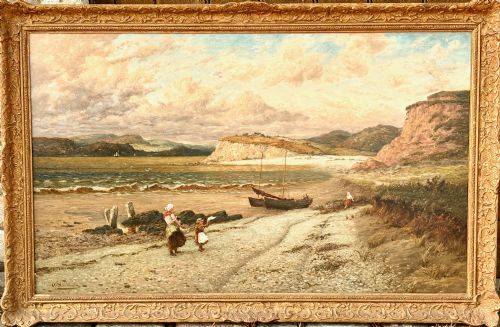
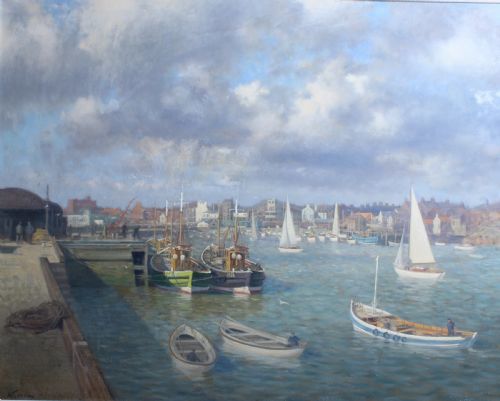
Traditional English coastal art encompasses oil paintings and watercolours depicting harbours, fishing boats, and chalk cliffs along the British coastline. These works record local maritime scenes from Cornwall, Yorkshire, Devon, and the Isle of Man.
Most pieces encountered on this page date from the nineteenth century through the mid-twentieth century. Subjects range from busy working harbours like St Ives and Whitby to quiet clifftops and beaches.
The style spans Victorian landscape and marine realism to British impressionism and mid-century British painting. Works frequently feature framed presentations in wood or gilt wood.
How they were made
Artists applied oil paint to canvas or board, and watercolour pigment to paper, often working directly outdoors to capture changing light. These traditional media defined the British marine and landscape tradition.
Sheep graze peacefully on clifftops near Kent while distant waves crash against the pebble beach below.
What varies in quality
Quality rests upon the artist's ability to render light, atmosphere, and movement within the marine environment. Stronger works convey the weight of choppy seas and the specific quality of light over northern and southern coasts.
Composition and the handling of detail distinguish accomplished pieces from simpler decorative works. The deft brushwork found in British impressionist and realist paintings elevates the visual record of these fishing communities.
William Banks Fortescue·Walter Goodin·William Edward Webb·Arthur Tucker·Herbert Royle·George Hamilton Constantine·Frederick Williamson·Albert Robert Quinton·Rowland Henry Hill·Walter Henry Sweet·William Sidney Cooper·Robert Leslie Howey·William Shayer·George Marks
The Traditional English Coastal Art Glossary
- Watercolour pigment
- Finely ground colour mixed with a water-soluble binder, applied to paper to create transparent washes of tone and light.
- Oil on canvas
- Pigment suspended in drying oil, spread across a stretched woven fabric support to yield rich colour depth and texture.
- Gilt wood
- Timber framing finished with a thin layer of gold leaf or metallic gilt, commonly used to frame period paintings.
- Maritime realism
- An artistic approach dedicated to the accurate portrayal of the sea, ships, and coastal life without stylistic exaggeration.
Traditional English Coastal Art: Frequently Asked Questions
What subjects appear in traditional English coastal art?
These works depict working harbours, fishing trawlers, chalk cliffs, and local fisher folk along the British coastline. Scenes often centre on familiar coastal locations in Yorkshire, Cornwall, and Devon.
Artists recorded specific regional vessels such as cobles and fishing boats, alongside landmarks like abbey ruins and seaside towns.
How do I care for antique watercolours and oil paintings?
Keep paper watercolours away from direct sunlight to prevent the watercolour pigment from fading over time. Glazing helps protect delicate paper surfaces from atmospheric moisture and dust.
Oil paintings on canvas benefit from stable indoor humidity and gentle dusting with a soft, dry brush. Avoid placing either medium near direct heat sources.
What periods do these coastal paintings span?
The available selection primarily spans the nineteenth century through the mid-twentieth century, including Victorian, Edwardian, and mid-century British eras. Dates range from Victorian maritime scenes up to works produced in the 1960s.
Earlier nineteenth-century pieces often reflect marine realism, while later decades show the influence of British impressionism.
How do I distinguish watercolours from oil paintings?
Watercolours utilise pigment on paper under glass, presenting a transparent and luminous surface. They capture fine details with lighter washes of colour.
Oil paintings use heavier paint applied to canvas or board, offering rich texture and opaque colour depth. Oils are typically displayed without glass protection.