
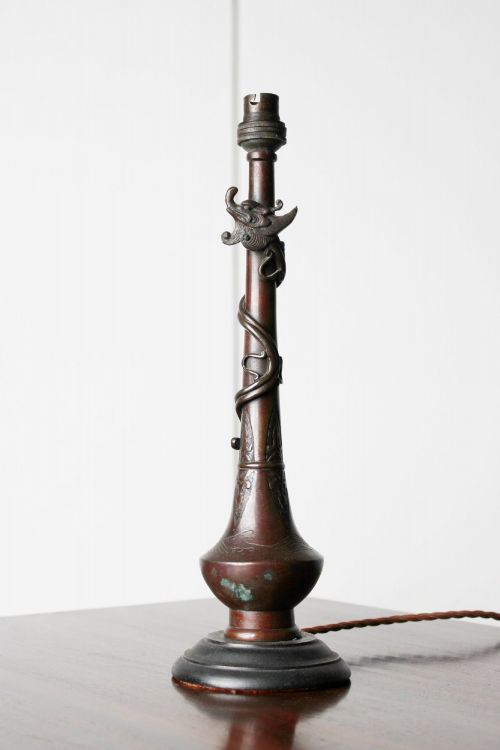
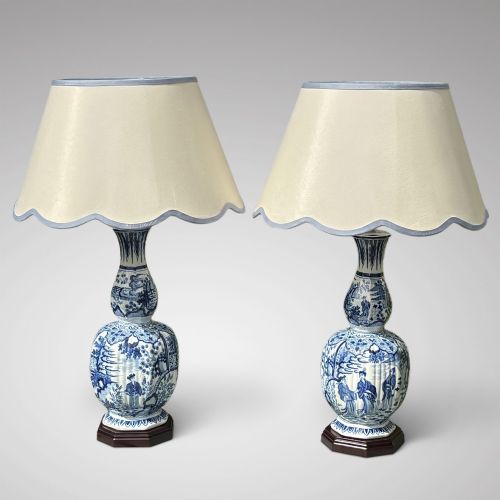


Traditional Chinoiserie Desk Lamp
These traditional chinoiserie desk lamps bring hand-painted narrative scenes and historic ceramic bodies straight to the working surface.
Traditional Chinoiserie Desk Lamp
A traditional chinoiserie desk lamp combines historic ceramic vessels with task lighting, adapting antique vases into functional table pieces. Buyers examining this page will find table lamps drawing upon 18th century, 19th century, Edwardian and Victorian eras.
The dominant forms rely heavily on converted vase shapes, including baluster profiles and crackle ware vessels. Many examples originate from Chinese and Japanese traditions, alongside Dutch Delftware interpretations.
Makers frequently employ Asian porcelain bodies, Japanese Meiji and Edo period aesthetics, or Anglo-Indian influences. The selection on this page centres on table lamps rather than pendant or floor lighting.
Materials and construction
Construction relies upon rigid structural foundations such as brass, wood and lacquered wood paired with delicate ceramic bodies. Artisans shape porcelain and pottery into vases before adapting them for electrical illumination.
Surface ornamentation utilises hand-painted pigments, gold leaf applications and dark lacquer finishes. Fabric and silk components frequently furnish the upper shade to diffuse the downward light.
Several heavy porcelain vases spent centuries serving tea or holding flowers before finally meeting an electrician with a drill.
Evaluating quality and execution
Quality rests upon the fidelity and age of the underlying ceramic body, whether an 18th century vase or a Victorian painted base. Finer examples display crisp hand-painted details and well-preserved glaze characteristics rather than flat, mechanical printing.
The integration of the lamp hardware into the historic vessel dictates stability and overall aesthetic success. Superior pieces preserve the structural integrity of the antique vase while ensuring secure wiring and mountings.
The Traditional Chinoiserie Desk Lamp Glossary
- Baluster
- A vertical architectural form featuring a rounded lower body that tapers upward toward the neck. This silhouette frequently appears in the ceramic vase bodies adapted for table lamps.
- Crackle ware
- A ceramic glaze marked by a network of fine decorative cracks intentionally formed during the firing process. It adds textural depth to the surface of historic porcelain lamp bases.
- Imari
- A traditional Japanese style of porcelain decorated in underglaze blue and overglaze red, gold and black. Pieces from the Edo period and later frequently serve as decorative lighting foundations.
- Famille verte
- A Chinese porcelain palette dominated by green enamel overglazes, developed during the Qing dynasty. These colourful narrative scenes define the visual appeal of many antique vase lamps.
- Dutch Delftware
- European tin-glazed earthenware inspired by imported Chinese blue and white porcelain. Local potteries produced these distinctive blue vessels during the 18th century and beyond.
Traditional Chinoiserie Desk Lamp: Frequently Asked Questions
Are these lamps wired for modern use?
Many antique vase lamps have received modern rewiring to meet contemporary safety standards while retaining their historic aesthetic.
Buyers should inspect the individual listing details to confirm the specific electrical setup of each lamp.
How do I date an antique lamp base?
Dating relies on examining the ceramic body style, glaze characteristics, and any visible potting marks rather than the modern electrical components.
Stylistic cues from the 18th century, Victorian era, or Edwardian period often guide the overall assessment.
Can I replace the lampshade safely?
Replacing the shade is straightforward provided the fitter matches the existing harp or gallery dimensions on the lamp.
Silk and fabric shades work well to complement the traditional aesthetic without overwhelming the delicate ceramic base.
Where should I place a chinoiserie lamp?
These lamps function effectively on desks, side tables, or credenzas where their detailed painted surfaces can catch the light.
Keep them away from direct moisture and heavy foot traffic to protect the delicate lacquer and porcelain finishes.