


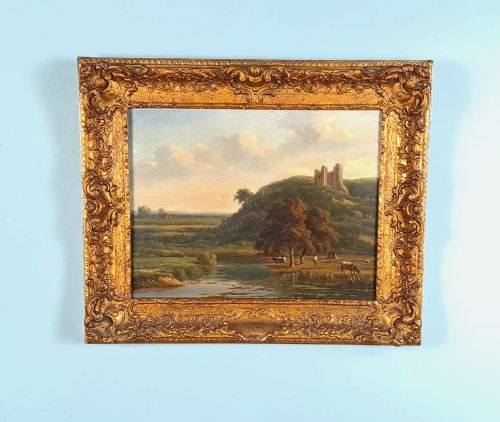


Traditional Castle Wall Painting
These traditional castle wall painting works capture historic fortresses and landscape scenes, offering collectors a classic window into British heritage and romantic scenery.
Traditional Castle Wall Painting
Traditional castle wall painting pieces depict historic fortifications, rivers, and estates across Britain, ranging from Windsor and Bolton to Urquhart and Gwydir. These artworks function as prominent wall art and oil paintings that record significant architectural landmarks.
The selections available here span the nineteenth century, Victorian, and Edwardian eras, alongside pieces dated into the early twentieth century. Buyers encounter both expansive oil on canvas compositions and delicate watercolour paintings.
Many of these works centre on specific locales such as Windsor Castle, Barnard Castle, and Arundel Castle, often framed within nineteenth century landscape traditions. Such pieces suit period interiors and traditional gallery walls alike.
How they were made
Artists executed these compositions primarily using oil paint on canvas or board, alongside paper supports for watercolour paintings. Giltwood frames frequently house the finished works, providing structural support and decorative emphasis.
Makers applied pigments with brushwork characteristic of British Impressionism and Victorian landscape art, building texture and depth. Preparation involved stretching canvas over wood frames or laying paper down securely before applying paint.
Listings feature oil on canvas, watercolour paintings, and oil on board spanning the 19th century, Victorian, Edwardian, and 1920 periods.
What varies in quality
Quality rests upon the handling of light, atmospheric perspective, and architectural accuracy within the landscape. Masterful brushwork distinguishes works with compelling depth from simpler illustrative records.
The integration of the castle within its natural surroundings determines the visual balance of the composition. Superior examples demonstrate careful attention to scale, texture, and the interplay between stone architecture and surrounding rivers or woods.
Alfred Young Nutt·T C Hofland·George Graham·William Mellor·James Bell Anderson·James L. Brooke·Samuel Sidley·James Canter·Frederick Tully Lott·William Edward Webb·George Willis Pryce·Charles Walter Radclyffe·R.E Richardson
The Traditional Castle Wall Painting Glossary
- Oil on Canvas
- Pigment suspended in drying oil applied to a woven fabric support. This material allows for rich colour blending and textured application.
- Watercolour Painting
- Pigments suspended in a water-soluble vehicle applied to paper. This medium creates translucent washes and delicate atmospheric effects.
- Giltwood
- Wood carved and coated with a thin layer of gold leaf. This material appears frequently in traditional picture frames.
- British Impressionism
- A painting style focusing on light and modern subjects using visible brushstrokes. This approach influences many nineteenth and twentieth century landscape works.
Traditional Castle Wall Painting: Frequently Asked Questions
What periods do these paintings date from?
The works span from the late eighteenth century through the Victorian and Edwardian eras into the mid-twentieth century.
Most pieces originate from the nineteenth century, reflecting popular landscape traditions of that period.
Are these works painted on canvas?
Many examples utilise oil paint on stretched canvas or wooden board, while others employ watercolour on paper.
Framing materials frequently include traditional giltwood surrounds that complement the period of the artwork.
Which castles appear in these artworks?
Represented structures include famous fortresses such as Windsor Castle, Bolton Castle, Urquhart Castle, and Arundel Castle.
Views often incorporate surrounding rivers, valleys, and woodland settings alongside the historic architecture.
How do I hang a heavy oil painting?
Large canvas works set in wooden and giltwood frames require secure wall fixings suited to the weight of the piece.
Ensure placement avoids direct sunlight and excessive moisture to protect the canvas and paint layers over time.