
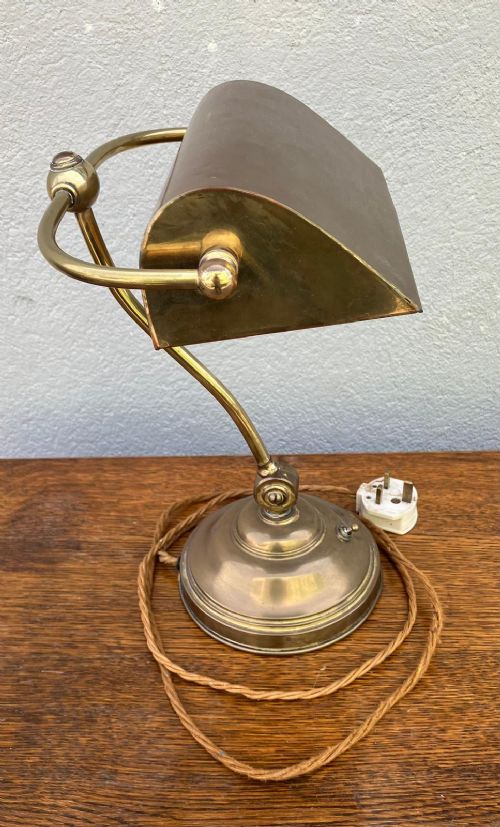
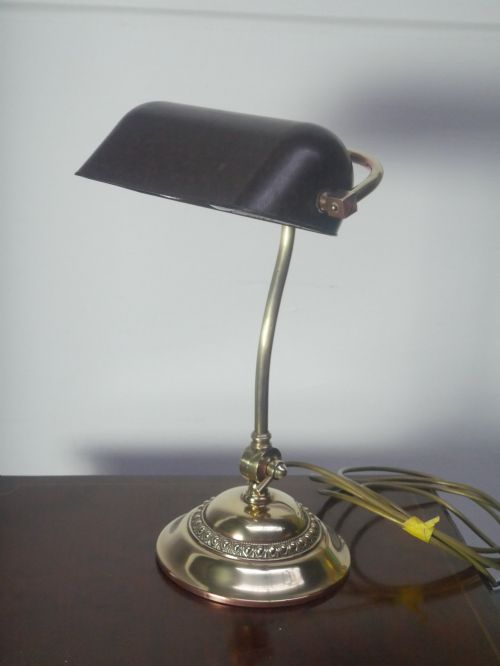


Traditional Brass Task Lamp
A traditional brass task lamp brings honest, functional metalwork to your workspace, offering the direct light and sturdy build that working desks demand.

Traditional Brass Task Lamp
A traditional brass task lamp is essentially a robust desk or table light engineered for focused illumination, appearing frequently in Edwardian and 1920s forms. You will most commonly encounter adjustable swan neck desk lamps and bankers desk lamps featuring heavy brass construction designed for daily use.
The materials and styles span from 19th century ormolu and French Empire bouillotte lamps with toleware shades to early 20th century brass and bronze notary designs. These pieces range from simple adjustable office fittings to elaborate multi-branch table lamps incorporating etched glass and fabric elements.
Construction and materials
These lamps rely on solid brass, bronze, and ormolu for their primary structural components, ensuring a heavy and stable base for adjustable arms. Metal spinning and casting techniques shape the heavy brass tubing and weighted bases needed to support extended swan necks without tipping.
Shades and decorative accents introduce contrasting materials like painted toleware, etched glass, and fabric, while adjustable joints utilise mechanical screws and pivots to direct the beam. The integration of bronze and brass components demonstrates period metalworking methods focused on durability and utility.
Listings for traditional brass task lamps span the Edwardian period, the 1920s, and the 1930s, utilising brass, glass, fabric, and toleware.
Judging quality and craftsmanship
Quality reveals itself in the heft of the solid brass and the precision of the adjustable swan neck or articulated joints, where finer examples maintain tension smoothly over decades. Heavy casting and substantial gauge metal separate superior desk lamps from lighter, mass-produced alternatives.
The presence of secondary materials like hand-painted toleware shades, etched glass, or intricate ormolu detailing elevates a piece from a utilitarian office tool to a refined interior furnishing. Better pieces display clean finishing on all component parts, including the weighted undersides of the bases.
The Traditional Brass Task Lamp Glossary
- Swan neck
- A curved, tubular metal arm that resembles the neck of a swan, allowing the lamp shade to be positioned directly over a workspace. This flexible profile is a hallmark of early 20th century desk lighting.
- Bouillotte lamp
- A traditional French table lamp featuring a central shaft, multiple candle-style arms or a single bulb, and a characteristic adjustable toleware shade. It is named after the eighteenth-century card game bouillotte.
- Ormolu
- Gilded bronze ornamentation applied to decorative lamps and furniture, popular in nineteenth-century French design. The technique involves coating base metal with a finely ground gold-mercury amalgam.
- Toleware
- Painted or lacquered metalware used traditionally for lamp shades and canisters, offering a durable and colourful contrast to polished brass. This material often appears in dark green or black finishes on French table lamps.
- Notary lamp
- A specialised desk lamp designed for legal and administrative work, typically featuring an adjustable brass frame and a distinct directional shade. These pieces emphasise focused downward illumination for reading documents.
Traditional Brass Task Lamp: Frequently Asked Questions
What defines a traditional brass task lamp?
A traditional brass task lamp is defined by its metal construction, adjustable arm or swan neck, and primary purpose as a functional desk or table light. These pieces originate predominantly from the Edwardian era through the 1930s.
They utilise heavy brass, bronze, or ormolu to provide stability during adjustment, often incorporating shades made of glass or painted toleware to direct the light.
How do I date a brass desk lamp?
Dating a brass desk lamp involves examining the weight of the metal, the style of the mechanical joints, and the manufacturing techniques used on the base and shade. Edwardian and 1920s examples typically feature heavy sand-cast brass and straightforward screw adjustments.
Later pieces often shift towards lighter stamped components or distinct Art Deco geometric styling. Comparing the patina and wiring style also helps establish the period of manufacture.
Where were these lamps used historically?
Historically, these lamps were designed for functional workspaces such as legal offices, banks, studies, and writing rooms where focused illumination was essential. Bankers and notaries relied on adjustable brass lights to illuminate ledgers and documents.
Over time, more decorative French bouillotte and ormolu variants transitioned from workspaces into formal drawing rooms and libraries as accent lighting.
How should I care for antique brass?
Caring for antique brass requires minimal intervention to preserve the natural oxidation and historical patina that accumulates over decades of use. Dusting with a soft, dry cloth is usually sufficient for regular maintenance.
Avoid using harsh chemical polishes that strip away the aged surface character and diminish the visual depth of the metal.