



Art Nouveau Desk Light
An art nouveau desk light brings organic lines and botanical curves directly to your workspace.

Art Nouveau Desk Light
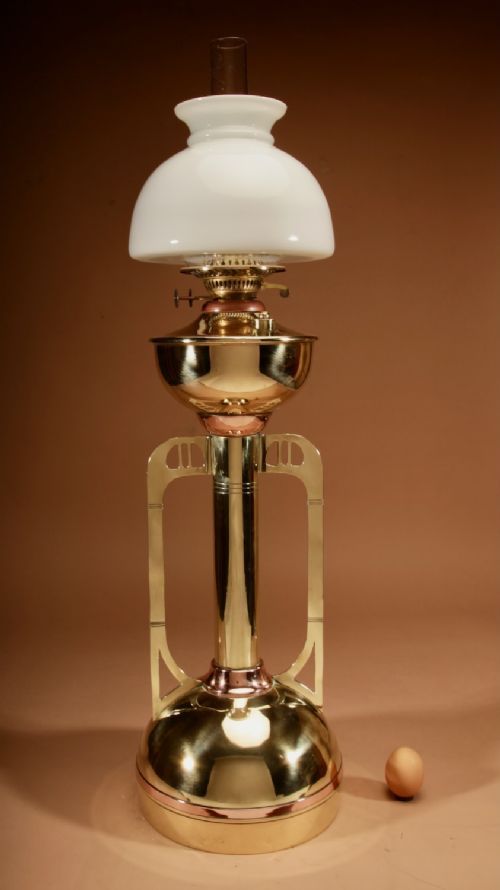
When searching for an art nouveau desk light, buyers encounter task lighting that merges functional illumination with flowing, plant-inspired forms. The examples found here span table lamps, reading lamps, and desk lamps originating primarily from the late nineteenth century through the Edwardian period and up to the 1920s.
Most pieces display the characteristic whipped curves and floral motifs associated with the Art Nouveau style, alongside related Arts and Crafts, Secessionist, and Amsterdam School aesthetics. These lights often double as sculptural objects, utilising figural elements or graceful botanical shapes to anchor a room.
Makers and workshops from France, England, and the wider continent produced these pieces in forms ranging from adjustable reading lights to large table lamps. Materials vary widely, providing distinct silhouettes whether executed in metal or fitted with decorative glass shades.
Materials and Manufacture
Foundry work and metal shaping form the basis of these pieces, utilising brass, bronze, copper, or spelter to construct the main body and flexible or swan neck stems. Ormolu and silver plating also appear on select lights, offering varied surface finishes.
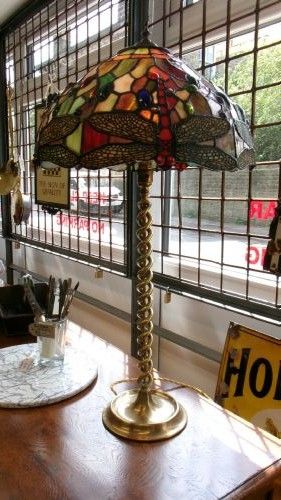
Lighting elements incorporate glass, ranging from frosted glass and glass cabochons to enameled shades and Tiffany-style configurations. Faience pottery components and wooden fretwork elements also contribute to the mixed-media construction seen across the period.
The inventory spans the late nineteenth century through the Edwardian era into the 1920s.
Assessing Quality
The distinction between tiers of these lights rests on the crispness of the casting and the artistic ambition of the design. Masterworks feature detailed figural modeling, refined chasing on bronze, and harmonious integration of glass elements.
Simpler production relies on spelter and standard brass work, where the artistic merit depends heavily on the purity of the stylistic lines and the integrity of the original components rather than elaborate metalwork.
L and F Moreau·Gustave Serrurier Bovy·Georges Leleu·WAS Benson·Daum·The Charles Parker Company·Jan Eisenlöffel·Ivan Zaiec·Tiffany Studios
The Art Nouveau Desk Light Glossary
- Spelter
- A zinc alloy commonly used as a cost-effective substitute for bronze in decorative metalwork. It takes patination well but requires careful handling due to its relative softness.
- Secessionist
- A Central European design movement related to Art Nouveau that favoured geometric stylisation alongside organic forms. It appears frequently in continental metalwork and lighting from the turn of the twentieth century.
- Cabochon
- A polished, convex gem or piece of glass without facets, often set into metal lamp bases to catch the light. These add tactile colour to otherwise monochromatic bronze or brass frames.
- Ormolu
- Gilded bronze produced by applying a finely ground high-carat gold-mercury amalgam to a bronze object. The technique yields a rich, warm golden surface finish.
- Faience
- Tin-glazed earthenware used in decorative bases and body components. It introduces colourful ceramic textures into lighting design.
Art Nouveau Desk Light: Frequently Asked Questions
How were these lamps used originally?
Originally placed on writing desks, notary tables, and side surfaces, these lamps provided focused illumination for reading, writing, and administrative tasks. Adjustable stems and swan necks allowed users to direct the beam precisely where needed.
Beyond simple utility, they served as decorative accents in domestic and professional interiors, reflecting the owner's taste for modern design.
Are these lamps suitable for daily use?
Many antique lamps accommodate modern wiring standards and low-heat LED bulbs, making them practical for everyday desk or table use. It is wise to have older or rewired examples checked by a qualified professional before plugging them in.
Placing them on stable side tables or desks protects their delicate glass components and original patinated surfaces from accidental knocks.
How do I distinguish Art Nouveau from Arts and Crafts?
Art Nouveau prioritises fluid, asymmetrical curves and botanical motifs that mimic growing plants. Arts and Crafts pieces tend to emphasise visible construction methods, simpler geometric forms, and the honesty of the worked material.
Both movements overlapped chronologically, and some workshop output combined elements of both styles into practical lighting fixtures.