


Traditional Brass Balance Weights
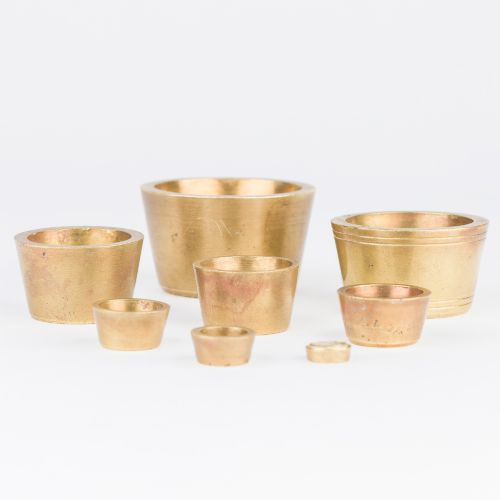
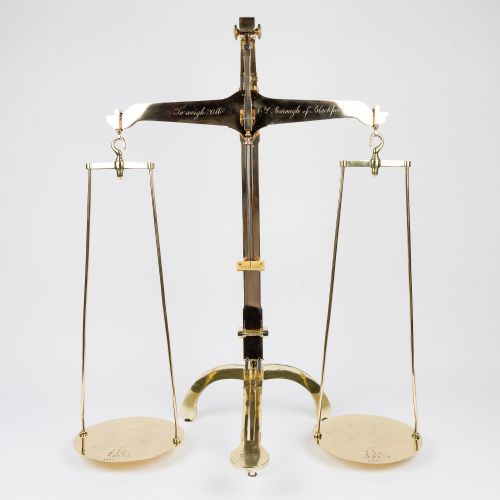
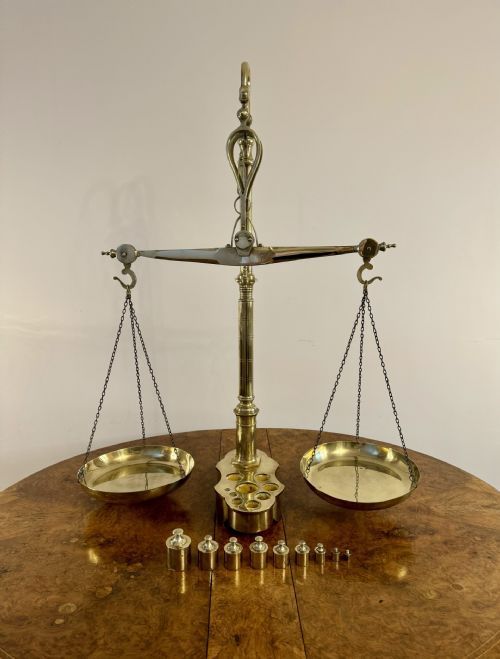
Traditional brass balance weights are essential components of historic weighing instruments, prized for their precision engineering and pleasing metallic lustre.
Traditional Brass Balance Weights
Traditional brass balance weights are tangible links to historical commerce, medicine, and domestic administration, frequently found paired with complete sets of scales. When searching for traditional brass balance weights, collectors commonly encounter pieces dating from the Victorian and Edwardian eras, alongside specialised sets such as Troy ounce measures or postal increments. These objects reflect a period when accurate measurement governed everything from apothecary dispensaries to grocers' shops.
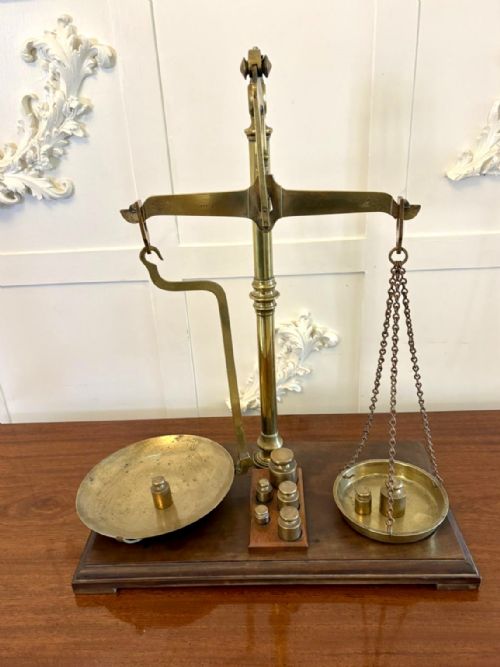
The items listed on this page encompass various forms, ranging from individual scale weights to comprehensive cased sets housed in mahogany or oak bases. Alongside postal and letter scales, one finds larger commercial apparatus such as grocers' scales from cooperative societies and medical personal weighing devices. The preponderance of pieces hails from the late nineteenth and early twentieth centuries, embodying utilitarian design executed with durable materials.
How traditional brass balance weights were made
These pieces rely heavily on brass, chosen for its resistance to corrosion and its dependable weight, paired with hardwood components like mahogany and oak for bases and storage boxes. Iron and wrought iron frequently provide structural reinforcement for larger balance arms and mechanisms, while marble appears in specific apothecary contexts for hygiene.
Makers shaped the brass through casting and turning on lathes, finishing surfaces to a bright polish that often bears the stamp of inspection or ownership. Wooden mounting boards and fitted boxes received careful joinery to securely house the individual weights, ensuring stability during frequent commercial use.
Materials appearing in these listings include brass, mahogany, hardwood, marble, iron, copper, wrought iron, and oak across multiple decades.
What varies in quality
The distinction between standard utility items and finer examples lies in the crispness of the maker's stamp, the completeness of the original weight set, and the quality of the timber housing. Superior pieces retain their matching weights in unbroken sequences, housed in fitted hardwood boxes with original brass clasps and hinges.
Workmanship is further demonstrated by the refinement of the beam balance adjustments and the absence of excessive wear on pivot points. Simpler utilitarian grocers' or garden scales prioritize robust construction over delicate decorative detailing, whereas domestic postal scales often exhibit more considered cabinetwork.
The Traditional Brass Balance Weights Glossary
- Troy ounce
- A system of units of mass used for precious metals. Sets measured in Troy ounces indicate specialised commercial or laboratory use.
- Apothecary
- A historical practitioner who prepared and sold medicines. Apothecary balances required extreme precision due to the potency of the substances weighed.
- Beam scales
- A weighing device consisting of a horizontal lever with arms of equal length. This mechanism relies on gravity to establish equilibrium between a known weight and an unknown mass.
- Postal scales
- Compact domestic scales designed for weighing letters to determine postage rates. They frequently feature decorative brass pans and wooden bases.
Traditional Brass Balance Weights: Frequently Asked Questions
How do I clean brass weights?
Maintenance of brass requires gentle cleaning to preserve the historic patina rather than achieving a modern mirror finish. Harsh chemical abrasives should be avoided in favour of mild soapy water and a soft cloth.
Ensuring the metal is thoroughly dried prevents spotting and maintains the subtle oxidation that accumulates over decades of handling.
Were these weights used in shops?
Many surviving sets originated in commercial environments such as grocers' shops, cooperative societies, and post offices. These units were subject to regular government inspection for trade accuracy.
Other examples served in private households for weighing post or in professional settings like apothecary dispensaries and doctors' surgeries.
Are complete sets necessary?
Original sets containing all their corresponding weights command greater interest from collectors. Missing pieces alter the visual symmetry and historical utility of the object.
Individual weights still find favour as decorative objects or paperweights, even if their matching balance scale is absent.
How do I date these scales?
Dating relies on stylistic clues in the wooden housing, the presence of specific Victorian or Edwardian design motifs, and any stamped maker marks. Government verification stamps often provide reliable chronological markers.
The evolution from heavy mahogany bases to simpler oak mounts helps distinguish mid-nineteenth-century items from early twentieth-century equivalents.