


Antique Brass Trade Weights
Antique brass trade weights are dense, utilitarian objects of measurement that bring industrial heft and honest proportion to a modern interior.
Antique Brass Trade Weights
Antique brass trade weights are functional instruments designed for commerce, laboratories and domestic measurement. When you search for antique brass trade weights, you encounter sets and single pieces spanning the nineteenth and twentieth centuries.
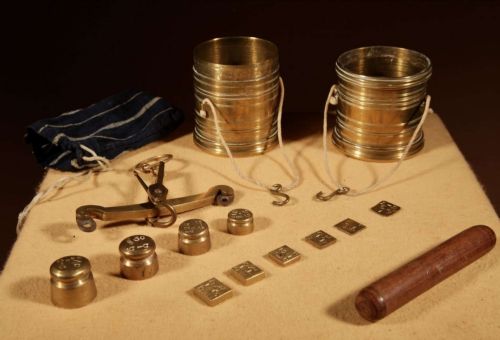
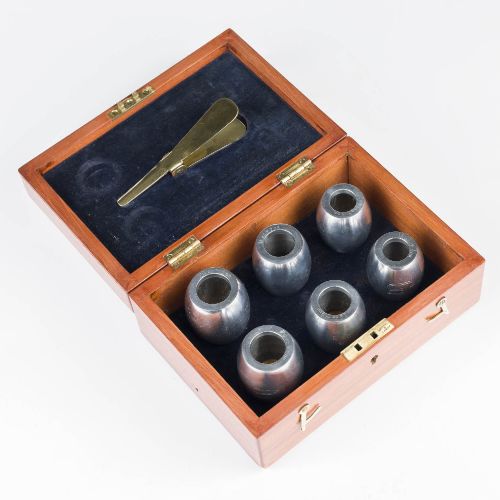
The selections on this page commonly include standard sets stamped for specific counties, cities or official inspectors, alongside apothecary and troy ounce variants. Many survive in original fitted wooden blocks or box stands that protected the metal during verification.
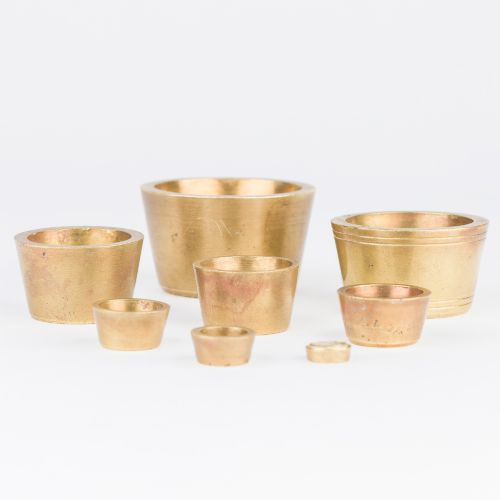
Forms range from nested bell weights to cylindrical stacks and flat standards, often bearing regional verification stamps, crown marks or maker inscriptions. These pieces reflect rigorous nineteenth and twentieth-century standards of trade regulation.
Materials and construction
These objects are cast and turned from solid brass, selected for its resistance to corrosion and stability over time. The metal carries the tool marks of the lathe alongside official adjustment notches and verification stamps.
Many sets rely on fitted hardwood blocks, mahogany storage cases and iron reinforcement to house the pieces securely. Interior linings of velvet or textile occasionally cushion individual weights within their designated slots.
Weights stamped for the Isle of Man remind us that even local potatoes required official imperial approval.
Assessing quality in trade weights
Quality rests in the legibility of official stamps, crisp regional markings and the survival of complete, matching sets. Pieces bearing named makers or specific city jurisdictions hold greater documentary interest.
The integrity of original wooden storage blocks and the retention of unpolished, patinated brass surfaces distinguish higher-grade examples from stray, heavily cleaned single items.
De Grave Short And Co·W And T Avery
The Antique Brass Trade Weights Glossary
- Avoirdupois
- A system of weights based on a pound of sixteen ounces, commonly used for everyday goods and general commerce.
- Troy ounce
- A system of units of mass traditionally used for precious metals, distinct from standard avoirdupois measures.
- Verification balance
- A precision scale utilised by official inspectors to test and certify the accuracy of commercial weights.
- Nested weights
- A set of hollow cup-shaped brass weights designed to fit inside one another under a single lid.
Antique Brass Trade Weights: Frequently Asked Questions
What are antique brass trade weights?
Antique brass trade weights are heavy, calibrated metal pieces used in markets, shops and official inspection offices to measure goods accurately.
They were produced in standardised systems such as avoirdupois and troy, often stamped with regional verification marks and the cypher of the reigning monarch.
How were trade weights used?
These weights sat on balance scales in grocery shops, apothecaries and municipal offices to weigh commodities or check the accuracy of other measures.
Official inspectors carried them in fitted wooden boxes to verify that local merchants used honest scales.
How do I display them at home?
Their dense metal forms and patinated surfaces suit placement on bookshelves, desks or sideboards either as single sculptural objects or grouped in their original wooden stands.
Keeping them in their fitted mahogany blocks preserves the historical arrangement and protects the brass from surface knocks.
How do I date these pieces?
Dating relies on stamped verification ciphers, maker inscriptions, and the style of the accompanying wooden block stands spanning the nineteenth and twentieth centuries.
Regional stamps naming specific boroughs or counties often correspond to the tenure of local inspectors recorded in civic archives.