
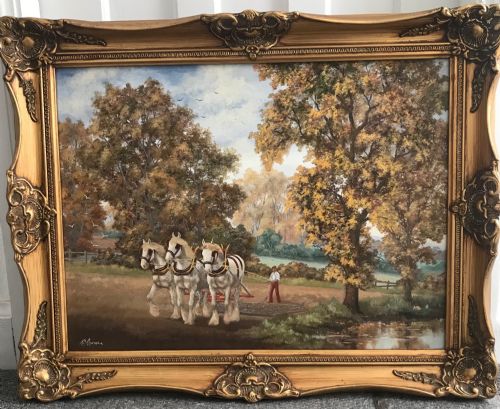
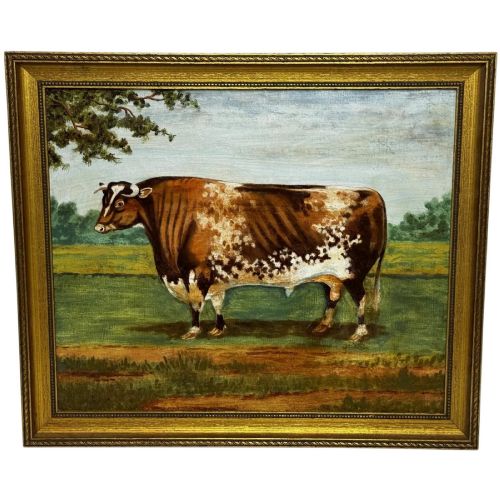


Traditional Agricultural Oil Artwork
Traditional agricultural oil artwork captures the heavy labour of country life and prize livestock through oil paint on canvas.
Traditional Agricultural Oil Artwork
Traditional agricultural oil artwork depicts rural scenes, working horses, prize bulls, and harvest fields across the nineteenth and twentieth centuries. These paintings reflect British pastoral life, rural landscapes, and farmyard scenes rendered in traditional realisms and British Impressionism.
Buyers most frequently encounter canvases originating from the Victorian period through to the mid-twentieth century. The subjects range from detailed portraits of shire horses and shorthorn cattle to wide views of haymaking and ploughing.
The works span multiple decades, drawing on regional British schools and continental animaliers. Each piece documents agrarian practices, farm animals, and rural workers using oil paints on stretched canvas or wood panels.
What varies in the quality of traditional agricultural oil artwork
Anatomical precision and handling of light separate standard academic works from master animal portraits. The rendering of muscle structure in heavy horses or cattle demonstrates the painter's observational skill.
Compositional complexity dictates the visual weight of each piece. Large farmyard scenes with multiple figures and animals demand greater technical mastery than single livestock studies.
One canvas preserves nine shire horses together in a single oversized farmyard portrait.
A M Gauci·James Kyd·Herbert Royle·Percival Glenfern·J.C. Grey·James William Booth·Arthur Winter Shaw·Thomas Sidney Cooper·Arthur Charles Dodd·Vernon Stokes·Joseph Paulman·J L VAN Leemputten·John Percy Cooke·Ernest Higgins Rigg·William Greaves·W. A. Clark·Owen Bowen·William Huggins·William Sidney Cooper·Louis Marie Dominique Robbe·George Cole·Frederick J Haycock·B J Burrows
The Traditional Agricultural Oil Artwork Glossary
- Canvas
- A heavy woven fabric used as a surface for oil painting. It is typically stretched over a wooden frame before application of gesso and pigment.
- Gesso
- A plaster mixture used as a primer on wood or canvas panels. It creates a smooth, stable surface for oil paint adhesion.
- Gold leaf
- Gold beaten into extremely thin sheets used for gilding picture frames. It adds a reflective metallic border around the painted canvas.
- British Impressionism
- A painting style focusing on light and loose brushwork adapted by British artists. It appears in rural landscapes from the early twentieth century.
- Pastoral
- A genre of art depicting rural life and agricultural scenes in an idealized or scenic manner. These works emphasise harmony between farmers, animals, and the countryside.
Traditional Agricultural Oil Artwork: Frequently Asked Questions
What subjects appear in these paintings?
These works depict shire horses, shorthorn cattle, sheep, farmyard scenes, and harvest fields. Painters recorded the daily labour of farmers alongside prize livestock.
The compositions range from intimate animal portraits to wide rural landscapes documenting British agricultural history.
Which periods do these artworks span?
The pieces date from the nineteenth century through to the mid-twentieth century. Victorian realisms and Edwardian pastoral scenes form a significant portion of the available works.
Dates extend from the eighteen-fifties up to nineteen-sixty, capturing changing rural traditions across several decades.
Where were these paintings created?
Many works originate from British artists working within regional schools, capturing specific local fields and farmyards. Continental painters also contributed rural genre scenes and animal studies.
Artists frequently worked plein air in rural landscapes or within farm settings to capture livestock accurately.