




Equine Landscape Oil Painting
An equine landscape oil painting captures horses within a countryside setting, offering a direct view into historical rural life and sporting art.
Equine Landscape Oil Painting
An equine landscape oil painting depicts horses situated within rural, agricultural, or sporting scenery. The works appearing here span from the Regency era through the nineteenth century and into the mid-twentieth century.
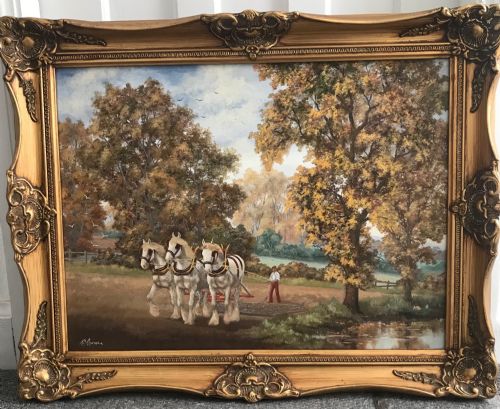
Buyers encounter subjects ranging from heavy plough horses in fields and ponies near coasts to hunting scenes and cart horses on country roads. These pieces function simultaneously as animal portraits and topographical records of past landscapes.
Traditional realism and Victorian romanticism dominate the selection, showing animals at work or rest in British and Irish countryside settings. The focus remains on the relationship between the horse, the human handler, and the surrounding terrain.
Materials and Construction
The physical works rely primarily on oil paint applied to canvas, often supported by wooden stretcher frames. Artists utilised rich oil pigments to build texture and depth within both the animal coats and the surrounding sky and soil.
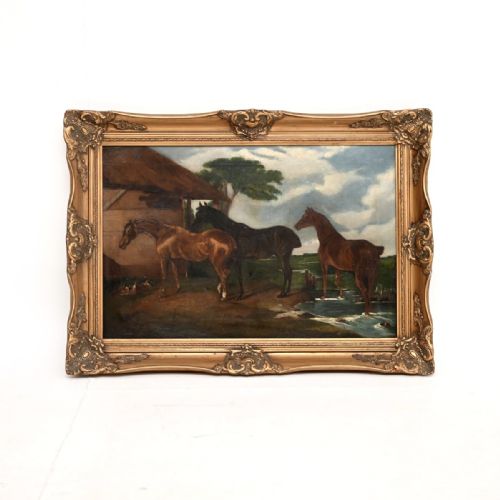
Many of the older works retain their original giltwood and gesso frames, ornamented with gold leaf. The combination of durable oil paint on canvas has allowed these rural scenes to survive across multiple centuries with their pigment intact.
Farmyard animals including pigs and ducks frequently share the canvas with horses in nineteenth-century rural scenes.
Distinctions in Quality
Quality rests upon the artist's anatomical accuracy in rendering the horse alongside the atmospheric harmony of the landscape. Superior hands capture the musculature, tension, and character of the animal rather than presenting a stiff silhouette.
The integration of the horse into its environment separates standard decorative works from accomplished paintings. Stronger compositions balance the focal animal against the background fields, skies, and secondary figures without losing narrative clarity.
John Ferneley Senior·Eugene Joseph Verboeckhoven·John Frederick Herring·Clifton Tomson·Arthur Winter Shaw·George Goodwin Kilburne·Ernest Higgins Rigg·Edward Lloyd·James Barenger·George Cole·John Parker Davis
The Equine Landscape Oil Painting Glossary
- Regency
- A period spanning the early nineteenth century defined by specific neoclassical tastes in British art and architecture. Paintings from this time often exhibit refined detailing in sporting subjects.
- Giltwood
- Wood carved and coated with gold leaf or metallic powder to create an ornamental frame. These frames frequently accompany nineteenth-century canvases.
- Gesso
- A plaster-like mixture applied to wooden frames as a base for gilding. It provides a smooth surface for intricate moulding.
- Sporting Art
- A genre of painting dedicated to horses, hounds, shooting, and rural sports. These works place heavy emphasis on the accurate depiction of livestock and country pursuits.
Equine Landscape Oil Painting: Frequently Asked Questions
How do I date an equine landscape oil painting?
Dating relies heavily on the clothing of any human figures, the style of the horse tack, and the framing materials. Canvas types and stretcher construction also offer clues to the age of the work.
Signatures, exhibition labels on the reverse, and recorded artist working dates help narrow the period further. Stylistic shifts between Regency formality and Victorian romanticism provide additional chronological markers.
Where should I hang these paintings?
These works suit traditional dining rooms, studies, or hallways where rural and sporting art traditionally finds a home. Keep them away from direct sunlight and damp walls to protect the oil paint and canvas.
Ensure the weight of the frame is supported by appropriate wall fixings. Proper placement away from direct heat sources prevents the canvas and wooden stretcher from warping.
What is the difference between a portrait and a landscape?
An equine portrait focuses primarily on the animal itself, often with a neutral or minimal background. An equine landscape integrates the horse fully into a wider geographical setting, such as a river valley or a ploughing field.
In landscape works, the scenery holds equal visual weight to the animal. Both forms appear frequently across nineteenth-century British art.
How do I care for an oil painting on canvas?
Dust the surface gently with a soft, dry brush or feather duster without pressing into the canvas. Avoid using water, chemical cleaners, or damp cloths on the paint layer.
Maintain stable room temperatures and humidity levels to prevent the canvas from sagging or the oil paint from cracking. Consult a professional conservator if the surface requires deeper cleaning or varnish removal.