
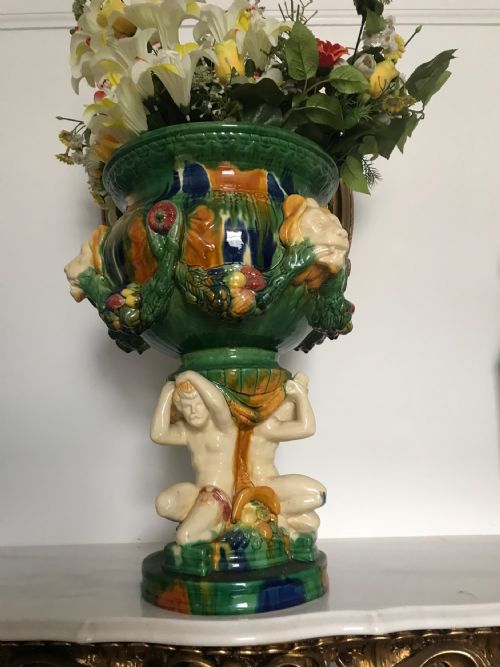


Tin Glaze Majolica Urns
These tin glaze majolica urns bring vibrant Italian and European colour to a room, offering rich polychrome painted surfaces that draw the eye immediately.
Tin Glaze Majolica Urns
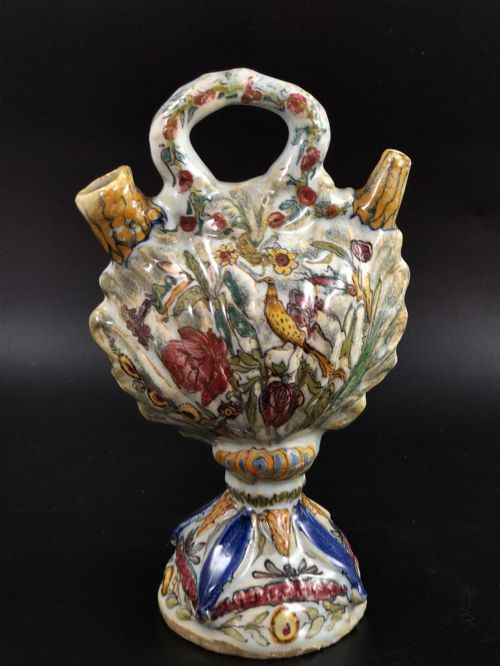
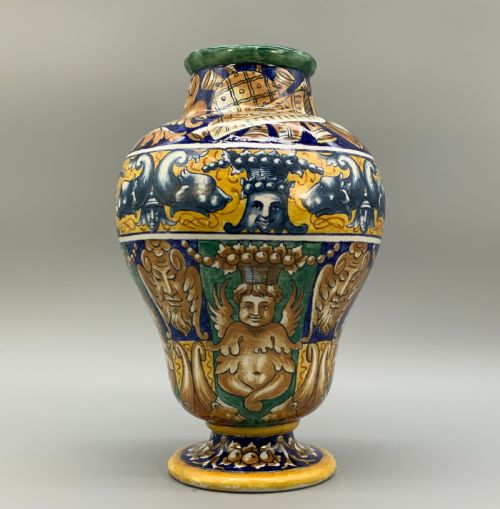
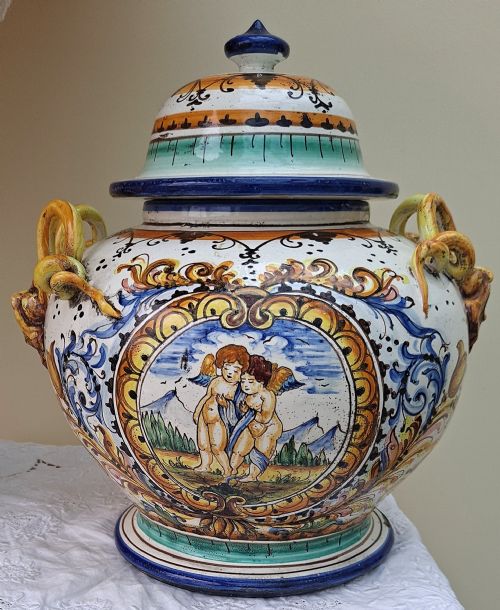
Tin glaze majolica urns cover a variety of decorative vessels, lidded jars, cabinet vases, and large planters rooted in centuries of European ceramic tradition. When searching for tin glaze majolica urns, a buyer encounters everything from eighteenth-century Italian examples to nineteenth-century revival pieces made in Florence, France, and England.
The forms range from lidded vases and pilgrim flasks to monumental planters resting on figural bases with lions head decoration. Most pieces originate from Italian or French workshops, leaning heavily into Renaissance revival and Italian Baroque styles.
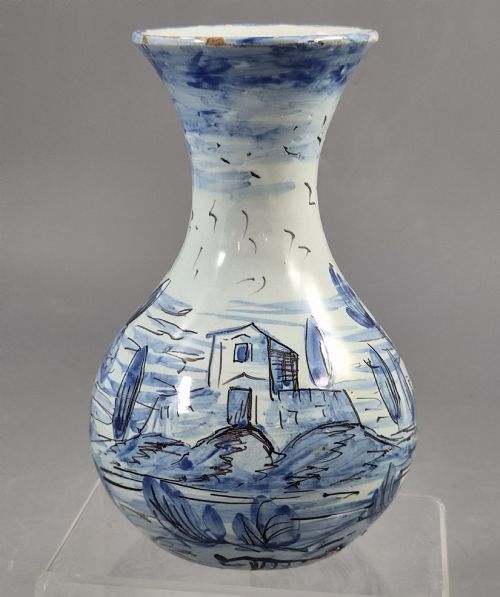
Victorian makers also reinterpreted these classical designs, producing heavy earthenware vessels coated in opaque white tin glaze and painted with polychrome or blue and white motifs. A collector finds that standard decorative vases and table lamps also appear within this group.
Materials and production methods
These vessels are built from earthenware or terracotta bodies shaped by hand or on a wheel before receiving an opaque white tin glaze. This absorbent surface serves as a canvas for metal oxide paints applied before a final firing.
Makers utilise cobalt blue, metallic lustre, and multi-coloured pigments to achieve the rich palettes characteristic of Italian maiolica and French faience. The resulting glaze creates a smooth, glossy skin that holds pigment securely across centuries.
Several pieces feature fierce lions head decorations, keeping a watchful, toothy guard over your mantelpiece.
Assessing quality and craftsmanship
Quality in these ceramics rests on the control of the brushwork and the depth of the painted palette. Finer vessels display confident, detailed polychrome scenes or precise blue and white patterns rather than rushed or muddy application.
The complexity of the form also dictates the tier of the piece, separating standard cabinet vases from large lidded urns with sculptural figural bases and applied ornamentation. The smoothness of the tin glaze and the brilliance of the firing determine how successfully the surface resists dullness over time.
Cantagalli
The Tin Glaze Majolica Urns Glossary
- Maiolica
- Tin-glazed earthenware produced in Italy or in the Italian style, known for colourful painted decoration. The technique became popular during the Renaissance and inspired later revival movements.
- Faience
- European tin-glazed pottery, particularly associated with French and Dutch production. It shares the porous earthenware body and opaque white glaze characteristic of majolica.
- Pilgrim flask
- A flattened bottle form with side lugs for suspension, often decorated with pictorial scenes. These vessels originated as travel containers before becoming purely ornamental cabinet pieces.
- Garofano
- A traditional decorative pattern featuring stylized carnation motifs. This design appears frequently on eighteenth-century Italian ceramic pieces.
- Tin glaze
- An opaque white ceramic glaze containing tin oxide that provides a smooth surface for painted decoration. It allows vibrant mineral pigments to sit crisply on the fired clay body.
Tin Glaze Majolica Urns: Frequently Asked Questions
How do I clean tin glaze majolica urns?
Dust these ceramic surfaces gently with a dry, soft cloth to prevent any buildup of grime.
Avoid using water, chemical cleaners, or abrasive sponges, as the historic tin glaze can be sensitive to moisture and harsh treatment.
Can I use these urns for fresh flowers?
Most antique tin glaze vessels are porous and prone to seepage, making them unsuited for holding water.
Display them dry as standalone sculptural objects or use internal liners if water is strictly necessary.
How do I distinguish eighteenth-century pieces from nineteenth-century revivals?
Eighteenth-century examples typically show the looser brushwork and softer palette characteristic of period production.
Nineteenth-century revival pieces often exhibit heavier earthenware bodies, brighter chemical pigments, and sharper execution inspired by Renaissance styles.
Where should I display large majolica planters?
Position large planters on sturdy pedestals, floor stands, or heavy tables that can adequately support their substantial weight.
Keep them away from high-traffic walkways where accidental bumps could chip the glazed earthenware surface.