
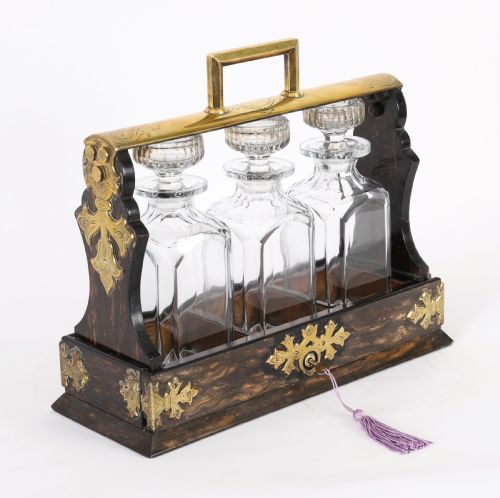


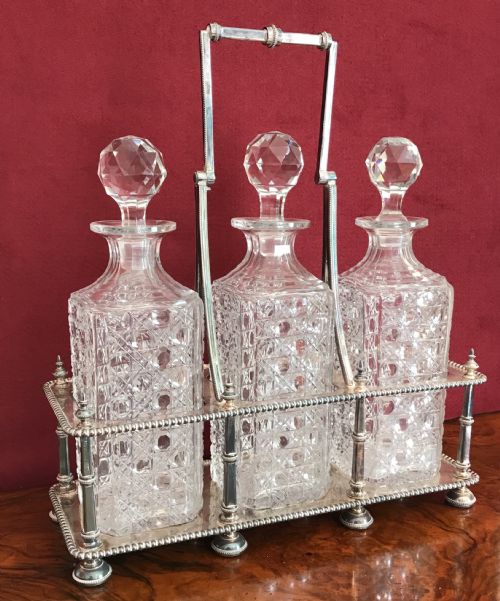

Three Decanter Caddy
A three decanter caddy secures your finest spirits behind a locking frame, combining practical barware storage with decorative display.
Three Decanter Caddy
When you search for a three decanter caddy, you encounter various secure drinks cabinets and frames designed to hold three bottles securely. The most common forms on this page include Victorian and Edwardian tantaluses alongside later Art Deco examples.
These pieces function primarily as barware and drink dispensers, often incorporating locking mechanisms to prevent unauthorised access to the spirits inside. Examples range from ornate Victorian coromandel and walnut caskets to sturdy oak frames mounted with silver plate or brass.
Originating largely from the nineteenth and early twentieth centuries, these items reflect the social habits of their periods. You will find them described variously as tantaluses, decanter sets, or scent caskets, each serving the purpose of housing three bottles.
Materials and construction
Cabinetmakers utilised timber such as oak, walnut, and coromandel wood to construct the frames and caskets, often incorporating brass or silver-plated mountings for structural reinforcement and visual contrast.
The bottles themselves consist of cut glass or cut crystal, frequently paired with silver-plated frames, handles, and locking bars that secure the vessels in place.
Later twentieth-century examples introduce modernist materials like chrome alongside glass, marking a shift from traditional timber construction towards industrial aesthetics.
Some caddies doubled as games compendiums, hiding playing cards beneath the decanters so guests could gamble and drink simultaneously.
Quality and craftsmanship
The choice of primary wood and secondary decorative elements dictates the tier of the piece, with exotic timbers like coromandel and intricate inlay work marking out finer examples against plain oak.
The intricacy of the glass cutting on the decanters and the robustness of the silver plating or brass mountings distinguish standard production items from superior workshop output.
Mechanical precision in the locking mechanism and the integration of auxiliary items, such as integrated games compartments or tot pails, elevate the sophistication of the caddy.
Jacques Adnet
The Three Decanter Caddy Glossary
- Tantalus
- A locking drink cabinet or frame that holds decanters securely while displaying their contents. The locking bar prevents the removal of the bottles without a key.
- Coromandel wood
- A dense, heavy timber with dark brown and black grain patterns originating from Southeast Asia. Makers utilised it for high-end Victorian caskets and tantaluses.
- Silver plate
- A thin layer of silver applied to a base metal such as copper or brass. It provided the appearance of solid silver for frames and mountings at a lower cost.
- Cut crystal
- High-clarity glass containing lead oxide, cut with decorative facets that refract light. It is commonly found on decanters housed within nineteenth-century caddies.
- Tot pail
- A small bucket or container designed to hold measures of spirits, occasionally accompanying barware sets of the nineteenth century.
Three Decanter Caddy: Frequently Asked Questions
What is a three decanter caddy?
A three decanter caddy is a locking wooden or metal frame designed to hold three glass bottles of spirits securely. These pieces protect the contents while allowing them to be displayed on a sideboard or table.
They appear primarily in Victorian, Edwardian, and Art Deco styles, often featuring silver-plated mounts and cut crystal decanters.
How do you open a tantalus?
Most tantaluses operate with a small key that releases a locking bar at the top or side of the frame. Once unlocked, the bar lifts or slides out to allow the decanters to be lifted free.
Without the key, the bottles remain securely held within the metal framework, which gave the device its teasing name.
What wood are they made from?
The frames and caskets utilise hardwoods typical of their respective periods, most commonly oak, walnut, and coromandel wood. These timbers provided the durability required to house heavy glass bottles.
Some examples also incorporate brass or silver-plated metal components to reinforce the structure and secure the locking mechanisms.
How do I date a decanter caddy?
Dating relies on the primary materials, the style of the woodwork, and the mounting designs characteristic of different eras. Victorian examples often feature ornate coromandel or walnut with heavy brass work, while Edwardian versions frequently utilise plain oak.
Later Art Deco pieces from the 1930s introduce chrome and modernist lines that contrast with nineteenth-century aesthetics.
Were these caddies used at home?
Households utilised these pieces in dining rooms, studies, and drawing rooms to serve whiskey, brandy, and other spirits to guests. The locking mechanism kept the expensive contents secure from household staff.
They served as both functional barware and decorative objects reflecting the social status of the owner.