
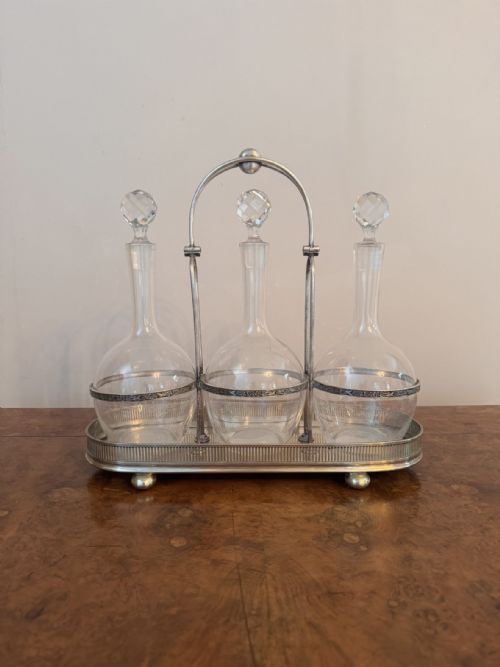
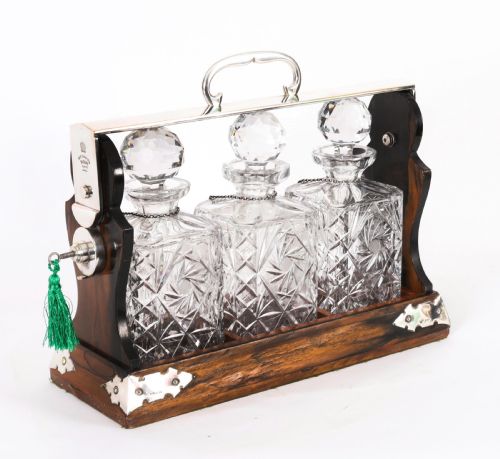

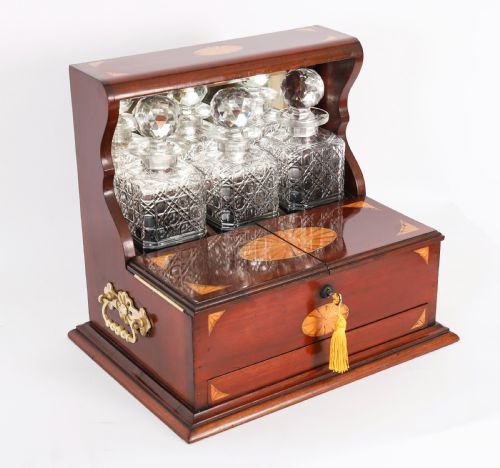


Edwardian Bottle Tantalus
An edwardian bottle tantalus is a locking barware frame designed to secure liquor decanters from unauthorized access while on display.
Edwardian Bottle Tantalus
When you search for an edwardian bottle tantalus, you encounter secure locking frames primarily built to house two or three glass decanters. These pieces belong predominantly to the Edwardian period and the late Victorian era, though related barware spans from the nineteenth century into the 1930s.
The version most commonly met on this page pairs a sturdy timber frame with silver plated or brass mounts and cut crystal decanters. Oak serves as the primary wood across the selection, complemented by occasional examples in mahogany, coromandel, and satin wood.
Materials and construction
Makers constructed the frames using solid oak or mahogany, frequently employing marquetry stringing and brass handles or mountings to reinforce the structure. Locking mechanisms made from metal secure a folding top bar across the stoppers, preventing the removal of the bottles when engaged.
The accompanying vessels consist of cut glass and cut crystal, shaped into decanters that fit precisely into recessed wooden bases. Silver plate and sterling silver mounts provide decorative collars and hardware, while mirror glass panels occasionally line the interior back of the frame.
Listings demonstrate that oak remains the dominant timber for these frames, appearing alongside mahogany and coromandel.
Distinctions in quality
Quality in these pieces rests upon the precision of the joinery and the selection of cabinet timbers, where figured oak or exotic woods like coromandel indicate higher craftsmanship. The complexity of the metal mounting, from plain brass to substantial silver plate or hallmarked silver, elevates the standing of a piece.
The integrity and matching nature of the glassware dictate value, particularly when original cut crystal decanters retain their matching stoppers and functional keys. Pieces featuring integrated compartments for games or auxiliary glassware demonstrate superior ambition from the maker.
Betjemann’s·Hukin and Heath
The Edwardian Bottle Tantalus Glossary
- Tantalus
- A locking wooden frame designed to hold decanters securely so that the liquor cannot be poured without a key. The name derives from the mythological figure of Tantalus, who was kept just out of reach of food and water.
- Marquetry
- The art of applying pieces of veneer to a structure to form decorative patterns. Craftsmen utilised different coloured woods to create delicate inlaid lines upon the timber cases.
- Silver plate
- A layer of silver applied to a base metal foundation. This technique gave the appearance of solid silver hardware on mounts and handles at a lower cost.
- Coromandel
- A dense, dark cabinet wood imported from Asia, prized for its rich contrasting grain. It appears on higher end nineteenth century pieces.
- Decanter
- A vessel used to hold and serve alcoholic beverages. These glass bottles often feature deep hand cut facets and matching stoppers.
Edwardian Bottle Tantalus: Frequently Asked Questions
How does the locking mechanism work?
The mechanism relies on a metal swing arm or top bar that locks down over the glass stoppers of the decanters. Turning the key engages a bolt within the wooden base or side armature, preventing the bar from lifting.
When unlocked, the bar pivots downward or swings aside to release the bottles for pouring. Original working keys remain a notable feature for collectors.
Where were they used in the home?
These pieces sat prominently on sideboards, in smoking rooms, or inside home bars during the late Victorian and Edwardian periods. Gentlemen kept spirits locked away to prevent domestic staff from sampling the contents.
They served as both practical barware and decorative household furnishings during evening hospitality.
How do I care for the wood and glass?
Maintain the timber frame by applying appropriate wax polish sparingly to preserve the finish without building up residue. Clean the cut crystal decanters gently with warm water, avoiding harsh detergents that might harm antique glass.
Keep the metal mounts polished using non abrasive cloths to prevent tarnish on the silver plate or brass.
Can I replace missing decanters?
Finding exact replacement decanters requires matching the precise height, base diameter, and neck configuration dictated by the wooden frame partitions. Because nineteenth century glassware was mouth blown and hand cut, standard modern bottles rarely fit the recessed slots.
Replacements must be sourced from period inventory that matches the specific dimensions of the individual compartments.