


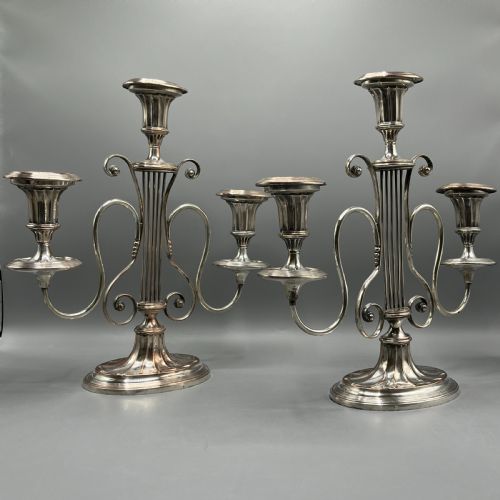


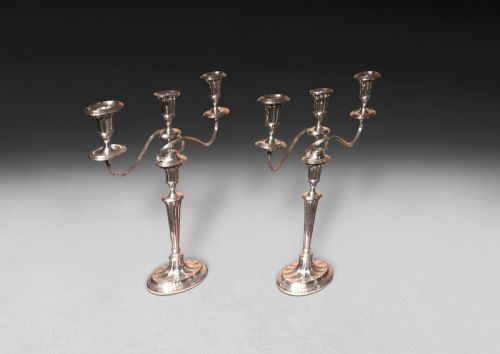


Three Branch Candleholder
These three branch candleholder pieces bring layered light to a room, uniting period metals and glass across centuries of dining and parlour design.
Three Branch Candleholder
A three branch candleholder holds multiple lights on separate arms branching from a single central stem, designed for dining tables and mantelpieces. When searching for a three branch candleholder, buyers encounter candelabra and candelabras spanning the eighteenth century, the Regency era, and the Victorian period.
The selections on this page run from Georgian George III examples to Edwardian glass pieces and Victorian revivals. Most entries take the form of matched pairs in Old Sheffield plate, silver, bronze, or gilt bronze.
Forms vary from lyre-shaped plates to figural cherub designs and French Régence styles. Buyers find both monumental pairs and smaller table candelabra reflecting changing interior illumination needs across the decades.
How they were made
Maker workshops cast bronze, gilt bronze, and silver plate over base metals, combining structural rigidity with ornamental detail. Sheffield plating fuses thin sheets of silver onto copper foundations, creating durable surfaces that weather gracefully.
Glass sections utilise lead crystal moulded and cut into faceted drops or candle cups. Artisans chased and gilded bronze components by hand, achieving sharp contrasts between polished highlights and matte textures.
Three Branch Candleholder Retail Price Guide 2026
Typical asking prices for three branch candleholder among the pieces listed under this phrase on Sellingantiques today, from the lower quarter to the upper quarter. They describe what is for sale here now, not the wider market.
Several pairs feature cheerful cherubs holding up branches, keeping watch over centuries of candlelit dinners.
What varies in quality
Quality rests in the crispness of the casting and the integrity of the original plating or gilding. Finer pieces retain deep chasing on figures and foliage, whereas simpler items show softer details from worn moulds.
Proportion dictates value, where branching arms balance harmoniously with weighted bases rather than appearing heavy or strained. Matched pairs require identical casting marks and uniform patination across both items.
Blagden Hodgson And Co
The Three Branch Candleholder Glossary
- Old Sheffield Plate
- A composite material made by fusing a thin sheet of silver to a thicker copper ingot before rolling. This technique was largely superseded by electroplating in the nineteenth century.
- Gilt Bronze
- Bronze metal treated with a fine layer of gold amalgam to produce a rich, durable golden surface. Also known by the French term ormolu.
- Régence Style
- A French design transitional phase between Louis XIV and Rococo, marked by asymmetrical curves and naturalistic motifs. It resurfaced in popularity during the nineteenth century.
- Lead Crystal
- Heavy glass containing metallic oxide to increase brilliance and weight. It refracts candle flame effectively.
- Candelabra
- A branched candlestick holding multiple lights. The singular and plural forms are frequently interchanged in antique descriptions.
Three Branch Candleholder: Frequently Asked Questions
What is a three branch candleholder?
A three branch candleholder is a branched lighting fixture designed to hold three candles simultaneously. These pieces typically feature a central shaft supporting three distinct arms or sockets.
They appear in silver, plate, bronze, and glass forms across Georgian, Victorian, and Edwardian periods. Their primary function was to multiply the light cast onto dining tables and sideboards.
How do I date a three branch candleholder?
Dating relies on stylistic clues, manufacturing techniques, and materials such as Old Sheffield plate or lead crystal. Georgian pieces show restrained neoclassical or early rococo lines, while Victorian examples often embrace heavier revival ornamentation.
Examining construction marks and mounting pins helps separate eighteenth-century work from later nineteenth-century interpretations. Comparing known period silhouettes provides further chronological clarity.
Where were three branch candleholders placed?
These items stood on dining tables, mantelpieces, and pier tables to illuminate large reception rooms. Pairs were arranged symmetrically to balance the decor of formal drawing rooms.
Their substantial presence made them focal points for evening entertaining before the widespread adoption of gas and electric lighting.
How should I clean a metal three branch candleholder?
Metal surfaces require gentle dusting and minimal interference with the existing patina. Silver plate and Old Sheffield plate should be treated with non-abrasive polishes only when necessary to remove harmful tarnish.
Bronze and gilt bronze need dry microfiber cloths to protect the original historical finish. Avoid harsh chemical dips that strip away age and character.