
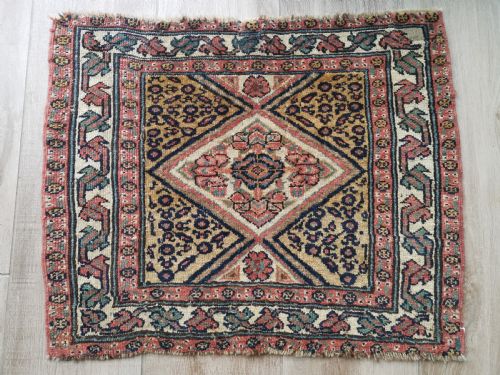
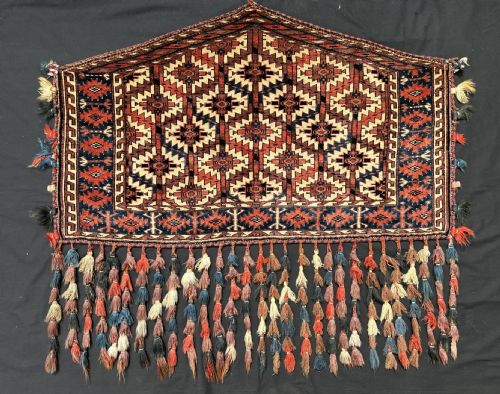


Terracotta Woven Panel
These terracotta woven panel examples are tribal textile fragments and flatweaves offering deep earthy tones and bold geometric structures.
Terracotta Woven Panel
A terracotta woven panel search brings up tribal textiles, rugs, and flatwoven fragments originating from Central Asia, Persia, and the Caucasus. These pieces include storage bag faces, torbas, mafrash panels, and kilims dating from the nineteenth and early twentieth centuries. The listings show Turkmen, Shahsavan, Bakhtiar, and Qashqa'i origins.
Buyers are most likely to meet utilitarian tribal fragments and complete bag faces rather than formal court carpets. These items were made for nomadic or village use, serving as saddle bags, storage compartments, or decorative wall hangings. Their formats range from small fragments to larger multi-strip covers.
How they were made
The pieces rely on natural dyes applied to handspun cotton and wool. These materials provide the characteristic terracotta and earthy palette seen across the tribal fragments.
Weaving techniques include flatweaving, soumak wrapping, and pile knotting. Many items utilise banded flatweave designs or structural strip construction to build durable domestic objects.
The listings span from the mid-nineteenth century through to the early twentieth century, featuring Turkmen, Persian, and Caucasian tribal structures.
What varies in quality
Quality depends on the crispness of the tribal design elements and the saturation of the natural dyes. Strong graphic guls and balanced geometric compartments distinguish finer weaving.
The integrity of the wool foundation and the completeness of original borders or backs also influence the standard of the piece.
The Terracotta Woven Panel Glossary
- Gul
- A primary medallion or repeating motif used in Turkmen and other Central Asian tribal weaving. These geometric crests identify specific tribal groups and sub-tribes.
- Torba
- A small storage bag face produced by nomadic weavers. These pieces were hung inside tents for household storage.
- Soumak
- A flatweaving technique where pattern threads are wrapped around the warp threads before passing back. This method creates a textured, durable surface.
- Mafrash
- A rectangular storage chest or large bag panel used during nomadic migration. They often feature bold stripes or geometric compartmentalised designs.
- Kilim
- A flatwoven textile made without pile. These pieces rely on interlocking weft techniques to form sharp geometric patterns.
Terracotta Woven Panel: Frequently Asked Questions
What is a terracotta woven panel?
A terracotta woven panel refers to antique tribal textiles and flatweaves displaying earthy reddish-brown tones. These items originate from nomadic and village weaving traditions in Persia, the Caucasus, and Central Asia.
They encompass bag faces, storage sacks, and fragments produced during the nineteenth and early twentieth centuries. The designs are typically geometric, utilising natural dyes and wool or cotton foundations.
How were these panels used originally?
Nomadic and village communities utilised these woven pieces for practical storage and domestic transport. Many started as saddle bags, tent bags, or bedding covers.
Over time, surviving sections have been separated from their original leather or textile backs to be hung as decorative art panels.
How do I identify a tribal origin?
Tribal attribution relies on specific structural patterns, border arrangements, and characteristic medallion motifs called guls. Different groups such as the Yomut, Tekke, Shahsavan, and Qashqa'i employed distinct colour palettes and weaving methods.
Comparing the geometric structures against known regional examples helps determine the likely weaving origin.
How do I care for an antique textile panel?
Antique textile panels require gentle treatment to preserve their natural wool fibres and vegetable dyes. Keep them away from direct sunlight to prevent colour fading and rotate them periodically.
Mounting them securely distributes the weight evenly if hung on a wall, avoiding strain on the fragile foundation threads.