

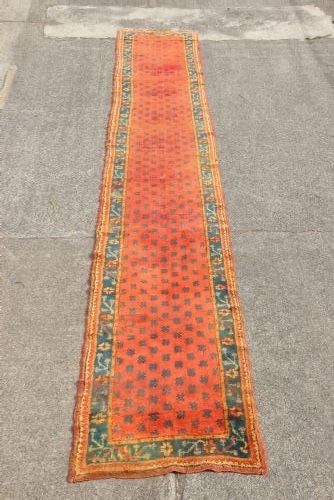

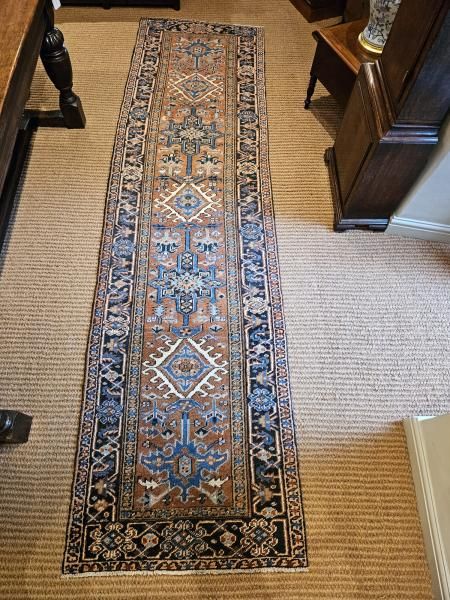
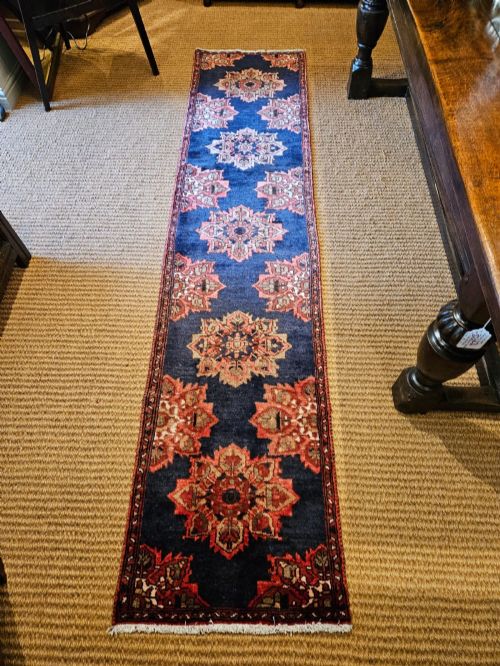

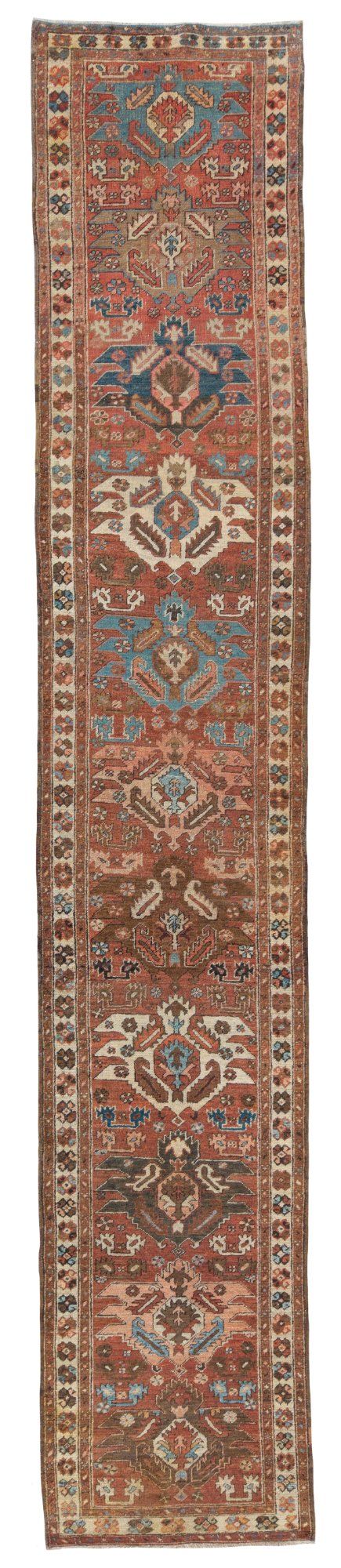
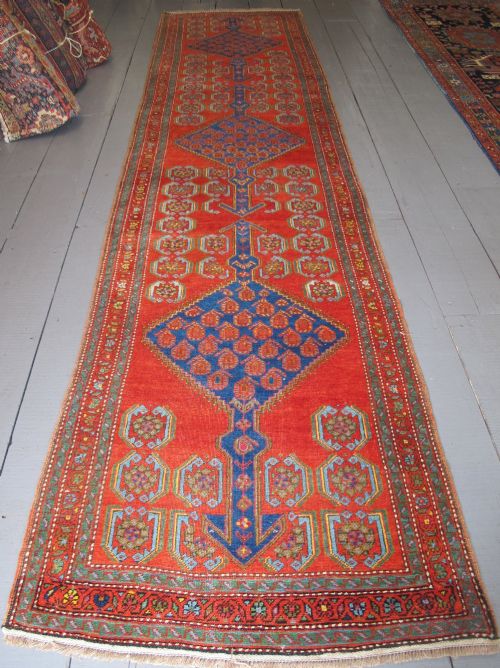


Terracotta Corridor Runner
A terracotta corridor runner brings warmth and pattern to long hallways, utilising traditional tribal and regional weaves from the late nineteenth and early twentieth centuries.
Terracotta Corridor Runner
A terracotta corridor runner is a long, narrow carpet designed specifically for hallways and passageways, typically originating from Persian, Turkish, and Caucasian weaving traditions. When searching for a terracotta corridor runner, buyers encounter pieces spanning from the late nineteenth century into the 1930s, featuring earthy red and terracotta tones.
The format of these pieces naturally suits long floors, employing geometric medallions, all-over shrub designs, and tribal motifs. Originating largely from regions such as Heriz, Bakshaish, Kurdish areas, and Oushak, these runners serve functional paths while delivering robust decorative presence.
Most examples found in this category rely on wool pile knotted on cotton or wool foundations, reflecting traditional village and workshop production. The enduring appeal lies in how these floor coverings handle high-traffic areas while ageing gracefully through mellowed colour palettes.
Materials and construction methods
Makers constructed these runners using hand-spun wool for the pile, yielding a resilient texture capable of withstanding heavy hallway traffic. Natural dyes provided the characteristic terracotta, madder red, and secondary tones that soften appealingly over decades of light and use.
Foundations typically combine wool and cotton yarns, knotted by hand to create durable structures with distinct regional variations in knot density and pile height. Village and tribal weavers employed upright looms, utilising traditional techniques passed down through generations in Persian and Anatolian communities.
Geographic origins span Persian tribal regions, Kurdish areas, and Turkish workshops including Oushak and Heriz.
Evaluating quality and execution
Quality in these runners rests upon the consistency of the hand-spun wool and the complexity of the natural dye palette. Superior examples display depth in the terracotta ground and precision in tribal or geometric motifs without appearing rigid.
Structural integrity also dictates worth, observed in the tightness of the knotting along the wool or cotton foundation. Finer weaves maintain straight borders and even pile wear down the entire length of the narrow format.
Waring and Gillow
The Terracotta Corridor Runner Glossary
- Runner
- A long, narrow carpet format designed for hallways, corridors, and staircases. These pieces measure significantly longer than they are wide.
- Pile
- The vertical or slanted loops of yarn that form the usable surface of a carpet. It is sheared evenly after knotting.
- Natural Dyes
- Colourants derived from plant, insect, and mineral sources prior to the widespread adoption of synthetic alternatives. They yield harmonious, fading patinas over time.
- Kelleh
- A rug format that is longer than a standard scatter rug but shorter and wider than a corridor runner. It often shares design vocabulary with larger room carpets.
- Foundation
- The underlying grid of warp and weft threads that supports the knotted wool pile. It provides the structural stability for the entire textile.
Terracotta Corridor Runner: Frequently Asked Questions
Where should I place a terracotta corridor runner?
These narrow formats suit hallways, long entryways, and narrow gallery spaces where traditional floor coverings soften hard timber or stone floors.
The elongated proportions draw the eye down the passage while protecting high-traffic wooden floorboards from daily wear.
How do I clean an antique wool runner?
Vacuum gently using a suction-only attachment without a rotating brush roll to protect the antique wool pile from pulling.
Professional specialist rug cleaning is recommended for deep cleaning to preserve the natural dyes and historical foundation.
How do I tell an Anatolian runner from a Persian runner?
Anatolian and Turkish pieces often display broader geometric or Oushak designs with lighter palettes, while Persian village runners frequently incorporate denser Heriz, Bakshaish, or Kurdish motifs.
Foundation materials and knotting structures also provide clues to the specific weaving district and origin.
Do natural dyes fade over time?
Natural dyes mellow and patina gently when exposed to ambient light, often developing greater tonal complexity across the terracotta field.
This gradual softening is considered a desirable characteristic of genuine nineteenth and early twentieth-century textiles.