



Tekke Tribal Weaving
Tekke tribal weaving comprises hand-knotted bags, carpets and tent bands from Central Asia that bring rich madder palettes and intricate guls into domestic interiors.
Tekke Tribal Weaving
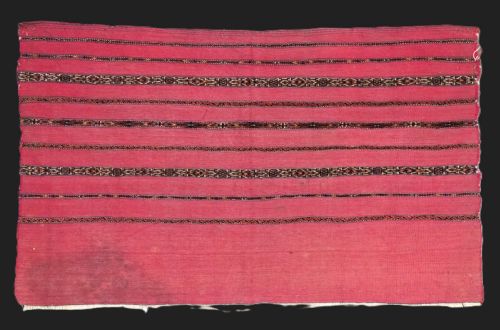
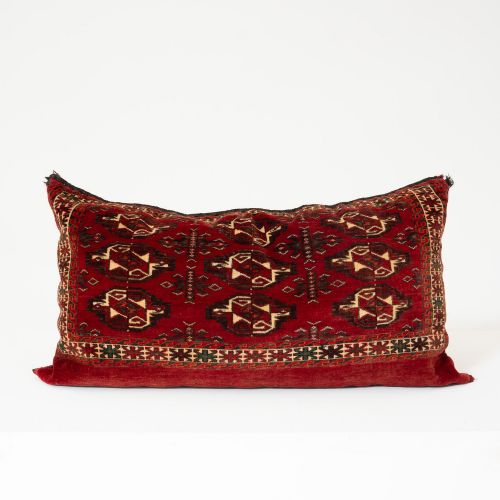
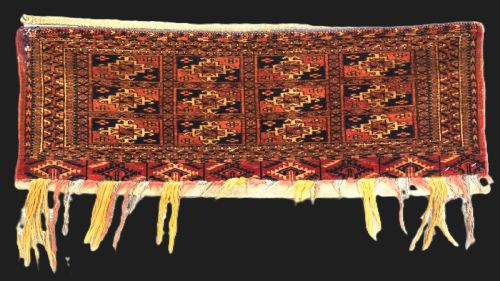
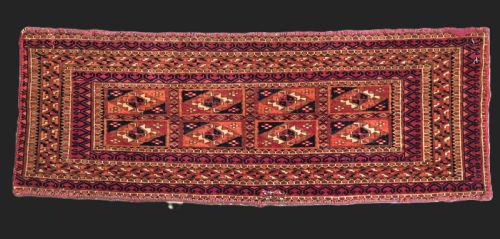
Tekke tribal weaving encompasses practical household and nomadic furnishings produced across Central Asia by Turkmen weavers during the eighteenth, nineteenth and early twentieth centuries. The selection on this page centres predominantly upon smaller utilitarian forms such as torba faces, chuvals and mafrash panels, alongside occasional dowry rugs and tent bands.
Torbas and chuvals function as storage bags within nomadic dwellings, woven in symmetrical knotting with plain-weave backs designed to protect household goods. Collectors encounter these pieces either as complete bags retaining their original backing and hanging loops or as isolated faces trimmed from the parent structure for display.
Larger formats appear as engsi tent door hangings, expansive carpets and long yurt bands utilised for securing nomadic tent frameworks. These textile traditions reflect the specific tribal identity of the Tekke people through repeating medallion motifs known as guls.
How they were made
These textiles rely on hand-spun wool foundations combined with supplementary cotton and occasional silk highlights used to accentuate specific medallion details. Natural dyes provide the underlying chromatic structure, dominated by deep madder reds alongside ivory, brown and dark indigo contrasts.
Weavers construct the pile using dense symmetrical knots tied across wool and cotton warp threads, finished with flat-woven plain-weave backs and braided hanging loops. The resulting handle ranges from supple to rigid depending on the density of the knotting and the thickness of the wool.
Tekke Tribal Weaving Retail Price Guide 2026
Typical asking prices for tekke tribal weaving among the pieces listed under this phrase on Sellingantiques today, from the lower quarter to the upper quarter. They describe what is for sale here now, not the wider market.
Some tent bands stretch fifty feet long, proving nomads took interior decoration very seriously indeed.
What varies in quality
Quality rests upon knot density, drawing precision and the depth of the natural dye palette across the field. Exceptional examples display remarkably fine weaves that render intricate guls with absolute geometric clarity and crisp symmetry.
Survival of original structural elements influences desirability, distinguishing complete bags with intact plain-weave backs from fragments or trimmed faces. The retention of silk highlights and uncommon structural variations further separates standard utilitarian weaving from masterwork tribal pieces.
The Tekke Tribal Weaving Glossary
- Gul
- A repeating primary medallion motif characteristic of Turkmen tribal weaving, often denoting specific clan or tribal lineages. These octagonal or principal guls anchor the field design of chuvals and torbas.
- Torba
- A small horizontal storage bag traditionally used inside nomadic tents for personal possessions or household goods. They frequently feature elaborate border designs and multiple primary guls across the face.
- Chuval
- A large tent storage bag utilised for bedding and blankets, possessing greater vertical dimensions than a torba. Chuval faces often showcase rows of large guls paired with secondary minor motifs.
- Engsi
- A specialised tribal wall hanging or tent door rug designed to cover the wooden frame of a yurt entrance. They display a characteristic quartered field layout divided by a candelabra motif.
- Mafrash
- A rectangular storage container or travel bag panel woven in pile or flat-weave technique. These panels form the sides of larger domestic chests used during nomadic migrations.
- Kizil
- A designation applied to specific red-ground Turkmen weaving variations. The term references the dominant madder-dyed red coloration characteristic of these traditional tribal pieces.
Tekke Tribal Weaving: Frequently Asked Questions
What is a chuval used for?
Chuvals served as large storage sacks inside nomadic tents, specifically designed for holding bedding, woolens and heavy household textiles during migrations.
Over generations, many of these utilitarian bags were separated into individual decorative faces for easier display as wall hangings.
How do I identify a Tekke weaving?
Tekke pieces are identified by their characteristic octagonal primary guls, fine symmetrical knotting and deep madder red colour palettes derived from natural dyes.
They also frequently incorporate secondary quartered motifs and ivory highlights across the field.
What is a torba?
A torba is a smaller horizontal storage bag traditionally hung inside the yurt for holding domestic implements or personal items.
These smaller formats often feature three to nine principal guls arranged in a row across the face.
Are these pieces from the nineteenth century?
The listings span from the eighteenth century through the early twentieth century, with the majority originating from the nineteenth century.
Weaving during this period relied exclusively on hand-spun wool, cotton foundations and traditional natural dye recipes.