

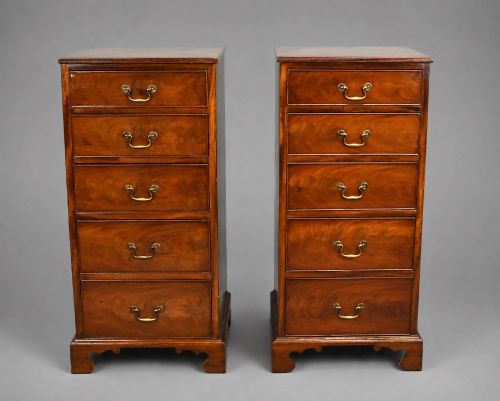

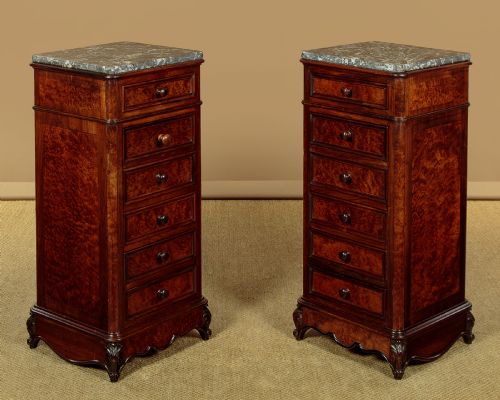


Tall Narrow Nightstands
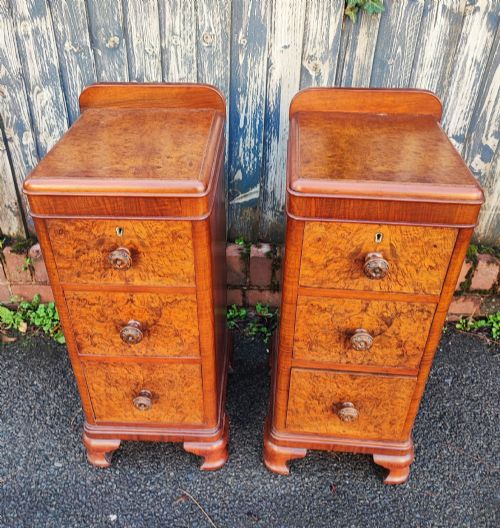
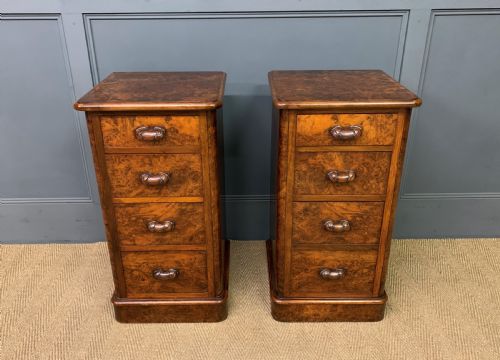
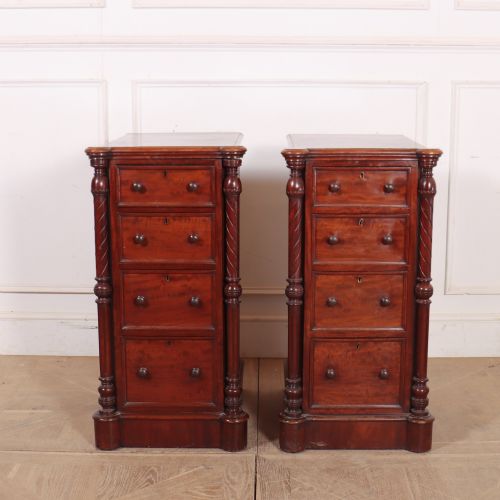
These tall narrow nightstands bring compact bedside storage with proper period character.
Tall Narrow Nightstands
When you search for tall narrow nightstands, you encounter bedside chests, cabinets, and drawer pedestals designed to fit beside a bed without taking up excessive floor space. These pieces serve as practical bedroom furniture that keeps nighttime necessities close at hand while maintaining a slim footprint.
The selections available here span the Victorian, Edwardian, and Art Deco periods, reaching back to the nineteenth century alongside French provincial and revival styles. Most examples appear as matched pairs, fashioned to flank a bed frame symmetrically with matching timber and hardware.
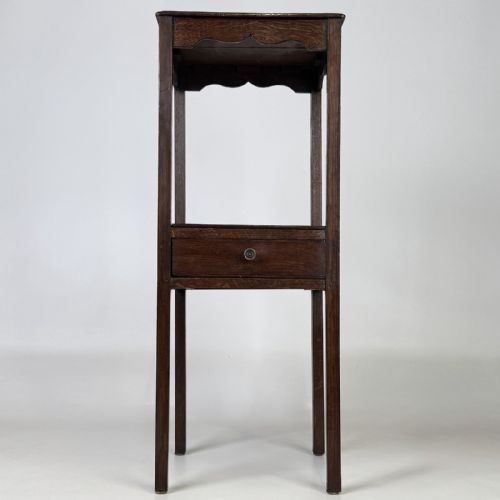
Forms vary from traditional drawer chests and cupboards to tambour front stands and open side tables. Their defining characteristic remains the elevated and slender proportion, offering vertical storage capacity where width is restricted.
How they were made
Cabinet makers utilised dense hardwoods such as mahogany, walnut, rosewood, and oak, often laid over secondary timbers. Selected veneers, including amboyna and parquetry patterns, provide decorative surfaces on drawer fronts and top panels.
Construction techniques involve traditional joinery, panelled doors, and fitted drawers built to withstand daily use. Details such as brass handles, marble tops, and tambour tracks appear on specific examples from the nineteenth and early twentieth centuries.
Tall Narrow Nightstands Retail Price Guide 2026
Typical asking prices for tall narrow nightstands among the pieces listed under this phrase on Sellingantiques today, from the lower quarter to the upper quarter. They describe what is for sale here now, not the wider market.
Several pairs are described simply as neat, proving that Victorians understood the eternal struggle of fitting too much furniture into too little space.
What varies in quality
The standard of timber selection and veneer matching defines the visual weight of each piece. Superior examples display carefully chosen grain patterns that run continuously across drawer fronts, while simpler utilitarian items rely on plain plank construction.
Proportion and execution of detail separate standard production from finer work. Crisp mouldings, well-fitted drawers, and original brass hardware indicate the care taken by the maker during construction.
The Tall Narrow Nightstands Glossary
- Tambour
- A flexible sliding shutter formed of narrow strips of wood glued to canvas, allowing access to a cabinet interior without a swinging door arc. This mechanism appears on French walnut stands.
- Pedestal
- A single vertical support structure, or in this context, a tall narrow chest of drawers designed to stand independently beside a bed. These units maximise vertical storage capacity.
- Parquetry
- A geometric mosaic of wood pieces used for decorative surfaces on furniture tops and drawer fronts. It creates patterned wooden veneers found on twentieth-century tables.
- Satin birch
- A pale timber with a natural golden sheen utilised by nineteenth-century cabinet makers for bedroom furniture. It offers a bright alternative to darker mahoganies and walnuts.
Tall Narrow Nightstands: Frequently Asked Questions
What are tall narrow nightstands?
These are compact bedside storage pieces designed with a tall and slender frame. They provide drawer or cupboard space while occupying minimal floor width.
Most examples originate from the Victorian, Edwardian, and Art Deco eras, taking the form of bedside chests, cabinets, or pedestals.
How were these nightstands used?
They stood beside the bed to hold lamps, books, and personal items within easy reach. The enclosed cupboards and drawers kept private possessions tidy and out of sight.
In period bedrooms, matched pairs flanked the bed to maintain symmetry and balance across the room.
How do I live with antique bedside cabinets?
Integrate them into a modern bedroom by placing them alongside contemporary or period bed frames for practical bedside surface area. Their narrow proportions make them suitable for smaller guest rooms where space is limited.
Treat timber surfaces with care, using coasters for drinks and protecting marble tops from staining.
How can I tell the periods apart?
Victorian examples often feature solid mahogany or satin birch with traditional drawer construction and turned wooden pulls. Later pieces from the 1920s and 1930s introduce parquetry veneers, tambour fronts, and Art Deco geometric lines.
French provincial and Louis XV revival pieces display characteristic curved panels and decorative mounts distinct from plain English chests.