
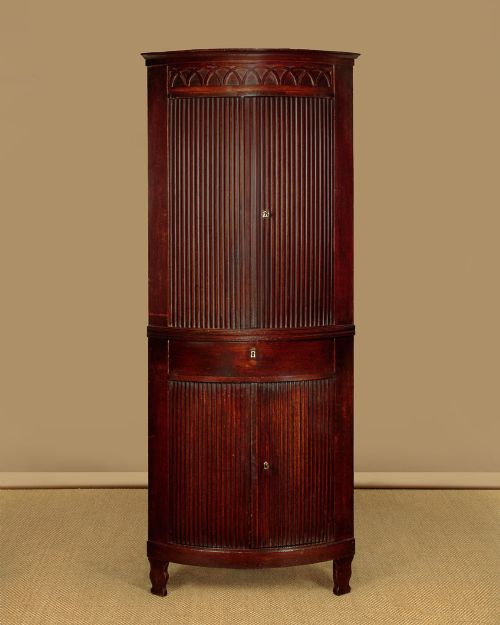
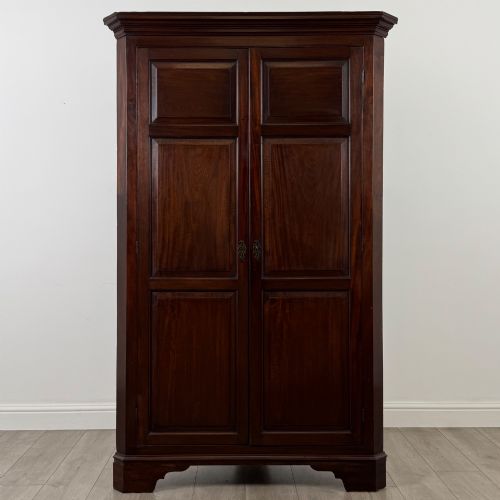
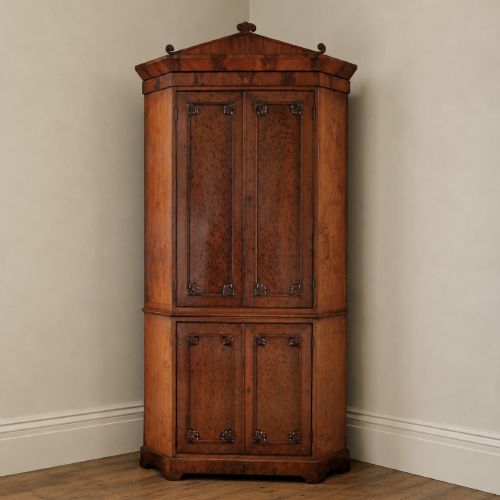


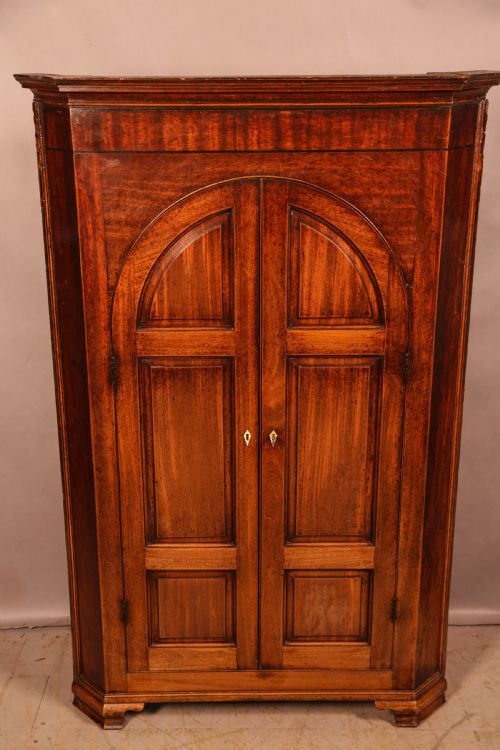


Tall Mahogany Corner Cupboard
A tall mahogany corner cupboard uses dead space to brilliant effect, storing precious possessions in a handsome triangular footprint.
Tall Mahogany Corner Cupboard
A tall mahogany corner cupboard is a disciplined piece of furniture designed to slot neatly into the angle of a room. The examples listed here span periods from the Georgian era through the Edwardian years to the mid-twentieth century, offering both single and double height configurations.
Most pieces you encounter are floor-standing uprights, often featuring glazed upper doors or solid timber panels. They serve as efficient display cabinets or concealed storage units without dominating the floor plan.
Makers utilised rich timbers to grace domestic interiors, creating furniture that combines architectural presence with practical storage. You find styles ranging from restrained Georgian forms to elaborate Sheraton revivals and glazed Danish designs.
How they were made
Cabinet makers built these cupboards primarily using solid mahogany and mahogany veneers, occasionally selecting striking plum pudding grain for prominent surfaces. Secondary timbers like fruitwood provided contrasting inlay work.
Glass panels were secured with delicate astragal glazing bars to create refined display doors on the upper sections. Brass hardware, including hinges, escutcheons and working keys, completed the construction.
Several cupboards still retain their original working keys, saving future generations from hunting down antique skeleton locks.
What varies in quality
The distinction between average and exceptional pieces lies in the choice of timber and the crispness of the joinery. Figured mahogany grain and precise fruitwood inlay elevate the visual weight of the piece.
Proportion and architectural detailing dictate the success of the design. Subtle elements like fine astragal bars, well-cast brasses and harmonious cornices separate standard utility cupboards from master cabinet work.
The Tall Mahogany Corner Cupboard Glossary
- Astragal glazing
- Timber bars forming a lattice grid to hold small panes of glass in a cabinet door. This technique lightens the visual mass of large doors.
- Bowfront
- A convex, outwardly curved front facade that softens the sharp angles of a room. It appears frequently on Georgian and Regency examples.
- Georgian style
- A retrospective design movement mimicking the symmetry and classical proportions of the eighteenth century. Pieces built in this manner date to later revival periods.
- Marquetry
- The art of applying small pieces of veneer to form decorative pictures or geometric patterns. Fruitwood inlay often provides the contrasting tones.
Tall Mahogany Corner Cupboard: Frequently Asked Questions
How do I fit a corner cupboard?
Measure the wall depth from the internal corner outward along both skirting boards to ensure the cabinet flanks fit flush against the plaster. Check that the door swing clears any nearby light switches or radiators.
Account for the cornice projection, which often extends further than the main body of the cupboard. Floor-standing models require a level surface to ensure the doors hang square and close properly.
Were these always meant for corners?
Yes, the triangular footprint is engineered specifically to utilise neglected room junctions without obstructing traffic flow. This clever geometry made them staples in dining rooms and parlours.
Some double height versions combine a lower cupboard with an upper display section to maximise vertical wall space. Their design turns an awkward angle into a striking focal point.
How do I date a mahogany cabinet?
Examine the timber preparation marks on the interior boards and the construction of the drawer linings if present. Hand-cut dovetails and cast brass hardware point towards earlier Georgian and Regency craftsmanship.
Later Edwardian and twentieth-century revival pieces often feature more uniform machine milling and standardised fixings. Comparing the secondary woods inside helps confirm the period of manufacture.
Can I use one for a display?
Glazed upper sections with astragal bars are specifically designed to showcase ceramics, glassware and books safely. The enclosed triangular shelves protect delicate items from dust while keeping them visible.
Solid panel doors suit rooms where you prefer to keep contents concealed out of sight. Many taller formats balance both functions by pairing a glazed top with a wooden base.